
“Biodegradable” is a broad environmental term. It may indicate that a material can break down through biological activity, but it does not necessarily define the required environment, timeframe or disposal route.
A certified compostable produce bag is more specific. It is connected to a defined composting environment, a recognized testing standard and an independent certification process.
For procurement teams, however, choosing the right logo is only part of the job. The certification must also apply to the bag you are actually buying.
A certificate for compostable resin or clear unprinted film may not cover a thicker green bag with multicolour printing, an adhesive label or a reinforced handle. Before production, the environmental claim, target-market requirements and finished bag construction must all point to the same product.
This is where YiTo Pack’s approach differs from a material-only quotation. We begin with the intended market and finished application, then review the bag structure, printing and available document scope together.
A Certificate Can Be Valid and Still Be Wrong for Your Order
A typical project starts smoothly. A US supermarket chain approved clear unprinted flat bags. After upgrading to thick, colour-printed handle bags, the original BPI listing no longer matched the finished SKU, triggering a 5-week project delay.
The customer approves the dimensions, tests the sample and confirms the price. The bag opens correctly, carries the required produce and fits the intended retail application.
Then the retailer requests the compliance file.
One document covers compostable resin. Another identifies compostable transparent film within a particular thickness range. The purchase order, however, calls for a colored produce bag with three-color branding and a heavier structure.
Nothing in the file clearly identifies the finished SKU.
The issue is not necessarily that the supplier has provided a false certificate. The issue is that the documents describe a different stage of the product.
Retailers do not approve a resin in isolation. They approve the finished item that will appear in stores.
At YiTo Pack, we compare the proposed final construction with the available certification scope before the artwork is released for production. When a gap appears, it can usually be addressed while the thickness, ink, color or structure can still be adjusted.
That early review helps avoid artwork holds, repeated document requests and finished inventory that cannot be supported by the original certification file.

What “Biodegradable” and “Compostable” Really Mean
In practical terms, all compostable products are biodegradable under the relevant composting conditions, but not every product described as biodegradable meets a recognised compostability standard. The difference lies in whether the disposal environment, testing method and timeframe are clearly defined.
YiTo Pack reviews these claims during artwork development to ensure the wording printed on the bag matches the selected product, certification scope, and destination market.
|
Procurement question |
Biodegradable |
Certified compostable |
| Is the treatment environment defined? | Not always | Yes |
| Is the disposal route clear? | Often unclear | Commercial, industrial or home composting |
| Is the claim based on a recognized standard? | Not necessarily | Yes |
| Is independent verification included? | Varies | Required for a certified claim |
| What should the customer verify? | Test method and intended conditions | Certification route and finished-product coverage |
“Biodegradable” means that a material can be broken down by microorganisms into simpler substances under certain environmental conditions. However, the term does not automatically tell you where the material will break down, how long the process will take, or whether any visible fragments will remain.
A plastic bag may technically be biodegradable but still require specific heat, moisture, or microbial conditions that are not available in soil, seawater, landfill, or a typical home compost system. For this reason, “biodegradable” alone is normally too broad for a retail packaging claim.
“Compostable” is more specific. A compostable bag must break down under defined composting conditions within a specified period and meet requirements for biodegradation, disintegration, and compost quality. Depending on the certification, the bag may be designed for industrial composting, home composting, or both.
“Plant-based” and “bio-based” should also be treated separately. These terms describe material origin, not end-of-life performance. A bag may contain renewable raw materials without meeting a compostability standard.

Traditional Plastic Bags vs Compostable Produce Bags
The difference between conventional plastic bags and compostable produce bags goes beyond the raw material. It also affects disposal pathways, regulatory readiness, brand positioning, and how customers perceive the final packaging.
| Comparison | Traditional Plastic Bags | Compostable Produce Bags |
|---|---|---|
| Material | Conventional PE plastic | Bio-based cellulose or certified compostable materials |
| End-of-life route | Often difficult to recycle when contaminated with food or organic residue | Designed for an appropriate commercial, industrial or home composting pathway, depending on certification |
| Environmental positioning | Conventional single-use packaging | Supports sustainability and waste-diversion goals |
| Regulatory outlook | Facing increasing restrictions in some markets | A future-oriented option when certification, labeling and local infrastructure are aligned |
| Brand presentation | Familiar but less differentiated | Premium, responsible and suitable for sustainability-led branding |
| Key procurement check | Thickness, strength and recycling availability | Finished-product certification, composting route, print coverage and market requirements |
Traditional polyethylene bags may still be appropriate where recycling systems and local regulations support their use. However, many retailers, growers, and produce brands are evaluating biodegradable produce bags and certified compostable alternatives as part of broader sustainable packaging programs.
The correct choice depends on the application. A bag used for lightweight berries, loose vegetables, or heavier citrus products may require different thicknesses, seals, perforations, and carrying strength. YiTo Pack develops each structure around the produce, retail environment, and intended disposal route rather than treating every sustainable bag as the same product.
The Sales Market Determines the Certification Route
There is no single compostability certificate that automatically covers every destination market. Before selecting a produce bag, confirm where the finished product will be sold and which certification route the customer or retailer recognizes.
| Market | Common Route | Main Point to Verify |
|---|---|---|
| North America | ASTM D6400 and BPI | Official listing and finished-SKU coverage |
| Europe | EN 13432 | Finished-product certification and mark authorization |
| Australia—Commercial Composting | AS 4736 and ABA verification | Local verification and assessed construction |
| Australia—Home Composting | AS 5810 and ABA verification | Home-compostability coverage |
| California Grocery Projects | Certification plus state bag rules | Application, dimensions and labeling |
In North America, an ASTM D6400 test report is not the same as a BPI-certified product listing. The report provides test data, while the BPI listing identifies the product covered by the certification. Buyers should therefore verify the actual SKU, thickness, color and print status rather than relying only on the supplier’s company name.
For European projects, stating that a resin or film meets EN 13432 does not automatically authorise the Seedling mark on every converted private-label bag. The finished product, certificate holder and mark authorisation should be confirmed before artwork approval.
Australia follows its own verification routes under AS 4736 for commercial composting and AS 5810 for home composting. EN 13432 or ASTM documentation may support a technical review, but it does not automatically replace the applicable Australian verification.
YiTo Pack confirms the destination market and finished bag specification before recommending a certification and document direction. This gives customers a focused compliance file for the selected SKU instead of a collection of unrelated material certificates.
Industrial Composting and Home Composting Are Not Interchangeable
Industrial composting takes place in a managed facility where temperature, moisture, airflow and processing time are controlled.
Home composting operates under less predictable conditions. Outdoor temperature, pile size, moisture and maintenance can vary significantly.
A produce bag certified for commercial or industrial composting should therefore not be described as home compostable unless the finished product also has the relevant home-compostability coverage.
BPI uses ASTM D6400 as the base standard for its commercial certification program. Its separate home-compostability program, launched in 2025, is based on NF T 51-800 and requires commercial certification as a prerequisite.
This distinction matters when approving printed artwork. “Commercially compostable", “industrially compostable” and “home compostable” are not alternative marketing phrases for the same certificate.
The same caution applies to claims such as “breaks down in 90 days.” Without identifying the testing environment, material thickness and product formulation, the statement may imply performance that the supporting evidence does not prove.
YiTo Pack reviews the intended environmental wording at the same time as the film structure and artwork. That reduces the risk of developing a design that later has to be revised because the claim is broader than the selected certification route.
California Projects Begin With the Bag’s Actual Use
California projects require an additional review because the applicable rules depend on where the bag is provided and how it is used.
A pre-checkout bag is provided before the point of sale for loose produce, bulk food or other unwrapped items. A carryout bag is provided at checkout, self-checkout, pickup or delivery. This distinction is especially important for handle fruit bags, because the presence of a handle does not determine the legal category by itself.
For qualifying compostable pre-checkout bags, buyers should confirm the applicable mouth-width, certification and labeling requirements. A similar-looking bag used at checkout may follow a different rule and should not be approved under the same product classification.
YiTo Pack confirms the distribution point and intended application before reviewing the dimensions, artwork and supporting documents. This helps prevent a produce-department bag from being incorrectly approved as a checkout carryout bag.
For detailed California requirements, including the 15-inch mouth width, green identification rules and upcoming material requirements, read our guide: California SB 1053: What Grocery Stores Need to Know About Compostable Produce Bags.

Certification Must Follow the Finished Bag, Not Stop at the Film
Retailers approve the finished produce bag, not the resin or film used at the beginning of production.
The final bag may differ from the certified base material in thickness, colour, printing, labels, seals or handle construction. These details should therefore be confirmed before the artwork is released and the order enters production.
YiTo Pack connects each project through one traceable path:
Quotation → Finished Specification → Certification Scope → Official Listing → Final Artwork
The dimensions, thickness, color, print status and product reference should remain consistent across these files. This allows the customer to see whether the available evidence applies to the exact SKU being ordered.
For example, if the current certificate covers clear 15-micron film while the project requires a green 25-micron handle bag with three-colour printing, we identify the difference before production. The project can then move forward by selecting a covered configuration, adjusting the specification, confirming an approved ink system or reviewing whether an additional certification step is required.
The objective is not to provide the largest possible document folder. It is to give the customer a clear, defensible connection between the finished product and the documents used for approval.

Three Produce Bag Formats, Developed Around the Application
YiTo Pack supplies compostable produce bags in roll, individual and handle formats.
The same general certification route may apply to all three, but their finished constructions are not automatically equivalent.
Roll produce bags are commonly used in supermarket produce departments, bakery areas and bulk-food displays. Their performance depends not only on the film but also on the roll width, core size, perforation, winding direction, and tear-off force. YiTo Pack can develop the roll around the customer’s existing dispenser rather than asking the store to adapt to a generic format.
Individual produce bags are suitable for growers, packers, pre-packed fruit and vegetable programs, and retail displays where no roll dispenser is required. The dimensions, seal structure, thickness and packing method can be adjusted to the produce and handling process.
Handle fruit bags are designed for apples, citrus, potatoes, onions, and other heavier produce. These products need more than a handle cut into a standard lightweight bag. The intended carrying weight affects film thickness, handle opening, stress distribution, and seal strength.
This is one of YiTo Pack’s practical differences: we do not separate product design from certification review.
A bag can be technically compostable but still be unsuitable for the product weight, store dispenser or intended distribution method. By reviewing the application and document scope together, we help customers avoid choosing a compliant material in the wrong finished structure.
Sustainable Packaging for Different Produce Applications
Different fruits and vegetables place different demands on the packaging structure.
For berries and other delicate products, sustainable packaging should provide sufficient clarity, ventilation, and handling protection without adding unnecessary material. Lightweight individual bags can be developed for pre-packed blueberries, strawberries, grapes, and other fresh produce programs.
For supermarkets and produce departments, YiTo Pack supplies compostable bags for vegetables in roll and individual formats. The roll width, perforation, opening performance, and dispenser compatibility can be adjusted for loose vegetables, herbs, bakery products, and bulk-food displays.
Heavier products such as apples, potatoes, onions, and citrus may require reinforced handle designs and greater seal strength. For these applications, we develop biodegradable bags for fruit packaging according to the intended carrying weight, filling process, and retail distribution method.
Customers exploring plastic-free produce packaging should first confirm what the term means for their project. Some cellulose and paper-based structures may provide genuinely plastic-free options, while other compostable bags use certified biopolymer materials. YiTo Pack reviews the material composition and the proposed environmental wording before production to ensure the final claim accurately reflects the selected packaging.
As a fresh produce packaging supplier, we can also combine produce bags with labels, trays, clamshells, cartons, and other packaging components to create a more consistent system.
Printing Is Part of the Product, Not a Final Decoration
Custom printing affects more than appearance. The ink system, print coverage and environmental wording may all influence whether the final artwork remains within the applicable certification scope.
For private-label projects, the customer should also confirm whether the certification mark can be used with its own brand. A supplier’s certified product does not automatically give every private-label customer the right to place the same logo on a new SKU.
YiTo Pack reviews the proposed colours, printing area, certification wording and mark authorisation before production. When changes are needed, they can be made while the artwork and ink selection are still flexible rather than after printed inventory has been produced.
We support one-color and multicolor printing for roll produce bags, individual bags and handle fruit bags. Final printing options are confirmed according to the selected bag structure, certification direction and destination market.
How YiTo Pack Supports Your Produce Bag Project
YiTo Pack is a professional fresh produce packaging supplier with more than ten years of manufacturing and export experience. We provide custom eco-friendly produce packaging for growers, packers, produce brands, supermarkets, distributors, and private-label projects, with custom dimensions, thickness, perforation, handle structures, roll specifications, and printing.
From prototype development and sample testing to artwork approval and mass production, we provide specifications and ODM support. Our custom compostable packaging bags are developed around the produce type, filling process, destination market, and certification requirements, helping ensure the finished product, environmental claims, and supporting documents remain
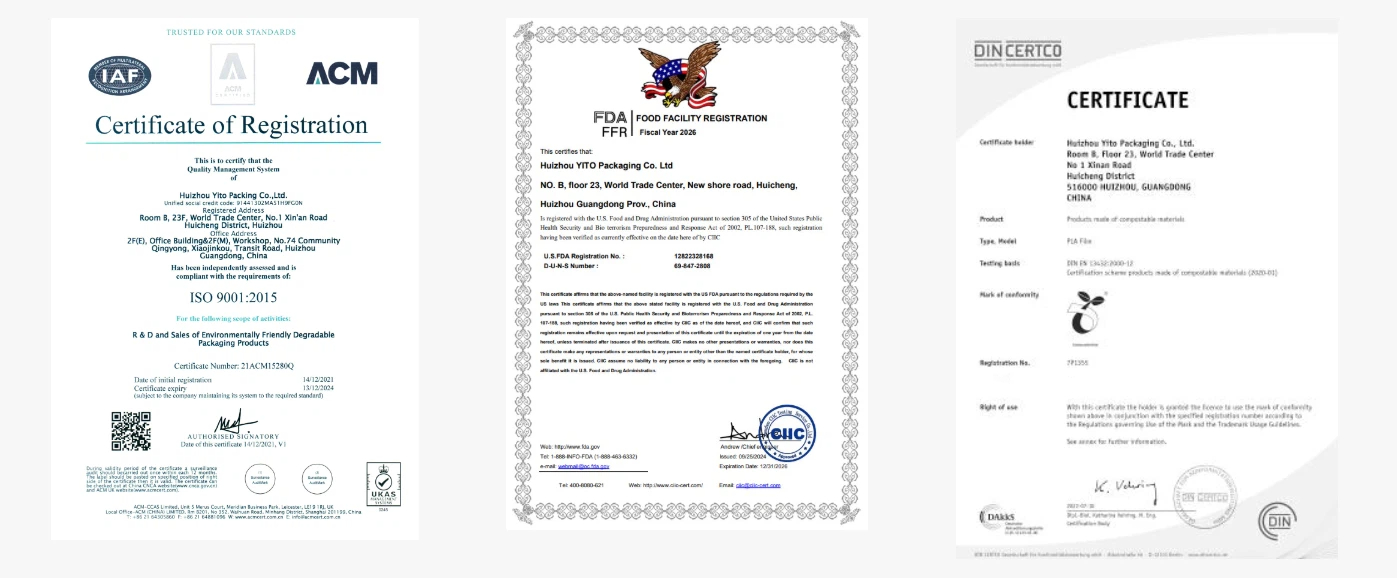
We also support certification and compliance requirements including BPI based on ASTM D6400, EN 13432, Seedling mark authorisation, AS 4736 and AS 5810, together with relevant food-contact declarations, ink and colourant safety documents, and other supporting test reports. Certification availability is reviewed according to the finished bag structure, printing, target market and intended composting route.
Conclusion
Choosing between biodegradable and certified compostable produce bags is not simply a matter of selecting an environmental label. The claim must match the intended composting route, the requirements of the destination market and the finished bag being ordered.
A valid material certificate is only the starting point. Changes in thickness, colour, printing, seals or handle construction may affect whether the final SKU remains within the available certification scope. Before production, the sample, specification, artwork and supporting documents should all describe the same finished product.
YiTo Pack brings these decisions into one project. With more than a decade of experience in packaging development, manufacturing and export, we support compostable roll produce bags, individual bags and handle fruit bags with custom structures, printing and relevant document direction. By reviewing the product and certification scope before mass production, we help customers reduce artwork delays, repeated document submissions and late specification changes.
FAQ
Are compostable and biodegradable produce bags the same?
No. “Biodegradable” may not specify a disposal environment, timeframe or certification route. A certified compostable bag is evaluated under a defined standard for a specified composting environment.
Does a certified resin automatically cover the finished bag?
No. The finished bag may have a different thickness, colour, printing, seal, label or handle structure. The final configuration should be compared with the certificate and official product listing.
Can YiTo Pack supply both roll bags and handle fruit bags?
Yes. YiTo Pack supplies compostable roll produce bags, individual produce bags and handle-fruit bags. Dimensions, thickness, roll structure, perforation, handle design and printing can be customised according to the application.
Can custom printing affect certification?
Yes. The ink system, ink percentage, print coverage, colour and certification mark use may affect the final review. These details should be confirmed before artwork approval and mass production.
Can an industrially compostable bag go into home compost?
Only when the finished product also has appropriate home-compostability coverage. Industrial and home composting use different conditions and certification routes.
Can compostable produce bags enter plastic recycling?
They are generally intended for an appropriate organics or composting route, not conventional plastic recycling. Local collection instructions should be checked before disposal wording is printed.
Tell us your target market, produce type, preferred bag format, dimensions, thickness and printing requirements. YiTo Pack will help you review the proposed structure, certification direction and supporting-document scope before production.
Related Products


Post time: Jul-24-2026