
A produce roll bag and a checkout shopping bag may sit under the same procurement category, but California treats them as different applications.
California SB 1053 changed the rules for carryout bags provided at checkout, self-checkout, pickup and delivery beginning January 1, 2026.
For grocery stores, however, the law does not mean that every plastic or compostable bag follows the same requirement. Compostable produce bags provided before checkout remain subject to California’s separate pre-checkout bag requirements under SB 1046.
The practical question for procurement teams is therefore not simply whether a bag is compostable. It is where the bag will be provided and how the customer will use it.
Once the use is clear, you can review the finished-product documents, artwork and store performance without mixing produce-bag requirements with checkout-bag rules.
Key Points for Procurement
- · Fast turnaround: Standard store-ready samples in about 7 days, with typical mass production in 15–20 days after approval
- · Produce and bulk-food bags: Covered stores may provide qualifying compostable bags or recycled paper bags
- · Checkout and delivery bags: Covered stores may provide qualifying recycled paper carryout bags for at least $0.10 each
- · Two effective dates: January 1, 2025 for pre-checkout bags and January 1, 2026 for point-of-sale carryout bags
- · Main approval check: The certificate, dimensions, artwork, sample and purchase order should all refer to the same finished SKU
Which California Bag Rule Applies to Your Product?
Start with where the bag enters the shopping process.
|
Store application |
Main rule |
Store-provided bag options |
| Produce aisle, bulk food, bakery, meat or seafood protection | SB 1046 | Qualifying compostable bag or recycled paper bag |
| Checkout, self-checkout, store pickup or delivery | SB 1053 | Qualifying recycled paper carryout bag |
| Product packed before reaching the store | Separate packaging review | Depends on the product and packaging application |
A pre-checkout bag is provided before the customer reaches the point of sale. It may hold loose fruit, vegetables or bulk food, or protect another purchased product from damage or contamination.
Bags used to prepackage products before they arrive at the store fall outside this pre-checkout definition.
The requirements affect most qualifying:
- · Grocery stores
- · Convenience stores
- · Food marts
- · Liquor stores
- · Retail stores with a pharmacy
Produce, checkout, pickup and delivery teams may need different specifications, even when the bags look similar.
Before requesting quotations, map each bag by department and use. This prevents a compostable produce bag from being incorrectly approved for checkout or delivery.
Choose the Produce Bag Format Around Store Use
| Bag format | Best for | Store advantage | Main check |
|---|---|---|---|
| Roll produce bags | Loose fruit, vegetables, bulk food | Fast dispensing, high-volume use | Core, perforation, roll direction |
| Individual produce bags | Bakery, specialty produce, low-volume displays | Easy placement, no dispenser needed | Opening, packing count, storage |
| Handle produce bags | Heavier fruit, bundled vegetables, grab-and-go produce | Easier carrying, stronger customer experience | Handle strength, load, application classification |
Not every produce department needs the same bag format. High-volume fruit and vegetable displays usually work best with roll bags. Individual bags are easier to place near bakery, specialty produce or lower-volume areas, while handle bags can improve carrying performance for apples, citrus and bundled vegetables.
At YiTo Pack, we can compare all three formats against your store layout, produce load and customer workflow. The key is to classify the bag by where it is provided and how it is used—not simply by whether it has a handle.
Our grocery customer initially planned to use one compostable bag across produce displays, bakery counters, checkout and pickup orders.
After reviewing the applications, we separated the project into two regulatory groups: pre-checkout produce bags under SB 1046 and carryout bags used for checkout and pickup under SB 1053.
YiTo Pack separated the applications first, then prepared the appropriate format and specification for each department.

Compostable Produce Bag Specifications
| Item | Details |
|---|---|
| Material | PLA / PBAT / starch-based compostable film |
| Bag Formats | Roll produce bags, individual bags and handle-produce bags |
| Applications | Fruits, vegetables, bulk foods, bakery items and grocery pre-checkout packaging |
| Thickness | Customized according to produce load, puncture resistance and store use |
| Size | Custom width and length; California pre-checkout options available with a minimum 15-inch mouth width |
| Perforation | Custom perforation, tear-off strength and bag opening design |
| Roll Configuration | Custom core size, roll direction and bags per roll to match existing dispensers |
| Printing | Custom flexographic printing with compostable wording, certification marks and private-label artwork |
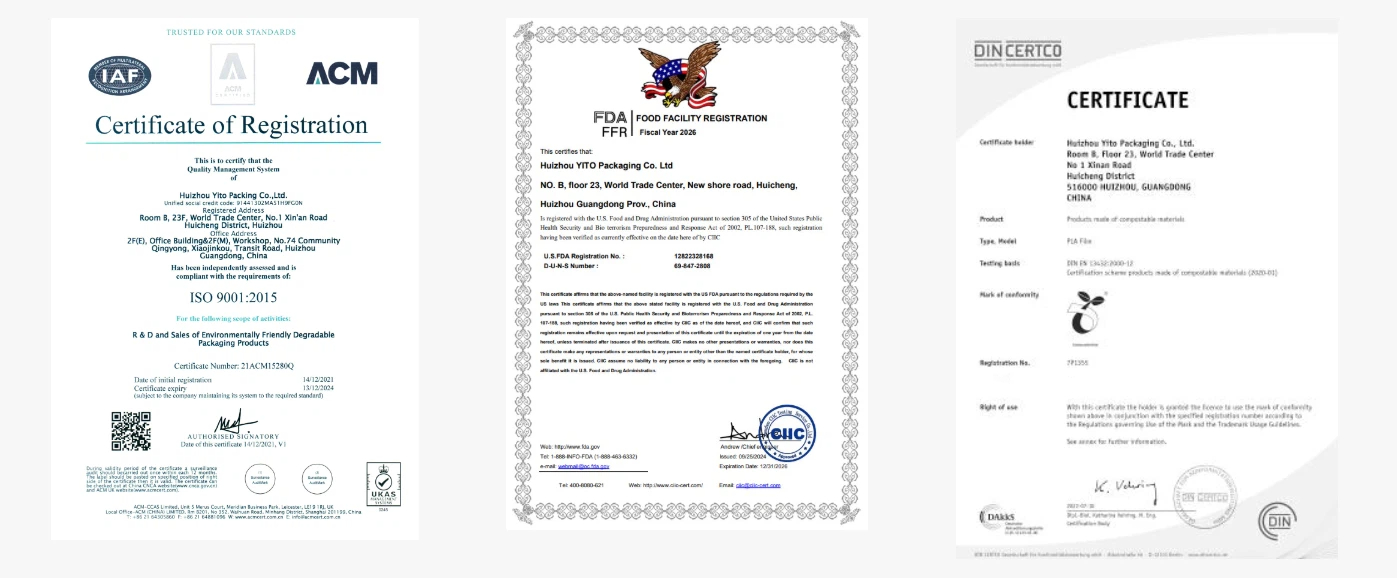
| Certification Options | ASTM D6400-19, BPI-certified options and EN 13432-certified options |
| Sample Lead Time | Standard store-ready samples in 7 days |
| Production Lead Time | Typically 15–20 days after specification and artwork approval |
What Should Buyers Verify Before Approval?
California requires more than a general "biodegradable", “bio-based” or “plant-based” claim.
A qualifying compostable pre-checkout bag must meet the applicable compostable-product requirements and have a minimum mouth width of 15 inches.
YiTo Pack offers standard compostable produce bag SKUs designed around this 15-inch minimum. For many common store applications, your can begin with an existing roll format rather than developing a new size from scratch.
Custom width, thickness, perforation and printing remain available when the standard format does not match the dispenser or produce application.

Compostable plastic products must meet ASTM D6400-19. California also applies labelling and identification requirements intended to distinguish compostable products from conventional plastics.
The finished bag may need:
- · An appropriate certification logo
- · Clear “compostable” wording
- · Green identification through the bag color, lettering or an identification band
- · Artwork without chasing-arrow resin codes or misleading recycling symbols
Bring the certificate, specification and artwork together during the purchasing review.
| Review item | What your team should confirm |
| Certification | It covers the product or product family being purchased |
| Finished dimensions | Open width, length and thickness match the approved sample |
| Material scope | Formulation, colorants and additives align with the supporting documents |
| Artwork | Certification logo, compostable wording and identification format are correct |
| SKU consistency | Sample, specification, artwork and purchase order describe the same bag |
| Supporting files | Available food-contact, fluorine and quality documents meet project needs |
A common sourcing problem appears when these files describe different constructions.
The sample may use one thickness. The certificate may cover another material family. The artwork may have been prepared for a third bag format.
Ask the supplier to organize the review around one finished SKU. Procurement, quality and compliance teams can then work from the same product record.
For a deeper supplier review, see our guide to evaluating compostable produce bag suppliers.
Regulatory Note for Projects Extending Beyond 2027
CalRecycle granted a two-year extension affecting certain National Organic Program-related material requirements for compostable products. The current extension runs through June 30, 2027. Specifications intended for continued use after that date should be reviewed again against the rules then in effect.
How Do You Avoid Buying a Bag That Fails in the Store?
A produce bag can meet California requirements and still perform poorly in the store.
At YiTo Pack, we normally check two areas: handling and freshness.
Handling Performance
Test the finished bag with real produce and store equipment.
Check:
- roll tear-off;
- opening speed;
- dispenser fit;
- seal strength;
- handle strength;
- puncture resistance.
Roll bags should tear cleanly and open easily. Handle bags should carry apples, citrus and heavier vegetables without splitting.
Freshness Performance
The bag also affects airflow, condensation and moisture loss.
Too little ventilation may trap moisture around leafy greens. Too much airflow may increase weight loss during storage.
In selected YiTo Pack tests, an optimised bag reduced weight loss from 8.43% to 0.92%.
In another comparison at 4°C, weight loss after 35 days was 2.02%, compared with 26.45% for the original packaging.
Results depend on the produce, bag structure and storage conditions.
Before selecting a bag, confirm the produce type, cold-chain temperature, transport time and expected retail period.

Why Choose YiTo Pack for California Produce Bag Projects?
YiTo Pack provides compostable produce bags and sustainable produce packaging for grocery stores, produce departments, bakeries and bulk-food displays. For California projects, we first confirm whether the bag is used before checkout, at checkout, for pickup or for delivery, helping distinguish SB 1046, SB 1053 and broader SB 54 packaging responsibilities.
Certification we have
- North America: BPI certification based on ASTM D6400
- Europe: EN 13432 and Seedling mark options
- Australia: AS 4736 and AS 5810 ABA-verified options
- Finished printed SKU documentation where applicable
Supporting documents and lead time
- Food-contact declaration
- Total organic fluorine test report
- Ink and colorant safety statement
- Samples in about 7 days
- Mass production in about 15–20 days after approval
Products marketed as biodegradable produce bags should still be reviewed against finished-product certification, dimensions and artwork rather than relying only on biodegradable or plant-based claims.
FAQ
What is the minimum mouth width for California compostable produce bags?
Under SB 1046, qualifying compostable pre-checkout bags must have a minimum mouth width of 15 inches.
YiTo Pack offers standard produce bag SKUs designed around this minimum, allowing many store projects to begin without custom tooling.
Does SB 1053 ban compostable produce bags?
SB 1053 applies to carryout bags provided at checkout, self-checkout, pickup and delivery.
Pre-checkout produce bags are excluded from the carryout bag category and remain subject to the separate pre-checkout bag requirements established under SB 1046.
What bags can covered stores provide for loose produce?
Covered stores may provide recycled paper bags or compostable bags that meet the applicable statutory requirements.
Is ASTM D6400 enough for purchasing approval?
ASTM D6400-19 is a core compostability requirement, but purchasing approval should also cover the finished dimensions, certification scope, artwork, identification format and relationship between the documents and the ordered SKU.
Can compostable produce bags go into every California organics bin?
Acceptance depends on the local jurisdiction and receiving facility.
Compostable plastics may enter a green-container stream when the material and facility meet the conditions established by California’s organics collection rules.
Related Reading
Are Produce Bags Compostable? How to Tell and What to Look For
Compostable Produce Bag Suppliers: How to Choose a Reliable One for Your Business
Compostable vs Biodegradable Produce Bags: Which Certification Actually Matters?
Related Products


Post time: Jul-22-2026