
Three suppliers may all quote a “certified compostable produce bag,” but the products behind those quotations may be quite different.
One bag may use a lower finished thickness, while another quotation may exclude printing. And some suppliers hand over a general certificate without explaining whether it actually covers the printed, perforated, and sealed bag you are ordering. Some products are also marketed as biodegradable produce bags, but that wording alone does not confirm the composting route or finished-product certification.
Price matters, but it should not be the first question. You first need to know whether the finished bag will work with your fruit or vegetables, packing process and target market.
A useful supplier review comes down to three areas: whether the documents match the finished bag, whether the bag performs under real conditions, and whether the approved result can be repeated in production.
Compostable Produce Bags vs Traditional Plastic Bags
Compostable and conventional plastic produce bags can both protect fresh fruit and vegetables, but they differ in material structure, end-of-life options and documentation requirements. The better choice depends on the produce, packing process, destination market and waste-management route.
| What to compare | Compostable Produce Bags | Traditional Plastic Produce Bags |
|---|---|---|
| Material structure | Often made from blends such as PLA, PBAT and thermoplastic starch; renewable content varies by formulation | Usually made from petroleum-based materials such as PE |
| End-of-life route | May be suitable for industrial composting when the finished bag is properly certified | Not compostable; recyclability depends on the material and local collection system |
| Produce performance | Thickness, ventilation, sealing and opening can be customized for different applications | Mature performance, wide availability and generally lower material cost |
| Certification | Finished-bag compostability and food-contact documents need to be checked separately | Food-contact compliance is required; plastic restrictions may also apply in some markets |
| Brand positioning | Can support verified sustainability and compostability goals | A familiar conventional option, but may not meet projects seeking plastic reduction |
A compostable bag is not automatically the better option for every project. It still needs to protect the produce, run smoothly during packing and carry documentation that matches the finished printed and perforated bag. Traditional plastic bags may offer familiar performance and lower cost, but they may be less suitable where customers or regulations are moving towards reduced conventional plastic use.
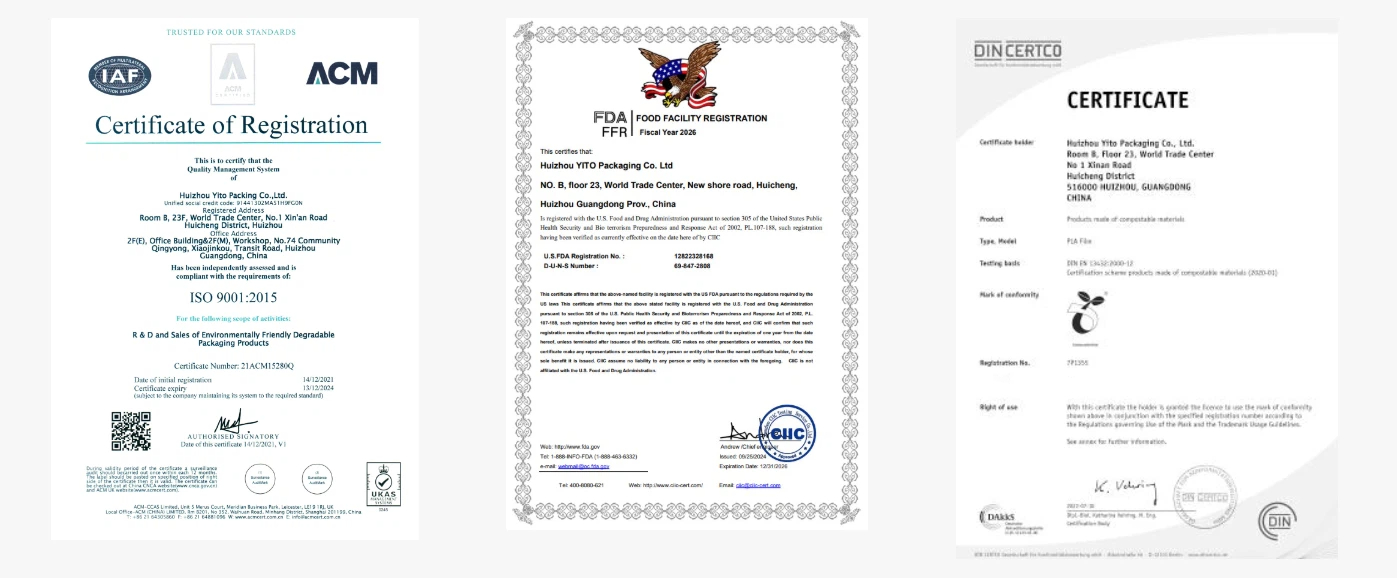
Does the Certificate Cover the Finished Produce Bag?

Your finished compostable produce bag may include printing, ventilation holes, and heat-sealed edges. Its thickness may also differ from the product named in the certificate. These details should be checked before the artwork is approved.
For EU projects, PPWR entered into force on 11 February 2025 and generally applies from 12 August 2026. The compostability requirements for the packaging formats listed under Article 9(1) apply from 12 February 2028. Article 9(2) also allows Member States, under defined collection and treatment conditions, to require certain lightweight and very lightweight plastic carrier bags to be compostable.
When a supplier says a bag is “PPWR compliant,” ask which bag category, requirement and destination market have been reviewed.
The same principle applies to compostability certification.
BPI certification applies to a specific finished product, defined by details such as its maximum approved thickness—not to every bag made from a certified material. Printing, heat-sealed edges or other changes may also require further review.
Before placing the order, ask:
Does this certificate cover the finished thickness, printing, perforation and seal structure in our specification?
A clear answer is more useful than a folder containing unrelated certificates.
You can also search the BPI online product catalog by company name, product name, SKU, or keyword. The catalogue lists approved products down to the item number, and individual records may show details such as printed or unprinted status and approved thickness.
Food-contact documents should be reviewed separately. Compostability certification supports the bag’s end-of-life claim. It does not automatically confirm that the finished printed bag meets the food-contact requirements of your target market.
Will the Bag Work with Your Fruit or Vegetables?
This is where most of the real supplier comparison happens.
Different products in bags create different packaging challenges. Compostable fruit bags for grapes and cherries need better puncture resistance, while compostable vegetable bags for leafy greens need a careful balance of moisture retention and ventilation.
Supermarket roll bags have another challenge: they need to separate and open quickly. A bag that is difficult to open may slow down workers or frustrate shoppers in the produce aisle.
The finished compostable produce bag should therefore be developed around the fruit or vegetable, fill weight, storage temperature, and packing method.
Thickness is part of the decision, but thicker is not always better. A thick bag may still fail when the bottom seal is weak. If the bag is too stiff, it may become difficult to open after refrigeration. If it is too soft, it may not separate or feed smoothly during packing.
Ventilation also needs to match the application.
Too few holes may increase condensation. Too many may allow the produce to lose water too quickly. Hole size and position should be considered together with the bag volume, cold-chain conditions and outer carton.

An empty sample cannot show these problems.
Fill the bag with the intended weight of real produce. Store it under the temperatures the pack will actually face. After refrigeration, check it again.
Does the bag still open easily? Are the seals secure? Have stems or sharp edges punctured it? Is there heavy condensation? Can the fruit still be seen clearly?
These answers are more useful than general claims such as “strong,” “breathable” or “fresh-keeping.”
In a controlled YiTo Pack blueberry packaging trial, an optimised structure recorded 0.92% weight loss and a 2.87% overall defect rate. The reference group recorded 8.43% weight loss and a 13.69% defect rate.

These figures do not guarantee the same result for every blueberry project. Variety, maturity, fill weight and temperature stability can all change the outcome.
The test shows why the finished bag, ventilation design and cold-chain conditions should be developed together.
For this reason, YiTo Pack develops produce bags based on different applications rather than using one standard structure for all fruits and vegetables. Our compostable produce bags can be customized with different sizes, ventilation designs, thickness options and sealing structures to match products such as berries, grapes, leafy greens and other fresh produce.
Whether the priority is clear retail presentation, puncture resistance, moisture control or easy opening during packing, the bag structure can be adjusted according to the actual supply chain requirements.
Test the Actual Roll or Bag Format
A few loose samples may look good but reveal little about production.
If your project uses roll bags, test a full roll. Bags that open easily when handled separately may become harder to separate after being tightly wound and stored for several days.
For automatic packing, use the planned roll direction, core size and operating speed. The trial should show whether the bags feed, separate, and open consistently.
When the commercial bag is printed, test the printed version. This is especially important for custom printed compostable produce bags, because print coverage can affect handling and certification scope.
A small pilot run is often enough to reveal the main problems before bulk production begins.
From Approved Sample to Bulk Production
The approved sample should be connected to a written specification.
That specification should record the finished dimensions, thickness, printing, perforation and seal structure. It becomes the reference for production and final inspection.
The supplier should not change the bag material, thickness, printing or sealing conditions without discussing the change with you first.
YiTo Pack targets a 7-day sample turnaround for custom compostable produce bag projects. After the sample, artwork, and final specification are approved, bulk production typically takes 15–20 days.
Simpler repeat orders may sit near the shorter end of the range. Complex printing or special structures may require the full production period.

Compare the Same Finished Bag
A lower quotation does not always mean that the same bag is being offered at a better price. It may be based on a thinner finished bag, an unprinted design or fewer bags in each roll or carton.
When comparing wholesale compostable produce bags, make sure each quotation is based on the same finished specification.
|
What to compare |
What to check |
| Finished bag thickness | Confirm the actual finished thickness, not only a general material range. It affects strength, feel and cost. |
| Bag format | Roll bags, flat bags and pre-opened bags use different production and packing processes. |
| Printing | Check the number of colours, print coverage and whether the printed version remains within the certification scope. |
| Pack quantity | Confirm the number of bags per roll, inner pack and carton before comparing the unit price. |
| Certificate coverage | Make sure the documents support the finished printed, perforated and sealed bag being quoted. |
Once these details are clear, it becomes much easier to see whether a lower quotation offers better value or simply refers to a different product.
Why Choose YiTo Pack?
YiTo Pack develops each produce bag around the actual application rather than using one standard structure for every project. We review the produce type, fill weight, packing method, storage conditions and destination market to define the bag format, thickness, ventilation, printing and document requirements before sampling. Test conditions such as opening performance, puncture risk, condensation, roll direction and packing-line compatibility can also be confirmed before bulk production.
For complete produce packaging projects, YiTo Pack can coordinate the bag with fruit labels, liners, freshness packaging, clamshells, punnets, fruit boxes and matching cartons. This one-stop approach supports a more coordinated eco-friendly produce packaging system and helps avoid problems such as labels covering ventilation holes, excessive moisture loss or poor carton fit.
FAQ
Q: Does PPWR require every produce bag sold in the EU to be compostable?
A: No. The answer depends on the bag category, intended use and destination market. Ask which PPWR requirement the supplier’s claim refers to.
Q: Does a general material certificate cover the finished printed produce bag?
A: Not automatically. The finished thickness, printing, perforation and seals need to fall within the applicable certification or product approval scope.
Q: Can a home-compostable produce bag be used for supermarket supply?
A: It depends on the retailer’s packaging policy and the destination market. Confirm the required claim and supporting documents before approving the bag.
Q: What information should I provide before requesting a sample?
A: Share the produce type, fill weight, bag size, packing method, storage temperature and destination market.
Related Reading
What Are Compostable Produce Bags Made Of? PLA, PBAT, and Starch Explained
How to Switch Your Store From Plastic to Compostable Produce Bags: A Step-by-Step Guide
Top Compostable Produce Bag Suppliers Compared: Brands, Certifications, and MOQ
Related Products


Post time: Jul-15-2026