
Ever ordered a "compostable" produce bag, only to have it stick to itself, tear on a stem, or fail your customer's certification check? You're not alone — and it's not because compostable packaging doesn't work. It's because most buyers get told the material name and nothing else.
Here's what nobody tells you upfront: commercial compostable packaging bags are rarely made from one material alone. Products marketed more broadly as biodegradable packaging bags may use similar blends, but the finished-bag certification still needs to match the actual environmental claim. It's a mix — usually PLA, PBAT, and starch, each doing a different job. PLA keeps it clear. PBAT keeps it stretchy so it doesn't rip. Starch makes it greener, but it hates moisture, so if the mix is off, your bag pays for it later — in storage, on the line, or in a customer's fridge.
And the material name alone won't save you at customs or on a retail shelf. EU buyers need EN 13432. US buyers need ASTM D6400 and BPI. Home compostable is a whole different certificate. Get the wrong one, and your "eco-friendly" bag becomes a very expensive problem.
PLA, PBAT and Starch Do Different Jobs
More PLA or more starch does not automatically make a better bag. The right structure depends on how the finished packaging needs to look, open, seal and perform with the produce.
| Material | Main advantage | Common produce packaging use |
|---|---|---|
| PLA | High transparency, structure and premium shelf appearance | Clear retail bags, lightweight fruit packs and PLA food packaging film |
| PBAT | Flexibility, elongation and better resistance to stems and sharp edges | Roll bags, softer PBAT compostable film and produce with higher puncture risk |
| Thermoplastic starch | Renewable content and support for balanced compostable formulations | Blended biodegradable packaging bags where moisture and storage conditions are controlled |
| PLA/PBAT/TPS blend | Balances clarity, flexibility, sealing and compostability | Custom compostable bags developed around the produce, packing line and supply chain |
PLA is commonly used in PLA film packaging where transparency and clean retail presentation matter. A suitable PLA compostable film can give fruit good visibility, but a high-PLA structure may feel too stiff for some roll bags or automatic packing applications.
PBAT is generally added when the bag needs more stretch and toughness. It supports flexible PBAT biodegradable packaging, especially for grapes, cherries and vegetables with stems or irregular edges.
Thermoplastic starch is normally blended with other polymers rather than used alone. In a well-designed PLA PBAT blend film, it can increase renewable content while the full formulation maintains the strength, opening and sealing required for commercial produce packaging.

One more thing people miss: "compostable" doesn't mean it'll disappear anywhere you toss it. "Certified compostable" means it breaks down under specific conditions—an industrial composting facility, basically—not in a landfill or a random pile of dirt. So the bag still needs to actually end up in the right place to compost properly.
Starch creates a different type of misunderstanding. Most “cornstarch bags” are not made from ordinary starch alone. The starch is normally converted into thermoplastic starch, or TPS, and blended with other polymers because plain starch cannot deliver the strength, flexibility and sealing required by a commercial produce bag.
A high starch percentage may look attractive in a sales presentation. In a cold and humid produce environment, however, moisture stability matters more than the headline number. A poorly balanced film may start to block, feel tacky at the surface, or lose clarity after storage.
So instead of chasing the highest PLA or starch percentage, we start from the other end: what do you actually need this bag to do? Open easily. Resist punctures. Stay clear. Seal properly. Compost the right way. That's the real spec.
Where These Materials Fit in Real Produce Packaging
Different produce needs different bags — this isn't one-size-fits-all.
A roll bag for loose fruit in a supermarket aisle? Speed is everything. It needs to separate cleanly and open fast, without a staff member fighting with it. Whether it hits the highest bio-based percentage matters way less than whether it actually opens.
Pre-packed berries, grapes, and cherries? Different story. You need clarity so the fruit looks good, but you also need toughness—stems and sharp edges will puncture a weak film. Throw refrigeration into the mix and now you're dealing with condensation too.
Leafy greens are trickier than they look. Too little airflow, and you get fog and wet leaves. Too much, and they dry out and wilt. It's a balancing act between thickness, ventilation, and temperature.
Shipping overseas? Add more handling, longer transport, and bigger temperature swings. A bag that looks perfect in a warm sample room can behave completely differently after a week in a container.
And if you're selling to organic or premium retailers, expect them to care more about certification and clean printing—so get your bag, label, and box designed together from the start. Bolt the label on later, and you'll probably be retesting everything.

The Sample Room Is Rarely Where the Real Problems Appear
A single sample never tells you the truth. It looks fine sitting on a desk — clear film, neat seal, decent strength. The real test starts when the full production roll shows up.
After sitting wound-up under pressure for a few days, the film can start sticking to itself. Workers end up rubbing the bag mouth or blowing into it just to get it open. Annoying with ten bags. A real problem with ten thousand.
Automatic lines are even less forgiving. If the film's too soft, too stiff, or just a little inconsistent, it jams the feed — and the machine doesn't care how good your sustainability story sounds.
Then there's puncture. Grapes, cherries, leafy greens — none of them behave like a lab test weight. Stems poke through, sharp edges cut, and a heavy fill puts real stress on the seams. Making the film thicker helps a little, but it can't fix a bad formula or a weak seal — it just makes the failure more expensive.
Cold storage is where things really fall apart. Pull a bag out of the fridge, and it can feel stiff, almost brittle—hard to open with your hands, let alone fast on a line. Every time the bag moves—packing room, cold store, truck, warm shelf—moisture builds up inside like a fogged-up window. Printing can smudge. Seals can quietly crack. And you usually don't find out until a customer's already complaining.
So when someone asks us for "a PLA bag," that's honestly not enough to go on. What actually matters is: what produce is going inside, how much it weighs, how it's packed, and what temperatures it'll travel through. That tells us far more than the material name ever could.
Certification Can Delay an Otherwise Good Project
A bag may run well on the line and still fail the document review.
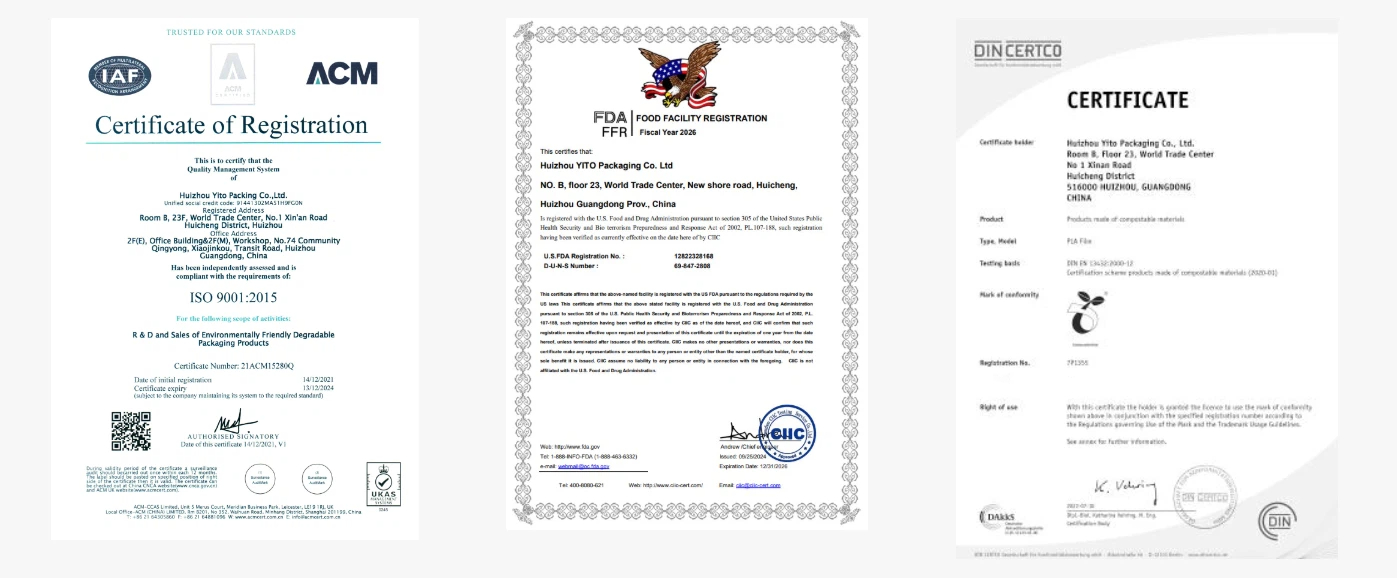
Here's a mistake we see a lot: someone gets a certificate for the resin, and assumes it covers the finished bag. It doesn't work like that. Certification is tied to a specific product — a specific thickness, a specific construction. Change any of that, and the certificate might not apply anymore.
Compare the documents with the product you are actually buying. The product or material name, thickness range, printing status and composting route should all match. If the bag includes a zipper, handle, ink system or another component, check whether the finished construction remains within the certification scope.
For an EU industrial-composting project, you may be reviewing EN 13432 and OK Compost INDUSTRIAL documentation. A North American commercial project may require ASTM D6400 and BPI support. Home compostability follows a separate route; industrial certification does not automatically support a home-composting claim.

Food-contact documents need to be checked alongside the compostability paperwork. A compostability certificate does not replace the food-contact declarations or test information required for the film, ink and final printed structure.
It is worth dealing with this before the artwork is approved. Discovering a mismatch after the bags have been printed is a much more expensive conversation.
What Our Blueberry Test Actually Shows
People often ask whether PLA, PBAT or starch keeps fruit fresh for longer. None of those materials can answer that question alone.
A bag changes the environment around the produce, but the result also depends on ventilation, film thickness, bag volume, produce respiration, storage temperature, and the outer carton. Too few holes may cause heavy condensation. Too many can dry the fruit out.
So here's what we actually found. We ran a controlled trial packing blueberries in an optimized bag structure. After 52 days, weight loss was just 0.92%, and only 2.87% of the fruit showed defects. The control group—same blueberries, standard cold-chain handling, and no preservation packaging—lost 8.43% of their weight and had a 13.69% defect rate.
We do not use those figures to claim that one polymer will keep every batch of blueberries fresh for 52 days.
The useful finding is the gap between a packaging structure developed around the fruit and a control relying on cold chain alone. The film, ventilation, and humidity control were working together.
Your fruit may have a different variety, maturity, pack weight, and transport route. The data gives us a strong development reference, but the final decision still comes from testing your own produce.

A Second Test: Sugarcane
Freshness data is more convincing when it comes from more than one product. In a YiTo Pack packaging trial with peeled sugarcane, the produce packed in an optimized bag structure remained visibly fresh after 19 days, while sugarcane in a standard bag showed visible yellowing within 2 days.

As with the blueberry trial, this result reflects one specific product, formulation, and storage condition. It is not a claim that every produce type or every bag will achieve the same outcome—but it illustrates why bag structure, not the material name alone, determines how produce looks and performs over time.
Order Process
Inquiry → Material & Structure Proposal → Sampling (7 Days) → Customer Testing → Spec & Certification Confirmed → Bulk Production (15–20 Days) → QC & Shipment
Why Choose YiTo Pack?
With 10+ years of sustainable packaging experience, YiTo Pack develops compostable produce bags around the actual application. We review the produce type, fill weight, packing method, ventilation, bag dimensions, and equipment requirements before sampling.
Our one-stop support includes custom bags, OEM printing, fruit labels, liners, freshness film, clamshells, punnets, fruit boxes, and matching cartons. This helps keep the bag, label and outer packaging compatible.
MOQ starts from 10,000 pieces. Samples are typically ready in 7 days, followed by 15–20 days for bulk production after approval. Depending on the project, we can also support FDA, EU 10/2011, LFGB, EN 13432, ASTM D6400 and ISO 9001-related documentation.
Conclusion
Choosing a compostable produce bag is not only about identifying which material sounds the most sustainable. For fruit and vegetable packers, growers and exporters, the better question is whether the finished bag will perform on your line, protect your produce, and support the environmental claim your customer expects.
A good compostable produce bag does a few simple things: it opens easily, seals properly, survives a puncture risk or two, handles the cold chain without falling apart, and comes with certification that actually matches the bag you're holding—not just the raw resin it started as.
YiTo Pack helps buyers develop compostable produce bags using PLA, PBAT, and thermoplastic starch blends matched to your produce type, fill weight, packing method, and destination market. Before bulk production, we can help review your material direction, certification requirements, and application conditions to reduce trial-and-error and avoid delays during customer approval.
FAQ
Q: Is a cornstarch produce bag really made from cornstarch?
A: In many cases, starch is part of the formulation, but the wording is usually oversimplified. It is generally processed into thermoplastic starch and blended with other polymers. Ask for the main material structure rather than relying on "cornstarch" as the full description.
Q: Is PBAT plant-based?
A: Usually not. Conventional PBAT is generally fossil-based, although it may still be biodegradable and used in a certified compostable formulation. Keep bio-based content and compostability as separate claims.
Q: How is PHA different from PLA/PBAT/starch blends?
A: PHA is a family of polymers made by microorganisms and is generally both bio-based and biodegradable, with some grades able to break down in soil or marine environments — not just industrial composting. That doesn't mean every PHA bag is automatically marine biodegradable; it still depends on the grade, thickness and testing. For most produce-bag projects, PLA/PBAT/starch blends remain the practical choice for clarity, flexibility and cost. PHA is worth considering when your project has a specific end-of-life requirement a standard blend can't meet.
Q: Can you guarantee the same 52-day result for my produce?
A: No — the YiTo Pack data came from a specific optimized blueberry packaging system under controlled conditions. Your variety, initial quality, fill weight, perforation and cold-chain stability can change the outcome. We use the data as a development reference, then test the final bag with your produce.
Q: Do I need to check certification again if the base film is certified?
A: Yes. Printing, thickness, seals and added components can change the certified construction. Confirm the scope against the actual finished bag before production.
Related Reading
Are Produce Bags Compostable? How to Tell and What to Look For
Compostable Produce Bag Suppliers: How to Choose a Reliable One for Your Business
Compostable vs Biodegradable Produce Bags: Which Certification Actually Matters?
Ready to test a compostable produce bag for your application?
Related Products


Post time: Jul-14-2026