
Many retail packaging projects fail before production begins. A clear bag may be described as “cellophane” while actually using conventional plastic film; an undersized flat bag can distort around a boxed product; and the wrong thickness, closure or print layout can lead to weak seals, poor shelf presentation and unsupported environmental claims.
For buyers sourcing biodegradable cellophane gift bags, the key challenge is turning a general packaging idea into a workable specification. The bag structure, dimensions, film thickness, gusset depth, closure and printing must match the product’s size, weight, surface and packing process. A greeting card may only require a 20–25 μm flat bag, while a candle box or stacked cookie pack may need a 30–35 μm side-gusset structure.
YiTo Pack supports flat, self-adhesive, side-gusset, lap-seal and centre-seal bags with custom dimensions, colours and logo printing. This guide provides practical starting points for material selection, artwork, samples and production quotations.
Key Takeaways
- · Genuine cellophane is made from regenerated cellulose, commonly derived from renewable wood pulp.
- · YiTo Pack supports flat, self-adhesive, side-gusset, lap-seal and centre-seal formats.
- · Available film gauges range from approximately 19.3 to 41.4 μm.
- · Accurate quotations require a defined structure, finished size, thickness, closure, artwork and order quantity.
What Are Biodegradable Cellophane Gift Bags Made From?
Renewable, Biodegradable and Compostable
Renewable refers to the material source. Cellulose made from managed wood resources uses a plant-based feedstock that can be replenished.
Biodegradable describes the material’s ability to break down through biological activity under suitable conditions.
Compostable packaging is assessed against defined criteria for biodegradation, disintegration and compost quality. For European industrial-composting projects, buyers commonly request documentation against EN 13432 or schemes such as OK compost INDUSTRIAL. In North America, BPI uses ASTM D6400 as the base standard for its commercial-compostability certification. BPI’s separate home-compostability programme is based on NF T 51-800.
The required route should be confirmed at the beginning of the project. A certificate should match the selected film grade, thickness, coating, printing and finished structure rather than only the general material name.
YiTo Pack’s plant-based cellophane materials can be developed as clear cellophane bags, transparent retail bags and selected compostable cellulose film structures. For brands seeking a plastic-alternative film, the material offers renewable cellulose packaging with high clarity, printability, and product presentation.
Genuine cellophane is produced from regenerated cellulose. The cellulose is commonly obtained from wood pulp, giving the film a plant-based and renewable raw-material source.
During production, purified cellulose is regenerated into a transparent film that can be coated, printed, slit and converted into bags. The finished material provides high clarity, gloss, a crisp feel and natural anti-static performance.
Selected coated grades also provide heat-sealing capability and resistance to oxygen, aromas, oils, grease and water vapour. These characteristics make cellulose bags suitable for gift products, confectionery, bakery items, personal care products and speciality retail packaging. YiTo Pack describes its heat-sealable film as a regenerated cellulose structure coated on both sides.
Transparent BOPP, CPP and OPP bags may look similar and are sometimes described commercially as “cello bags".
For a more detailed material comparison, read how biodegradable cellophane differs from conventional plastic film.

Cellophane Bags vs Plastic Bags: What Should Buyers Compare?
Biodegradable cellophane bags and conventional plastic bags can offer a similar clear appearance, but they differ in raw-material source, barrier performance, end-of-life route and suitability for environmental claims.
For retail brands, the choice should be based on the packed product and the target market rather than transparency alone.
| Comparison Factor | Regenerated Cellulose Bags | Conventional Plastic Bags |
|---|---|---|
| Raw-material source | Renewable wood pulp and regenerated cellulose film | Mainly fossil-based polymers such as BOPP, CPP, OPP or PE |
| Appearance | High clarity, gloss and a crisp premium feel | High clarity with softer or more flexible handling, depending on the polymer |
| Environmental route | Selected grades can support industrial or home-compostability certification | Usually non-compostable; recyclability depends on the polymer and local collection system |
| Oxygen and aroma barrier | Strong oxygen and aroma protection for confectionery, tea, soap and scented products | Performance varies by polymer and multilayer structure |
| Moisture resistance | Moderate to enhanced moisture resistance depending on the coating | Often stronger moisture barrier for humidity-sensitive products |
| Heat sealing | Available with coated cellulose grades; equipment trials are required | Widely heat-sealable, with settings depending on the plastic type |
| Printing | Suitable for custom logos, transparent windows and premium retail graphics | Suitable for high-speed printing and a wide range of decorative effects |
| Typical applications | Gift bags, confectionery, bakery products, soap, stationery and premium retail packaging | High-moisture foods, heavy products and applications requiring strong mechanical or moisture protection |
| Main purchasing advantage | Renewable cellulose packaging, premium presentation and certified compostable options | Cost efficiency, toughness and stronger moisture protection for selected applications |
For brands comparing transparent cellophane bags with clear plastic bags, regenerated cellulose is particularly useful when renewable materials, product visibility, aroma protection and certified compostability are priorities.
Conventional plastic may remain more suitable for products requiring very high moisture resistance, strong puncture protection or an established plastic-recycling route. The correct decision should balance product protection, packaging equipment, sustainability claims and the available waste-management system.
Which Bag Structure Should You Choose?
Lap-Seal and Centre-Seal Bags
Lap-seal and centre-seal formats are more suitable for repeated production, printed rollstock and automated packing.
A lap-seal bag overlaps the film along the rear panel, leaving the front clear for product display and branding. A centre-seal bag places the vertical seam in the middle of the rear panel, so barcodes and small text should be positioned away from the seal.
Flat and Open-Top Bags
Flat bags are suitable for products with limited depth, including greeting cards, gift tags, jewellery display cards, thin soap bars and lightweight accessories.
Their two-panel construction provides a large transparent display area and uses less film than a gusseted structure. The top can remain open or include additional length for folding, labelling or heat sealing.
Product thickness must still be included when calculating the width. A small rigid box may place too much pressure on a flat bag even when its front dimensions appear to fit.
Self-Adhesive Bags
Self-adhesive bags include a fold-over flap and adhesive strip, allowing operators to pack products without a heat sealer.
This format works well for stationery, cards, jewellery, cosmetic samples and lightweight accessories. It offers a simple insert-and-close packing process and creates a tidy retail presentation.
Where the finished packaging will carry a compostability claim, the adhesive and release liner should also be included in the component review.
Side-Gusset Bags
Side-gusset bags expand along both sides, creating extra room for boxed, stacked or thicker products.
They are commonly used for cookies, chocolates, soap sets, candle boxes, bakery gifts and promotional packs. A correctly sized gusset allows the front and rear panels to remain relatively flat after filling.
YiTo Pack’s custom cellulose side-gusset bags support custom size, thickness, colour and printing.


Recommended Starting Configurations

|
Product |
Recommended Structure |
Starting Thickness |
Closure |
Main Validation Point |
| Greeting cards and gift tags | Flat self-adhesive bag | 20–25 μm | Adhesive flap | Fit and flap position |
| Jewellery display cards | Flat bag | 20–25 μm | Adhesive or fold-over | Scratching and movement |
| Soap bars | Flat or side-gusset bag | 25–30 μm | Heat-seal or fold-over | Oil contact and print rub |
| Cookies and confectionery | Side-gusset or lap-seal bag | 25–30 μm | Heat seal | Seal cleanliness |
| Chocolate gift boxes | Side-gusset bag | 25–35 μm | Heat-seal or fold-over | Fit and aroma protection |
| Candle boxes | Side-gusset bag | 30–35 μm | Fold-over or adhesive | Corner pressure |
| Bakery gifts | Side-gusset or lap-seal bag | 25–30 μm | Heat seal | Grease contact |
| Multi-item gift sets | Side-gusset bag | 31–41 μm | Heat seal or decorative closure | Load distribution |
Film thickness influences stiffness, handling strength and the feel of the finished bag. The structure controls usable internal volume.
A correctly sized 30 μm side-gusset bag can fit a candle box more effectively than a thicker flat bag. Moisture protection is controlled mainly by the film grade and coating, so barrier requirements should be specified separately from thickness.
Custom Printing Options for Retail Brands
Cellulose film allows the packed product to remain part of the visual design. Effective artwork normally preserves a clear viewing area while using printed sections for branding, mandatory information and shelf differentiation.
|
Printing Option |
Best Suited For |
Design and Production Notes |
| Clear unprinted bags | New launches, lower-volume ranges and products using separate labels or sleeves | Avoids dedicated printing setup and allows easier artwork changes |
| One-colour logo printing | Soap, candles, stationery, confectionery and artisan gifts | Dark colours provide strong contrast; pale colours may require a white ink base |
| Multi-colour printing | Established retail ranges and seasonal campaigns | Artwork should specify Pantone colours, white ink, printing sides and seam positions |
| Printed borders with transparent windows | Chocolates, cookies, soap bars and candle boxes | Keeps the central product-viewing area clear while adding branded graphics |
| Artwork preparation | Printed side-gusset and other custom bag projects | AI or print-ready PDF is preferred; raster files should generally be at least 300 dpi |
YiTo Pack’s side-gusset page accepts AI, PDF, JPG and PNG artwork and requests at least 300 dpi for raster files.
For bakery and confectionery bags, printing should remain on the exterior surface, and the relevant food-contact documentation should be confirmed for the selected film and print structure.
Heat-Sealing and Barrier Performance
YiTo Pack lists a starting heat-sealing range of 115–120°C for standard pre-made bags, while the TDS for a selected double-sided coated cellulose film gives a range of 120–130°C; the final setting should be adjusted on the buyer’s actual equipment.
The same coated-film TDS lists an oxygen transmission rate of 5 cc/m²/24h and a water-vapour transmission rate of 35 g/m²/24h. This provides useful oxygen and aroma protection for confectionery, tea, scented products and selected bakery items, together with moderate moisture resistance for soap, sweets and dry baked goods. Products requiring long-term crispness retention or stronger humidity protection may need a higher-barrier cellulose grade or another packaging structure.
For premium cigar applications, YiTo Pack also recommends clear cellulose cigar bags where product visibility, aroma preservation and presentation quality are important. The natural transparency of cellulose film allows brands to showcase cigar appearance while providing a cleaner alternative to conventional plastic sleeves. Depending on cigar size, storage conditions and humidity requirements, options can include flat cigar sleeves, self-sealing bags or customised printed cigar packaging solutions.

PPWR Considerations for EU Projects
The EU Packaging and Packaging Waste Regulation entered into force on 11 February 2025 and generally applies from 12 August 2026. It covers packaging placed on the EU market and introduces requirements concerning packaging manufacture, composition, minimisation, recyclability and waste management.
Compostable cellulose film can support a sustainable packaging strategy, but an EN 13432 or compostability certificate represents only one part of the assessment. EU buyers should also review the finished bag’s composition, dimensions, weight, coating, printing and intended waste route.
Ordering Considerations for Custom Projects
|
Project Information |
Details |
| MOQ | From 1,000 pcs for selected side-gusset structures; generally from 10,000 pcs for fully custom printed bags |
| Sample Lead Time | Approximately 5–7 days |
| Production Lead Time | Approximately 12–16 working days for selected side-gusset bags; around 15–20 working days for standard custom projects |
| Custom Scope | Size, thickness, gusset depth, closure, colour and logo printing |
| Quotation Basis | Final specification, artwork, order quantity and delivery destination |
Buyers should compare quotations using the same bag size, thickness, structure, closure and printing requirements. A lower unit price may reflect a thinner film, simpler structure or different print coverage rather than an equivalent packaging specification.
Why Choose YiTo Pack
YiTo Pack supports custom cellophane gift bag projects from specification review through sampling and mass production. Our team evaluates the packed product, dimensions, weight, closure method and retail presentation before recommending a suitable bag structure and starting film thickness.
Available options include flat, self-adhesive, side-gusset, lap-seal and centre-seal bags, together with custom dimensions, gusset depth, colour and logo printing. This allows brands to develop packaging around the actual product rather than selecting from a limited range of standard sizes.
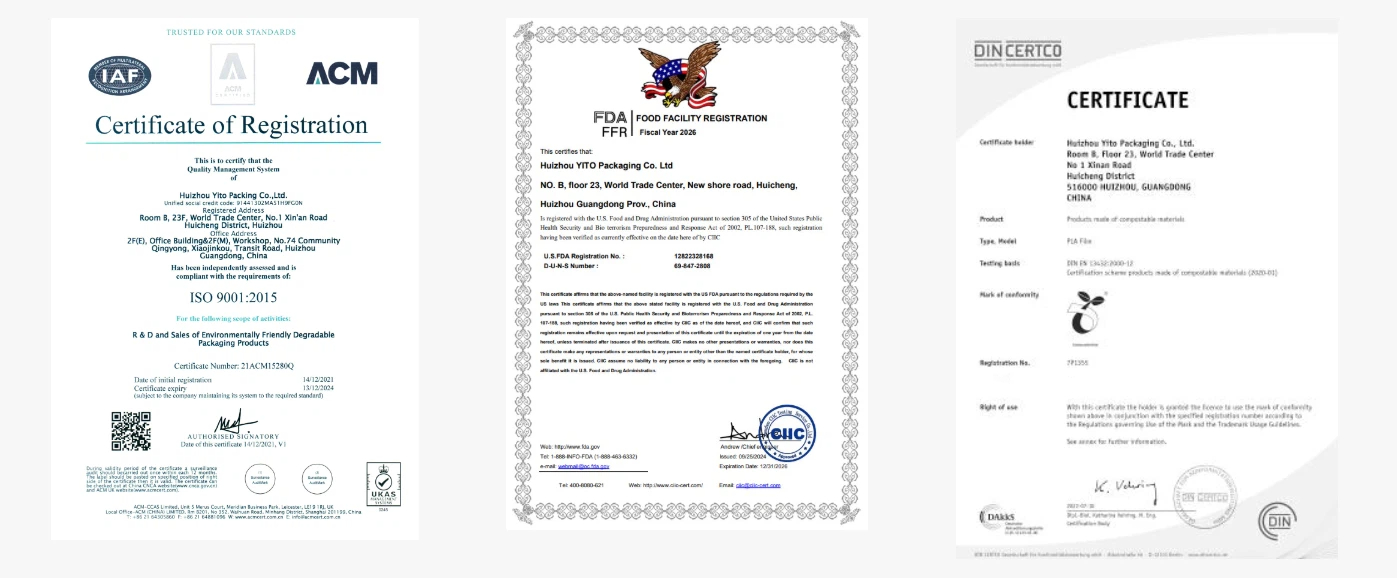
For applicable materials and finished structures, YiTo Pack can support documentation such as EN 13432, ASTM D6400, BPI, OK compost INDUSTRIAL, OK compost HOME, FSC, FDA, EU Regulation (EC) No 1935/2004, REACH and RoHS. Certificate availability should be confirmed according to the selected film grade, coating, thickness and printing configuration. Standard samples can normally be prepared within approximately 5–7 days, allowing buyers to verify fit, printing and sealing before mass production.
Conclusion
Selecting biodegradable cellophane gift bags begins with confirming that the material is genuine regenerated cellulose rather than conventional transparent plastic film. The bag structure, film thickness, closure, printing and barrier performance should then be matched to the packed product and its retail presentation.
Flat and self-adhesive bags suit lightweight products, while side-gusset, lap-seal and centre-seal formats provide more room or support repeat packing. Buyers should compare supplier quotations using the same dimensions, thickness, structure and print requirements rather than relying on the general product name alone.
YiTo Pack supports custom cellulose gift bags from specification review and sampling through to mass production, helping brands confirm product fit, print appearance, sealing performance and applicable documentation before bulk ordering.
FAQ
Are all clear cello bags biodegradable?
No, some cello bags are made from BOPP, CPP or OPP, so the specification should explicitly identify regenerated cellulose.
Are biodegradable cellophane gift bags compostable?
Selected grades can support industrial or home-compostability requirements when the film, coating, printing, closure and finished structure fall within the applicable certificate scope.
Can biodegradable cellophane bags support an EU PPWR project?
Yes, but the full material composition, packaging weight, printing, labelling and intended waste route must also be reviewed.
Is custom logo printing suitable for bakery and candy packaging?
Yes, when food-contact-suitable cellulose film and compatible exterior printing are used for the selected product and destination market.
Related Articles
Are Cellophane Bags Biodegradable? The Complete Material Science Answer
Biodegradable Cellophane Food Bags: Material Specs & Compliance for B2B Buyers
Biodegradable Cellophane Cone Bags: Shapes, Sizes & Wholesale Supply
Not sure which cellophane bag structure fits your product? Send YiTo Pack your product type, filled weight, preferred closure, artwork and target market for an initial material and structure recommendation.
Related Products


Post time: Aug-05-2026