
Pure cellophane, with regenerated cellulose as the core raw material, as long as it is in the biology, it can naturally complete the biodegradation process. However, don't be misled by the product name. All translucent packaging bags under the banner of "cellophane" on the market do not all have the same environmental protection attributes. Many transparent bags are made of ordinary plastic in essence and have no degradation ability at all. There are also some packaging bags. Although the base material is natural cellulose film, the subsequent processing is superimposed with coatings, printing inks, adhesive layers, paper labels or various sealing accessories. These additional structures will directly change the overall packaging of the finished product. Environmental degradation performance.
From the perspective of ordinary consumers, we don't need to worry about complicated professional concepts, we only need to clarify three core issues: What is the core material of this packaging bag in hand? What auxiliary materials are added to the production and processing? What are the compliant and feasible packaging waste disposal methods in our daily living areas?
What Is Real Cellophane?
Real cellophane is a transparent film material, the core component is regenerated cellulose, and most of the raw materials are taken from natural plant fibers such as wood pulp. Some microorganisms in nature can decompose cellulose components with exclusive enzymes. In high-quality compost with sufficient oxygen and active flora, this material can be gradually and completely decomposed, and finally converted into carbon dioxide, water and natural biomass. This is fundamentally different from the characteristics of plastic packaging that can only be weathered, brittle, and broken into tiny plastic particles.
Most people's cognitive misunderstandings stem from the general naming rules for packaging products. Everyday everyone's "cellophane" and "glass bags" have long become general names for all kinds of transparent, crisp and transparent packaging. OPP, BOPP, CPP, PE plastic film and regenerated cellulose film are all smooth and translucent in appearance and similar in texture. It is impossible to accurately distinguish the quality of materials and differences in attributes by naked eye observation alone.

If you want to accurately identify the material, the most reliable thing is to check the product material label. Biodegradable cellulose bags will clearly mark regenerated cellulose or cellulose film materials. If the packaging label indicates polypropylene, OPP, BOPP, CPP, polyethylene and other materials, it is definitely not real cellophane. If the product details lack complete material information, it is recommended that you take the initiative to consult the merchant and ask for accurate material instructions and qualification certificates for the adapted finished product.
Biodegradable, Industrially Compostable, and Home Compostable
“Industrially compostable” refers to packaging designed for professional facilities that control temperature, moisture, oxygen, microbial activity, and processing time. “Home compostable” is a separate claim because household composting is cooler, less stable, and more variable.
A credible environmental claim should identify the material, the intended disposal route, and whether testing or certification covers the finished product. Vague terms such as “green” or “naturally degradable” do not give consumers clear disposal guidance.
These distinctions also matter in brand communication. Packaging should not be promoted as able to “degrade anywhere.” Brands should explain the conditions required for degradation and provide simple, practical disposal instructions.
Can Cellophane Bags Be Industrially or Home Composted?
Professional commercial composting facilities, which can create stable and active degradation for organic waste and suitable compostable packaging. Packaging compliance projects in North America generally refer to the two major standards of ASTM D6400 and ASTM D6868, while the European market mainly follows the EN 13432 standard. The core of identifying whether the packaging is compliant does not lie in which standard is benchmarked, but in the relevant environmental protection certification, whether it covers the complete finished packaging bag, rather than only adapting to the unprocessed basic original film.
In addition, local waste disposal acceptance rules are also crucial. The organic waste treatment systems of some cities accept compostable packaging certified in compliance, but there are also many areas that only accept pure organic waste such as kitchen waste and garden dead branches. Before putting the cellophane bag into the organic trash can, you must confirm the specific regulations of the local collection and transportation agency in advance.

The Finished Bag Matters
Coatings and added components used for sealing, printing, or protection can change the disposal requirements of the complete package.
|
Component |
What to check before composting |
| Base film | It should be identified as regenerated cellulose. |
| Coating or seal layer | The certification should cover the coated, heat-sealable structure. |
| Printing ink | The printed version should fall within the certification scope. |
| Adhesive strip | Check whether the adhesive and release liner are compostable. |
| Label or sticker | Remove it unless it is included in the finished-product certification. |
| Zipper, tie, or metal part | Detach non-compostable closures before disposal. |
A certificate for untreated film does not necessarily cover the bag sold in a shop. Evidence should apply to the exact finished product and its attached components.
How Consumers Should Dispose of Cellophane Bags
To deal with waste cellophane bags, the safest thing is to check the packaging labels first. Packaging bags with formal industrial compostable certification can only be put into commercial composting facilities that specifically accept such compliant packaging, or corresponding organic waste collection and transportation projects.
There is also a special case: the packaging bag is only marked with recycled cellulose material, but there are no relevant guidelines for composting and treatment. In the face of such products, do not dispose of them at will. The safest thing is to consult the brand official, or dispose of them according to the general rules of local domestic waste.
The recycling process of compostable film and plastic film is completely different, and they must not be mixed and put in. Another thing to keep in mind: Even if the packaging is printed with a biodegradable label, it does not mean that it can be discarded at will. Natural and landfill sites cannot replicate professional and controllable compost degradation conditions at all.
How to Recognize a Trustworthy Environmental Claim
Don't blindly believe in the certification mark on the surface of the packaging, and must take the initiative to verify the authenticity of the qualification. Formal and compliant certification marks can be associated with official certification bodies, licensed companies, and corresponding product information, and support public database retrieval. At the same time, the complete product description will clearly inform whether the labels, sealing accessories and other details need to be removed before processing.

YiTo Compostable Cellophane Bag Solutions
YiTo cellophane bags are primarily made from regenerated cellulose film derived from natural wood pulp. The material offers high transparency, a crisp texture, and a plant-based origin. Compared with transparent plastic films such as PP and BOPP, which are produced from petroleum-based resources, regenerated cellulose is inherently biodegradable under suitable conditions. However, whether a finished bag can also be described as compostable depends on its complete structure, including coatings, heat-sealing layers, printing inks, adhesives, and closure components. The environmental performance of the product should not be judged solely by the base film.
For different compostable bags wholesale projects, YiTo can customize the bag size, thickness, and structure according to the packaged product and application requirements. Our cello bag wholesale formats include flat bags, side-gusset bags, and self-adhesive bags, with custom logo and graphic printing also supported. These bags can be used for food, gifts, flowers, cosmetics, and retail products. For projects with specific sustainability goals, a more reliable approach is to confirm the complete bag structure and the requirements of the target market before selecting the appropriate testing or certification route. This also helps prevent conventional PP or BOPP transparent bags from being mistaken for genuine regenerated-cellulose cellophane bags.
Why Choose YiTo as a Compostable Bags Manufacturer?
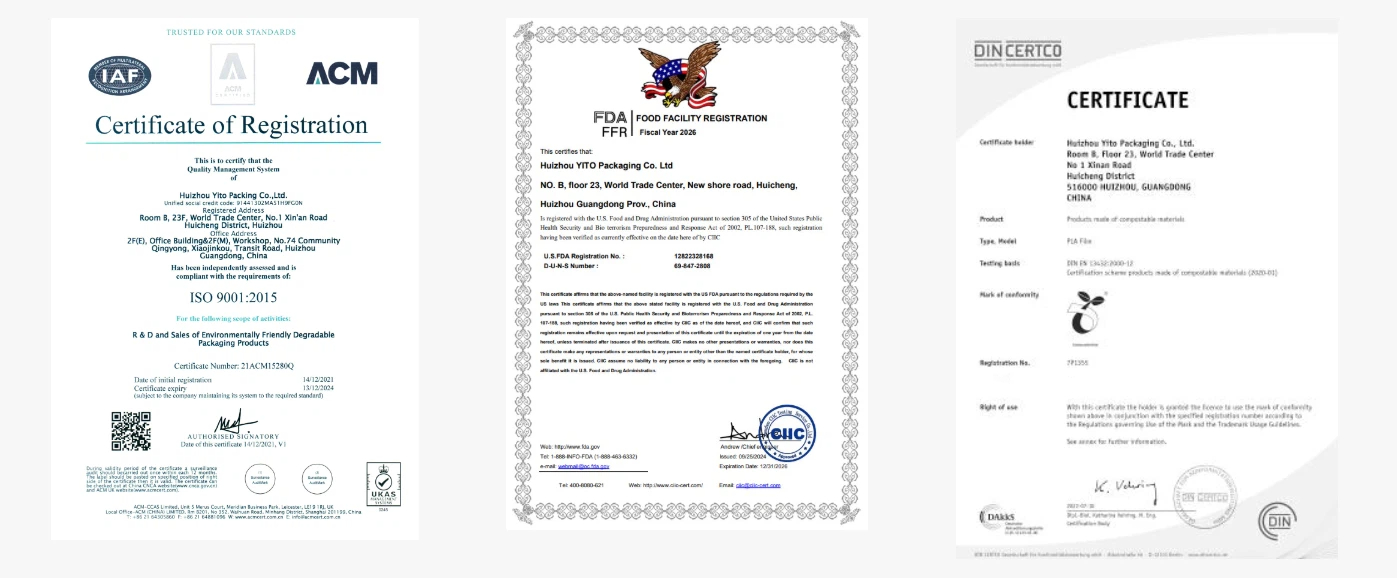
Since 2017, YiTo Packaging has been deeply involved in the field of fresh food and food packaging, focusing on providing customized packaging solutions for fruits and vegetables, market fresh food, baked goods and other categories. We strictly follow the ISO 9001 management system and comprehensively control the whole process of raw material warehousing, production and processing, printing quality inspection, and finished product delivery to ensure the quality stability of each batch of packaging.
For compostable packaging customization projects, we will comprehensively verify the film material and complete packaging structure in accordance with the compliance standards of the customer's target market. It can connect with mainstream international certification standards such as European EN 13432, North American ASTM D6400, and BPI on demand to ensure that products meet local market access requirements.
Conclusion
With the product name "cellophane" alone, consumers cannot judge the correct disposal of waste packaging at all. The correct identification process should be: first confirm whether the substrate is regenerated cellulose, then check the additional structures such as coating, printing, adhesive, label, sealing accessories one by one, and finally combine the existing local waste treatment channels to match the corresponding disposal.
Industrial compostable packaging can only be put into the corresponding professional commercial treatment system; Household compostable packaging must have exclusive qualifications and targeted operation guidelines. When the material and certification information are vague, subjective processing can easily lead to wrong packaging and garbage classification system.
YiTo Packaging always takes the complete structure of the finished product as the core, and carefully evaluates the environmental protection attributes of the product. We not only check the qualification of the basic cellulose film, but also comprehensively test the compliance of all additional accessories, and give accurate and practical waste treatment guidelines in combination with the real structure of the packaging. Clear and transparent product information can guide consumers to scientifically classify, dispose of packaging waste in compliance with regulations, and practice the concept of green environmental protection.
FAQ
Are all eco-friendly cellophane bags biodegradable?
Not really. "Cello" is just a common name for transparent packaging, and does not have any material reference significance. Some of the transparent bags on the market are made of degradable recycled cellulose, and a large number of products are ordinary plastics such as polypropylene and polyethylene. The core of identifying materials is to view written material announcements, rather than relying on subjective judgments on appearance.
Does biodegradable equate to compostable?
The two cannot be equated. Biodegradable is a broad description of material attributes, and the applicable scenes are blurred. Compostable is an accurate compliance attribute, and the appropriate degradation must be clearly marked, and at the same time, it has the official testing qualification of the corresponding finished product as a support.
Will industrial compostable packaging bags fit in a home compost bin?
Household composting is only allowed when the finished packaging bag also holds an exclusive qualification certificate for home composting. Professional commercial composting facilities can provide higher and more stable temperature and standardized process control, which cannot be achieved in ordinary home composting scenarios.
How long does cellophane take to break down?
The degradation cycle of cellophane has no fixed value and will be affected by multiple factors. Film thickness, surface coating, printing ink, temperature and humidity, oxygen content, flora activity and compost maintenance will directly change the degradation rate. All publicity labeling the degradation time must specify the corresponding product specifications and tests.
Can printed cellophane be composted?
Yes, but only if the entire printing system is included in the scope of compliance testing. The certification qualification of the blank original film cannot cover the packaging of printed finished products with different inks, printing coverage, and primer protection layers. The compostable attributes of the complete set of structures need to be verified separately.
Request free samples to test clarity, flexibility, and sealing performance in your real packaging conditions.
Related Products


Post time: Jul-27-2026