
Buying biodegradable cellophane food bags sounds easy—until the quotations arrive. Different cellophane bag suppliers may use the same wording for different films. The product name should never be the approval standard.
A reliable specification connects the food, shelf life, food packaging barrier requirements, film grade, bag structure, sealing, finished composition, compliance documents, compostability evidence, and production controls. This guide helps B2B buyers compare suppliers and move from trials to production.
Approve the Cellophane Bag Specification
“Biodegradable cellophane bag” is a search phrase, not a complete specification. Suppliers may use it for different polymers, thicknesses, coatings, structures, printing systems, and certification scopes.
Approve the application, grade, finished structure, performance target, document coverage, and production tolerance together. Otherwise, a low quote may hide thinner film, a substituted polymer, weak barriers, or certificates covering only plain base film.
Before comparing prices, give every supplier the same food type, dimensions, thickness, closure, printing, volume, market, destination, and compliance requirements.

Define the Food Packaging Application
Start with the food, not a phrase such as “high barrier.” Dry snacks may need moisture protection. Oily foods need grease resistance and reliable seals. Coffee, tea, herbs, and spices need aroma retention. Oxidation-sensitive products may need stronger oxygen protection.
A local-retail bag faces fewer demands than export packaging exposed to warehouses, humidity, long routes, and extended display. Filling matters too. Manual operators want easy opening and manageable static; automatic lines need suitable stiffness, feeding, positioning, and sealing speed.
|
Factor |
Question |
Buyer Benefit |
| Food | Dry, oily, aromatic, sharp-edged, or oxidation-sensitive? | Prevents quality loss |
| Shelf cycle | How long must quality remain acceptable? | Keeps the barrier realistic |
| Distribution | Local, export, warehouse, or e-commerce? | Reduces damage and exposure |
| Filling | Manual, semi-automatic, or automatic? | Improves output and controls rejects |
Verify the Material Before Comparing Prices
The words “cello” and “cello bag” are used loosely. A clear appearance proves little because regenerated cellulose, OPP, BOPP, CPP, and PE may look similar.
Ask for a declaration showing the polymer, film grade, product code, thickness, and composition. Is the film genuine regenerated cellulose, or conventional plastic sold under a familiar name? Check before comparing prices.

Check the Finished Bag Structure
Commercial food bags rarely use untreated film alone. They may include a moisture-resistant coating, heat-seal layer, primer, ink, adhesive strip, label, or closure. These additions affect sealing, compliance, compostability, and disposal.
A certificate for uncoated film should not automatically cover a printed, coated, self-adhesive, or converted bag. The supplier should show the finished cellophane bag structure and document scope.
|
Element |
Function |
Evidence |
| Base film | Main polymer and mechanical properties | Polymer, grade, code, and thickness |
| Coating | Moisture resistance or heat sealing | Coating description and technical data |
| Ink | Branding and information | Ink statement and print assessment |
| Adhesive or closure | Sealing or resealing | Composition and compatibility statement |
| Finished bag | Product actually purchased | Final specification and approved sample |
Plant-based origin does not automatically prove food safety, compostability, or shelf-life performance.
Biodegradable and compostable are related, but they are not interchangeable. Biodegradable describes a material’s ability to break down biologically, but it does not define the required environment, timeframe, or acceptance criteria. A compostable claim should identify whether it applies to industrial or home composting and should be supported by evidence covering the finished bag, not only the base film. Buyers should record the applicable standard, certificate holder, film grade, finished structure, and intended disposal route in the specification.
Quantify Packaging Performance
Bag style should solve a real need. Flat bags suit lightweight products. Side-gusset and flat-bottom bags add volume and standing stability for nuts, coffee, and snacks. The extra material should improve filling or shelf presentation.
Self-adhesive closures suit manual packing and short runs. Heat seals provide stronger closure and clearer tamper evidence, but equipment trials remain necessary.
Standard dimensions can reduce MOQ, tooling cost, and trial risk. Use custom sizing when it improves fit, material use, packing speed, protection, or appearance.
According to the needs of loading and display, choose the bag style reasonably
Side-gusset and flat-bottom bags offer more volume and standing stability for nuts, coffee, and snacks. They use more material, so the extra cost should be justified by filling efficiency or shelf presentation.
Self-adhesive closures suit manual packing or smaller runs. Heat seals are stronger and more tamper-evident, but equipment compatibility and stable parameters must be confirmed.
For a first order, standard sizes can reduce MOQ and trial risk. Use custom dimensions only when they improve material use, packing efficiency, protection, or appearance.
Verify Food Compliance and Compostability Separately
Food-contact compliance and compostability are separate. Food-contact evidence shows whether a material suits defined food-contact conditions. Compostability evidence concerns breakdown in a specific treatment environment.
Neither replaces the other: compostability does not prove food safety, and food-contact evidence does not prove compostability.
|
Approval Area |
What It Supports |
What It Does Not Prove |
| Food-contact compliance | Suitability under stated conditions | Compostability |
| Industrial compostability | Breakdown in industrial systems | Home or marine degradation |
| Home compostability | Breakdown under defined home conditions | Universal local acceptance |
| Base-film certificate | Qualification of a raw film | Printed or converted bags |
| Finished-bag evidence | Relevance to the purchased structure | Uses outside its scope |
Documents should match the food, contact period, temperature, market, grade, thickness, coating, printing, adhesive, and validity. Industrial compostability does not prove home compostability or local acceptance.

Compare Total Cost
Suppliers should quote the same polymer, grade, thickness, dimensions, style, coating, printing, quantity, destination, and trade terms.
Separate one-time costs from repeat-order costs. Plates, cylinders, tooling, samples, artwork, and inspection can make the first order look expensive even when later orders are competitive.
Compare cost per usable package, not unit price alone. Include freight, duties, labour, rejects, downtime, idle stock, repacking, complaints, and food loss. A higher-priced bag may cost less overall if it runs faster, seals better, and protects food consistently.
Validate Before Mass Production
First confirm the polymer, grade, thickness, coating, clarity, odour, and heat-seal response. Then test the finished food packaging bag with real food, normal fill weight, intended closure, and actual equipment.
Watch opening, filling speed, seal consistency, appearance, aroma, moisture, and food quality. Simulate transport where relevant.
For automatic lines, record feeding, sealing settings, speed, downtime, static, and rejects. After approval, freeze the grade, tolerance, dimensions, structure, coating, printing, sealing range, compliance file, and signed sample.

Evaluate the Cellophane Bag Supplier
A capable supplier should be able to connect the raw film, converting process, compliance documents, quality controls, and commercial terms. General claims such as “professional manufacturer” or “high quality” are not enough without product-specific evidence.
| Review Area | What to Request | Buyer Benefit |
|---|---|---|
| Material traceability | Film supplier, grade, batch code, thickness, and coating | Reduces material substitution risk |
| Converting capability | Bag styles, printing, sealing, tolerances, and equipment | Confirms production compatibility |
| Change control | Written notice before changing film, coating, ink, or adhesive | Protects repeat-order consistency |
| Quality control | Inspection criteria, batch records, and approved sample | Creates measurable acceptance standards |
| Commercial fit | MOQ, lead time, capacity, payment terms, and contingency plan | Reduces supply and inventory risk |
Request the Right Supplier Documents
The aim is not to collect the thickest file package. Every document should refer to the bag being purchased.
|
Document |
Procurement Value |
| Material declaration | Confirms polymer, grade, code, and composition |
| Technical data sheet | Provides thickness, barrier, and sealing data |
| Finished-bag specification | Defines size, structure, printing, and tolerances |
| Food-contact documents | Support the intended food and market |
| Compostability evidence | Identifies the applicable grade and validity |
| Ink and adhesive statements | Clarify added components |
| QC plan and approved sample | Set inspection and production standards |
Why Choose YiTo Pack?
YiTo Pack supplies flat, side-gusset, centre-seal, three-side-seal, self-adhesive, and heat-sealable biodegradable cellophane food bags. Size, thickness, structure, and printing can be customised for manufacturers, brands, packers, wholesalers, importers, and private-label customers.
Projects move through specification review, material confirmation, barrier assessment, sampling, real-food testing, heat-seal trials, and print approval.
Custom samples can usually be arranged in around seven days. Production may take roughly 15–20 days after approval, depending on material, style, printing, and quantity. Confirm timing for each order.
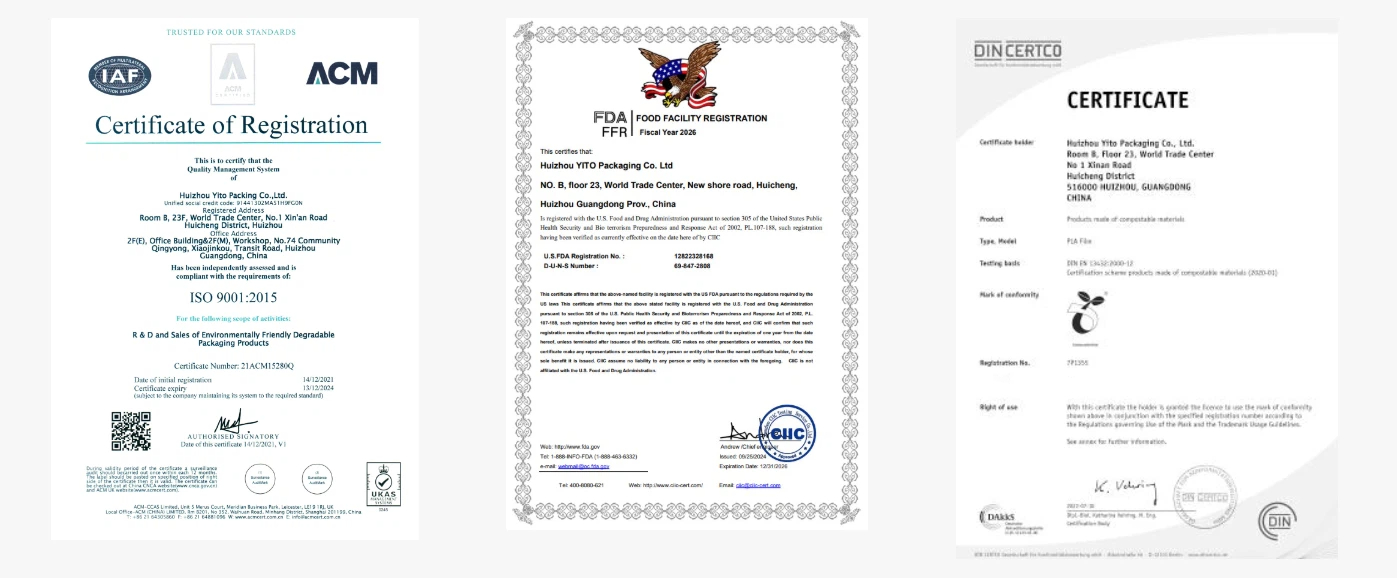
For industrially compostable projects, available evidence related to EN 13432, ASTM D6400, ASTM D6868, or BPI can be reviewed by material and market. Evidence must match the actual order; not every converted structure is automatically covered.
Conclusion
Biodegradable cellophane food bags become dependable only when the material, coating, structure, barrier, sealing, compliance evidence, and tolerances refer to the same finished package.
The lowest unit price is not always the lowest project cost. Base-film certification does not automatically cover every printed or converted product. Approval should combine real-food testing, equipment validation, document review, and a frozen production specification.
Share the food category, fill weight, shelf-life target, storage conditions, bag style, sealing method, target market, printing needs, and estimated volume. YiTo Pack can then define the structure, organise the compliance file, and prepare a controlled test plan.
FAQ
Can One Bag Suit Every Food?
No. Moisture, oil, aroma, oxidation sensitivity, fill weight, temperature, and shelf life affect the right film, coating, thickness, and structure.
Are Biodegradable Cellophane Bags Fully Moisture-Proof?
Not necessarily. Moisture resistance depends heavily on the film grade and coating. Uncoated regenerated cellulose behaves differently from moisture-resistant or heat-sealable coated film. Instead of relying on a general “waterproof” claim, ask for relevant barrier data and test the finished bag with the actual food under expected storage conditions.
Can Base-Film Evidence Cover Printing?
Not automatically. Ink, coating, adhesive, labels, thickness, and converting may change the scope. Review the printed bag separately.
What Should Be Tested Before a Bulk Order?
Run a packing trial using the final bag, real food, normal fill weight, intended sealing equipment, and expected storage conditions. Check bag opening, static, odour, clarity, seal strength, moisture behaviour, filling speed, transport resistance, and reject rate. Once the test passes, keep a signed reference sample and freeze the approved material, thickness, structure, dimensions, printing, and sealing parameters.
Can Existing Sealers Be Used?
Often, yes, especially with coated cellulose films. Still, run a trial and confirm temperature, pressure, dwell time, seal width, and speed.
Related Reading
Are Cellophane Bags Biodegradable? The Complete Material Science Answer
Biodegradable Cellophane Gift Bags: Custom Options for Retail & Brand Packaging
Biodegradable Cellophane Cone Bags: Shapes, Sizes & Wholesale Supply
Ready to test a compostable produce bag for your application?
Related Products


Post time: Jul-31-2026