
Ordering an “A4” or “A5” cellophane bag sounds simple, but the size name alone does not always tell you whether the finished bag will actually fit your product. Add a backing card, envelope or a little product thickness, and the same nominal size can feel very different once you start packing.
For B2B orders, this matters most before bulk production. YiTo Pack recommends using A3, A4, A5, A6, 5x7 and 9x12 as useful reference points, then checking the final bag against the real packed product.
Key Takeaways
- · A3, A4, A5 and A6 are reference formats, not fixed finished bag sizes.
- · A4 measures 210 × 297 mm; 9x12 measures 228.6 × 304.8 mm.
- · Inserts, backing cards and product thickness may require extra clearance.
- · Self-seal flap length should be checked separately.
- · Plastic-bag dimensions should be rechecked when switching to regenerated cellulose.
A3/A4/A5/A6/5x7/9x12 Cellophane Bag Size Reference
Here is the quick reference most buyers need first.
|
Size |
Reference Product Dimensions |
Imperial Size |
What to Check |
| A6 | 105 × 148 mm | 4.13 × 5.83 in | Allow a little packing room |
| A5 | 148 × 210 mm | 5.83 × 8.27 in | Include envelopes or backing cards |
| A4 | 210 × 297 mm | 8.27 × 11.69 in | Product size is not always bag size |
| A3 | 297 × 420 mm | 11.69 × 16.54 in | Leave enough loading space |
| 5x7 | 127 × 177.8 mm | 5 × 7 in | Confirm the finished dimensions |
| 9x12 | 228.6 × 304.8 mm | 9 × 12 in | Slightly larger than A4 |
Think of this table as a starting point. Once you know the product format, the next step is checking what else goes inside the bag.

Before Choosing a Size, Consider Your Application
The right biodegradable cellophane bag size depends on more than the product's front dimensions. Cookies may require extra room for product thickness, flower packaging often needs longer formats, gift packs may include inserts or backing cards, and retail packaging must balance product fit with shelf presentation. Start with the application, then confirm the finished bag dimensions using the actual packed product.
Cookies & Bakery
5×7, A6 and A5 are useful starting formats for cookies and dry bakery products. Allow additional clearance for product thickness and sealing.

Gift Packaging
A6 to A3 formats can cover cards, gift sets and branded packs. Include inserts, backing boards and decorative components when calculating the final size.

Flower & Bouquet Packaging
A3 and custom large-format structures are better suited to flowers and bouquets where extra width and usable length are required.

Retail Display
Choose a size that keeps the product visible without leaving excessive empty film. Labels, inserts and printed branding should be included in the sample check.

How A6 and A5 Sizes Work in Real Packaging
A6, at 105 × 148 mm, is often used for smaller cards, inserts and stationery. For a very thin item, choosing the bag is usually straightforward as long as there is enough room to slide the product in comfortably.
A5 is 148 × 210 mm, and this is where small differences begin to matter. A plain A5 card is one thing; the same card with an envelope and backing board is another.
You do not need to overcomplicate the calculation. Put together everything that will stay inside the final pack, measure it once, and use that as your starting point.
A4 Biodegradable Cellophane Bags Need Extra Attention
A4 deserves more attention because buyers often use the same term for both the product and the bag.
The reference size is 210 × 297 mm, or about 8.27 × 11.69 inches.
Suppose you are packing an A4 document with a stiff backing board. The front still looks like A4, but the finished pack is thicker. A bag measuring exactly 210 × 297 mm leaves almost no room to slide the product in.
This is where many sizing problems begin.
If you ask YiTo Pack for an A4 biodegradable cellophane bag, it is more useful to send the packed product dimensions than simply write “A4”. A few millimetres of practical clearance can make the difference between easy packing and a bag that feels uncomfortably tight.
A 9x12 format is 228.6 × 304.8 mm, so it gives more room than A4. It can suit some A4 products with backing boards or inserts, although a thin A4 item may look too loose inside it.
So the question is not simply “A4 or 9x12?” It is whether the extra space actually suits the product.
A3 Bags: Give Larger Products Room to Load
A3 measures 297 × 420 mm.
With a larger print or document pack, you quickly notice whether the opening is comfortable to use. If the operator has to bend the product, angle it repeatedly or work it slowly into the bag, the fit is probably too close.
You do not need a huge amount of extra space, either. Too much clearance can leave the film looking loose around a flat product.
For A3 projects, a quick packing test usually tells you more than another round of calculations.
Standard Size or Custom Size?
If one of the common sizes already fits well, use it. There is no need to customise every project.
What matters is knowing exactly what the quoted dimensions mean.
A flat bag shown as 220 × 310 mm is normally listed by width and length. A gusseted bag may look like 150 × 50 × 250 mm, where the middle figure represents the gusset.
For self-seal bags, check the flap as well. A quotation such as 215 × 305 mm + 40 mm flap is much clearer than a single overall length because you can see how much space belongs to the product and how much belongs to the closure.
If the nearest standard bag is only slightly larger and still looks good, it may be perfectly suitable. Custom sizing becomes more useful when the standard choice is clearly too tight or leaves a lot of empty film.

How Much Extra Clearance Should You Allow?
This is one of the questions buyers ask us most often.
For thin cards, prints and similar flat goods, around 5–10 mm of extra width and length can be a useful starting point.
If the pack includes an envelope, backing card or several inserts, you may want to start closer to 10–20 mm of working clearance.
These numbers are not fixed rules. A soft flat item and a rigid product with the same front dimensions will not necessarily need the same bag.
Once the product becomes noticeably thicker, it is also worth asking whether a flat bag is still the right structure. A gusseted bag has expandable side panels, giving thicker goods more depth without simply making the whole bag much wider.
Before deciding, measure the complete pack at its widest, tallest and thickest points.

Confirm the Material Before Finalising the Size
Size is only half of the specification.
“Cellophane” and “cello bag” are sometimes used for different transparent films, so buyers should also confirm what the bag is actually made from.
YiTo Pack supplies bags based on regenerated cellulose film, with film thickness, coating, printing and closure selected around the project.
One point is especially important if you are replacing BOPP or another plastic bag.
Regenerated cellulose does not behave exactly like conventional plastic film. It has different stiffness and converting characteristics, so a very tight plastic-bag specification should not simply be copied across.
If you already have an existing plastic bag, send the product and current dimensions together. The cellulose version can then be checked with the actual product rather than assumed to fit in exactly the same way.
For Australian projects, you can also see Biodegradable Cellophane Bags in Australia: Import Requirements & Sourcing for more detail on material, environmental claims and sourcing requirements.
Why Choose YiTo Pack
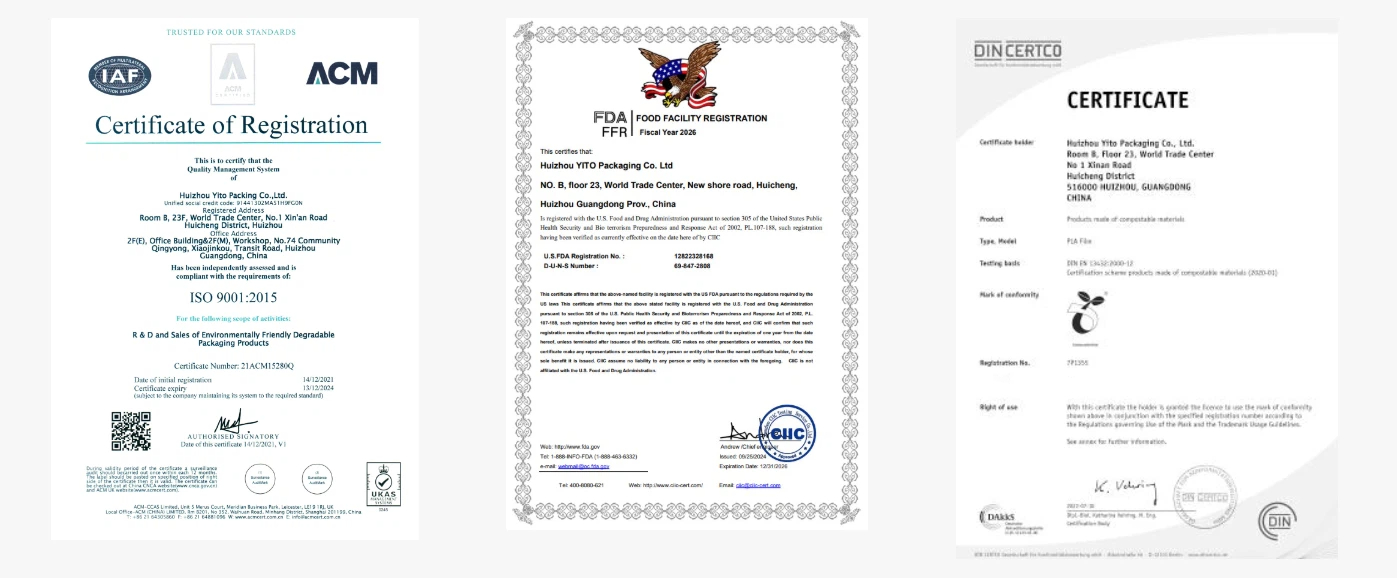
YiTo Pack combines material knowledge, custom converting, compliance support and export experience to help B2B buyers move from packaging concept to approved bulk production.
1. Material Expertise
Cellulose Film & Biodegradable Packaging Solutions
We work with regenerated cellulose film and biodegradable packaging structures for food, retail and branded applications. Depending on the selected material and finished structure, projects can be supported with compostability documentation related to AS 4736, AS 5810, EN 13432, ASTM D6400 and BPI.
2. Custom Manufacturing
Size / Thickness / Printing / Structure
Bag size, film thickness, printing, coating, closure and finished structure can be customized around your product and packing process. For fibre-based material sourcing, FSC/PEFC documentation can also be supported where applicable, helping brands connect packaging design with responsible material sourcing.
3. Quality & Compliance Control
Food Contact Testing + Factory Inspection
YiTo Pack coordinates material specifications, sample approval and finished-product inspection before bulk production. Food-packaging projects can be supported with applicable documentation such as FDA, EU 10/2011 and LFGB, while ISO 9001 supports consistent quality-management processes.
4. Global Export Experience
Supporting B2B Customers Worldwide
From specification confirmation and samples to export packing and repeat orders, YiTo Pack supports international procurement projects across different markets. For Australian compostable-packaging programs, AS 4736 and AS 5810 are especially relevant, while other documentation can be matched to the destination market and final packaging structure.
Conclusion
A3, A4, A5, A6, 5x7 and 9x12 are useful reference formats, but they should not be treated as universal finished bag dimensions. The correct biodegradable cellophane bag size depends on the complete packed product, including its width, height, thickness, inserts and closure requirements.
Before bulk production, confirm the usable bag dimensions, flap or gusset where applicable, and test the proposed size with the actual product. If no standard format gives the right fit, YiTo Pack can review a custom regenerated cellulose bag specification and provide samples for approval.
FAQ
What size biodegradable cellophane bag fits an A4 product?
A4 measures 210 × 297 mm, but the finished bag usually needs some additional space for insertion, product thickness and closure. Measure the complete packed product before deciding the final size.
Is an A4 cello bag exactly 210 × 297 mm?
Not always. “A4 cello bag” may refer to a bag close to A4 dimensions or a bag designed to hold an A4 item. For an order, use the approved finished dimensions.
Does the flap count as part of the bag length?
It depends on how the supplier lists the size. Ask for the usable body length and flap length separately so the specification is clear.
Can biodegradable cellophane bags be made in custom sizes?
Yes. Custom sizing is useful when standard formats are too tight, leave too much empty space or do not suit the required printing and packing setup.
Related Articles
Are Cellophane Bags Biodegradable? The Complete Material Science Answer
Biodegradable Cellophane Food Bags: Material Specs & Compliance for B2B Buyers
Biodegradable Cellophane Cone Bags: Shapes, Sizes & Wholesale Supply
Not sure which cellophane bag structure fits your product? Send YiTo Pack your product type, filled weight, preferred closure, artwork and target market for an initial material and structure recommendation.
Related Products


Post time: Aug-12-2026