
Custom biodegradable blueberry packaging is not a simple material switch—it is a cold chain packaging system decision that directly affects fruit damage rate, shelf life, logistics efficiency, and retail acceptance.
At YiTo Pack, we design and manufacture compostable blueberry packaging systems for growers, exporters, and retail brands who need to balance sustainability compliance, structural performance, and scalable production economics.
In real supply chain applications, switching from conventional PET packaging to engineered compostable systems can significantly reduce plastic usage while maintaining stable performance under 0–4°C cold chain environments and high-humidity transport conditions.
Key decision factors you must evaluate:
- · Structure design affects fruit damage more than material selection
- · MOQ is driven by tooling and printing systems, not supplier flexibility
- · Certification determines retail and export approval
- · Printing method can influence compostability compliance
- · Cold chain humidity is the most common hidden failure point
Packaging Decision Matrix: Choose Structure Before Material
| If your top priority is... | Start with this structure | Typical material | What you're trading off |
|---|---|---|---|
| Keeping fruit intact over long transport | Molded fiber clamshell | Bagasse fiber | No transparency — fruit isn't visible on shelf |
| Shelf appeal / brand visibility | Transparent vented clamshell | PLA sheet | More sensitive to heat above ~55°C during storage/transit |
| Export with long, humid transport legs | Vented punnet system | Fiber + hybrid film | Less rigid stacking than a full clamshell |
| Running large volumes at lower unit cost | Standard tray system | Fiber / PLA hybrid | Less design flexibility for custom shapes |
Engineering insight from YiTo Pack: in almost every project we've worked on, ventilation design ends up mattering more for shelf life than which material you pick — the structure decision usually comes first, and the material follows from it.

MOQ in Blueberry Packaging Is a Production Constraint

A common question we get early on is simply "What's your "MOQ?"—but the honest answer depends on which part of the production setup you're changing, not just the quantity you want.
Here's how it typically breaks down in our production:
| Scenario | MOQ Range | Why |
|---|---|---|
| Using an existing mold + digital printing | 1,000–3,000 pcs | No new tooling or print plates needed |
| Existing mold + offset printing | 3,000–5,000 pcs | Print plate setup cost needs to be spread across the run |
| Developing a new custom mold | 5,000–10,000 pcs | Mold tooling cost is amortized into the unit price |
If you're placing a full pallet-scale export order, that often lands around 21,600 units—which usually sits comfortably within the custom mold range above, especially once printing is factored in.
If your order volume is below the relevant range, the unit cost goes up — not because of pricing policy, but because tooling and plate costs get spread across fewer units.
Production Lead Time (Real Manufacturing Cycle)
Once your design and files are confirmed, here's roughly what to expect:
- File review: 1–3 days
- Sample production: 4–8 days (existing mold)
- New mold development: 12–18 days
- Bulk production: 10–20 days
- QC + shipping preparation: 3–5 days
Add these up, and most projects land in one of two ranges: 4–6 weeks if you're using an existing mold or 6–8 weeks if a new mold needs to be developed — the difference mostly comes down to that 12–18 day tooling step.
Cold Chain Performance & Real Test Data
Under our standard 0–4°C / 85–90% RH / 72-hour transport simulation, YiTo Pack testing showed that optimized packaging structure helped reduce fruit damage from 13.69% to 2.87% and weight loss from 8.43% to 0.92%.

PLA (Polylactic Acid)
- · Industrial compostable material
- · Stable in cold chain (0–4°C)
- · Softening risk above ~55°C
- · Best for transparent retail clamshells

Molded Fiber (Bagasse / Pulp)
- · Excellent ventilation performance
- · High stacking strength
- · No transparency
- · Best for export logistics and damage reduction

PET
- · High structural stability
- · Not compostable
- · Used as performance comparison baseline

Cold Chain Performance & Test Results
From our YiTo Pack testing results, we consistently find that structural design failures—especially ventilation imbalance and stacking weakness—cause more fruit loss than material differences in biodegradable packaging systems.
Printing, Design Files & Certification Verification
Printing Methods
- · Flexographic printing → high volume stability
- · Digital printing → low MOQ & sampling flexibility
Critical compliance risks:
- · Solvent-based inks → may fail compostability testing
- · PE coatings → invalidate certification
- · Non-certified adhesives → affect full-package compliance
Not all sustainable packaging requirements are aligned across global markets. Selecting the wrong material–certification combination for a specific destination can lead to retailer rejection, even when product quality meets expectations.
The comparison below outlines typical expectations in major blueberry export markets, based on current regulatory frameworks and retailer procurement standards.
| Market | Recommended Material | Commonly Requested Certification | Retail Expectation | Key Consideration |
|---|---|---|---|---|
| Germany / Netherlands | PLA | EN 13432 | Early retailer approval (6–8 weeks prior) | Must pass pre-shipment compatibility testing for container–label–lid system |
| France | Home-compostable PLA | EN 13432 + NF T51-800 | Higher sustainability threshold than EU baseline | Industrial-only compostability is often not sufficient |
| UK (post-Brexit) | rPET or PLA systems | EN 13432 or OPRL guidelines | Chain-specific sustainability scoring required | Requirements vary significantly by retailer group |
| Australia / New Zealand | PLA or molded fiber systems | AS 5810 + EN 13432 | Preference for home-compostable certification | Industrial-only PLA solutions may not fully comply |
| North America (premium retailers, e.g., Costco, Whole Foods) | PLA or rPET systems | ASTM D6400 (preferred) | Supplier sustainability assessment required | Retailer-led standards often stricter than federal regulation |
| North America (general retail) | rPET dominant | No unified mandatory standard | Recyclability preferred over compostability claims | Limited composting infrastructure affects PLA acceptance |
When exporting to multiple regions, packaging design should always be aligned with the strictest certification and compliance requirement within your target markets, rather than the most common one.
For a detailed breakdown of compostable blueberry packaging systems and certification support by region, you can refer to YiTo Pack’s blueberry packaging solutions page.
Design file requirements (important before sampling):
- · Vector die-line (AI/PDF/EPS)
- · CMYK color mode (not RGB)
- · Minimum 3mm bleed for fiber structures
- · Font outlines required
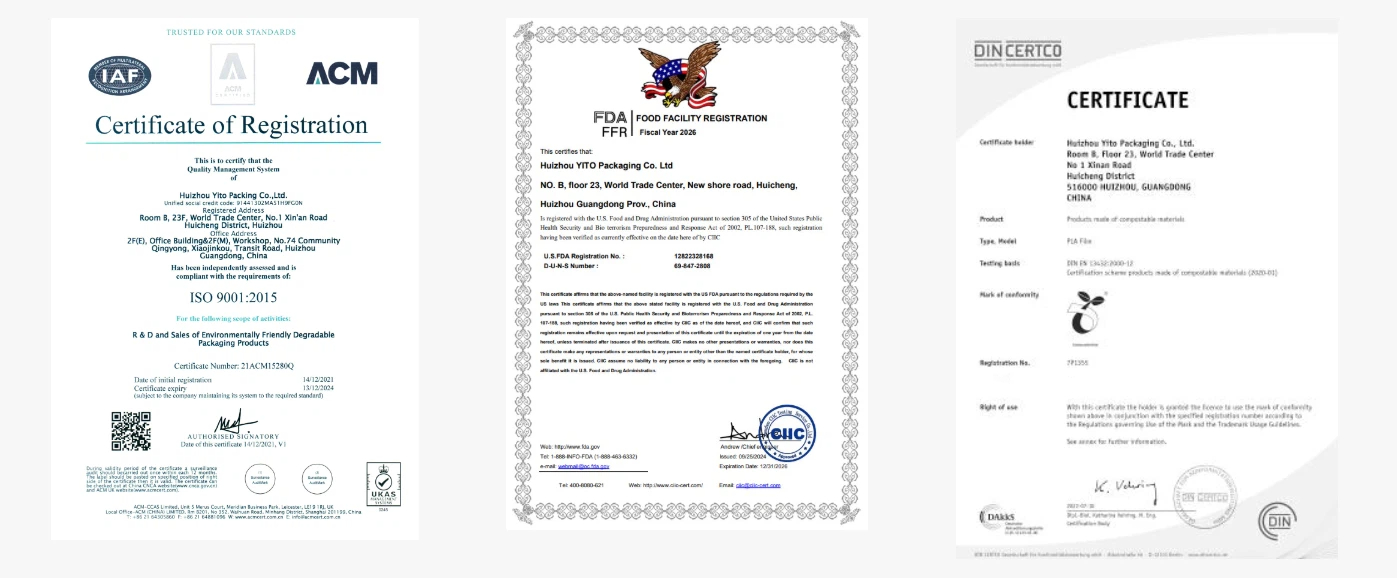
Certification system (what actually matters):
- · ASTM D6400 → US compostability standard
- · EN 13432 → EU compliance
- · BPI certification → finished product verification
- · TÜV OK Compost → industrial/home compost validation
Case Analysis: A Blueberry Supplier Replaced PET Clamshells with YiTo Pack’s Compostable Packaging
A large-scale blueberry supplier needed to replace traditional PET clamshells as its retail partners introduced stricter sustainability and plastic-reduction requirements across the supply chain.
The client wanted to upgrade packaging without changing its existing packing workflow, stacking format, or retail display layout. YiTo Pack developed an industrially compostable PLA clamshell based on the client’s original dimensions and stacking specifications, while optimizing the vent layout to improve cold-chain airflow and moisture control.
During cold-chain simulation testing, the optimized packaging structure helped reduce blueberry defect rate to 2.87% and weight loss rate to 0.92%. The clamshell was also paired with compostable labels and compatible adhesive solutions to support full-package compliance review.
The final packaging system was reviewed as a complete solution, covering material selection, structural design, printing, adhesive, label compatibility, EN 13432 compostability requirements, and food-contact compliance.
With this solution, the client successfully upgraded from conventional PET packaging to compostable blueberry packaging while keeping its original packing process, retail display format, and cold-chain operation standards unchanged. The project helped reduce plastic packaging use and supported the retailer’s sustainability requirements without disrupting operational efficiency.
Common Failure Points in Compostable Blueberry Packaging
Most issues we see with compostable blueberry packaging aren't material failures. They're the result of a structural or process decision that made sense on its own, but didn't account for how the package would actually be used.
Condensation buildup
This usually shows up when a structure that looks fully sealed — often chosen for shelf appeal — doesn't have enough airflow for the humidity levels blueberries are shipped under. The moisture has nowhere to go, and mold follows within days.
Crushed fruit at the bottom of pallets
This tends to happen when a lighter or more "eco-friendly-looking" structure is chosen without re-testing stacking strength under real pallet weight — the packaging looks fine on a shelf, but wasn't built for what's stacked on top of it during transport.
Labels that start peeling mid-transit
This is almost always a mismatch between the fruit adhesive label and the humidity the package will see — and it's the kind of thing that can pass a quick certification check on the base material, while the assembled product (label included) was never actually tested together.
Fruit that decays faster than expected on the shelf
Counterintuitively, this often comes from over-sealing a package to make it look "premium" or fully protected — when in reality, blueberries need some airflow, and a fully sealed compostable package can trap moisture just as easily as a sealed plastic one.
None of these are material problems. They're all decisions made earlier in the process — about structure, stacking, labeling, or sealing — that didn't get tested against real transport conditions.
How YiTo Pack Works With You
1. Share Your Packaging Requirements
Send us your target blueberry weight, container size, material preference, order quantity, destination market, and any retailer certification requirements.
2. Structure & Material Recommendation
YiTo Pack reviews your cold-chain conditions, shelf display needs, stacking requirements, and compliance targets, then recommends the most suitable packaging structure and material option.
3. Design File & Quotation Confirmation
After confirming the size, mold option, printing method, label requirements, and MOQ, we provide a quotation and check your artwork files, including dieline, color mode, bleed, and logo placement.
4. Sampling & Testing
Samples are produced for visual review, lid fit, ventilation, stacking strength, label adhesion, and cold-chain compatibility before bulk production.
5. Bulk Production
Once samples and files are approved, we arrange mass production, including molding, printing, labeling, quality inspection, and packing.
6. Quality Check & Shipment
Before shipment, we check packaging appearance, dimensions, stacking performance, printing quality, and packing condition to make sure the order is ready for transport and retail use.
Why Global Blueberry Suppliers Choose YiTo Pack
Selecting blueberry packaging is not only about finding a container supplier — it requires a partner who understands material performance, cold-chain requirements, compliance documentation, and scalable production.
At YiTo Pack, we support growers, exporters, distributors, and fresh produce brands with complete compostable packaging solutions from concept validation to mass production.
Our Packaging Capabilities
15+ Years of Packaging Experience: Experience in sustainable packaging development, material selection, and customized packaging projects.
Global Export Experience: Supporting customers across multiple international markets with packaging solutions aligned with different retail and regulatory requirements.
One-Stop Compostable Packaging Solutions: PLA clamshells, punnets, labels, films, and customized packaging components designed as complete systems.
OEM & ODM Customization Support: Custom sizes, structures, ventilation design, branding, and packaging optimization based on your supply chain.
Fast Sampling & Project Development: Rapid prototyping and sample support help buyers verify packaging performance before bulk production.
Stable Supply Chain & Quality Control: Consistent production capacity with quality management systems for long-term packaging programs.
Food Contact & Compostability Documentation Support: Available documentation including EN 13432, ASTM D6400, FDA food contact compliance, and related testing support based on project requirements.
FAQ
Q: What is the MOQ for custom biodegradable blueberry packaging?
A: MOQ ranges from 1,000–3,000 pcs (existing mold) to 5,000–10,000 pcs (custom mold systems).
Q: Does compostable packaging affect blueberry shelf life?
A: Not if properly engineered. Ventilation design and humidity control are more critical than material type.
Q: What certifications are required for export?
A: Common certifications include ASTM D6400, EN 13432, BPI, and TÜV OK Compost, depending on the market.
Q: Does printing affect compostability certification?
A: Yes. Ink type, coating, and adhesive system can all impact final certification status.
Q: Can I use my existing PET clamshell mold for PLA packaging?
A: In some cases, yes. We need to check the mold size, lid fit, vent design, and material thickness before confirming.
Q: Can you certify the full package, including the label and printing?
A: Yes, certification review should cover the assembled packaging system, including the container, ink, adhesive, and label when required by the retailer.
Related Blueberry Packaging Guides
Ultimate Guide to Blueberry Packaging Materials: Biodegradable vs Plastic: Compare material options before choosing your packaging system.
PLA vs PET for Blueberry Packaging: Which Is Better?:Understand which material fits your cold chain and retail needs.
Blueberry Packaging Size Guide: Punnets, Lids, and Clamshells:Choose the right size and structure for different blueberry pack formats.
Request free samples to test ventilation, stacking strength, clarity, and label adhesion in real cold-chain conditions.
Related Products


Post time: Jun-16-2026