
For UK brands and packaging buyers, choosing biodegradable stickers is not simply a matter of replacing a conventional label with a greener material. The label still has to stay attached, work with the packaging, support the environmental claim being made and arrive with documentation that matches the finished specification.
At YiTo Pack, we work from a simple principle:
Labels should be specified for real packaging, not just artwork and material datasheets.
That means looking at the facestock, adhesive, printing, packaging surface and end-of-life requirement together before bulk production.
Key Takeaways
- · Biodegradable, industrial compostable and home compostable are different requirements.
- · The complete sticker matters more than the facestock alone.
- · BS EN 13432 mainly relates to industrial compostability.
- · UK environmental claims should be clear and supported by evidence.
- · Samples should be tested on the actual packaging before production approval.
Biodegradable vs Compostable Labels: What's the Difference?
| Biodegradable Labels | Compostable Labels | |
|---|---|---|
| Definition | Designed to break down through biological processes | Designed to break down under defined composting conditions |
| Disposal Conditions | Depend on the specific material and claim | Industrial or home composting, depending on the specification |
| Standard | No single universal standard covers every biodegradable claim | Standards such as EN 13432 or ASTM D6400 may apply to specific compostable structures |
| Certification | Supporting evidence depends on the environmental claim | Certification or test documentation is commonly required when a specific compostability claim is made |
| Buyer Focus | Confirm what “biodegradable” means for the actual product | Confirm whether the finished label, not only the facestock, is covered |
For packaging buyers, the practical difference is not just terminology. Biodegradable labels and compostable labels should be specified according to the intended disposal route, finished label construction and supporting documentation.
Start With the Environmental Requirement
For buyers comparing biodegradable label and sticker options, the practical starting point is therefore the complete packaging system.
If the pack is intended for industrial composting, the label should support that route. If the sticker is applied to conventional plastic or glass packaging, its end-of-life role may be different.
This early clarification is also one of the first things we review at YiTo Pack. It is easier to match the right material at the beginning than to change the label after artwork and samples have already been approved.

“Biodegradable” is useful as a general description, but it is often too broad to work as a production specification.
A buyer may actually need an industrial compostable label, a home compostable label, or simply a lower-impact alternative to a conventional plastic sticker.
These requirements are not interchangeable.
Industrial compostable materials are designed to break down under controlled commercial composting conditions. Home composting takes place at lower and less consistent temperatures, so separate evidence is normally required.
Bio-based is different again. It describes where the raw material comes from rather than what happens to the material after disposal.
Evaluate the Complete Sticker Structure
A sticker is not a single material.
The visible layer, usually called the facestock, sits on an adhesive and is then printed or finished. Depending on the design, coatings or other surface treatments may also be involved.
A compostable paper, cellulose or PLA facestock therefore does not automatically make the finished printed sticker compostable.
Facestock
Paper is often suitable where a natural, opaque appearance is preferred.
Regenerated cellulose can provide a clear label while using cellulose derived from plant-based sources. PLA is another transparent film option made from renewable feedstocks and is generally associated with industrial composting conditions.
For transparent applications, PLA adhesive labels can be evaluated alongside cellulose-based structures.
The best choice still depends on the package rather than the material name.
Adhesive and Printing
Adhesive is one of the most common areas where a good-looking sample can become a poor production label.
A label that performs well on dry cardboard may behave very differently on a smooth glass bottle, flexible pouch or chilled fruit pack. Low temperature, moisture and condensation can all affect tack and edge adhesion.
Printing should also be reviewed as part of the finished structure. Ink coverage, coatings and other finishing processes may matter when a specific compostability claim is required.
This is exactly why YiTo Pack reviews facestock + adhesive + printing as one specification for custom projects rather than treating them as unrelated purchasing items.
The objective is simple: the finished label should work on the real package and support the claim the customer intends to use.

BS EN 13432 and Certificate Scope
BS EN 13432 is widely referenced in the UK and Europe when discussing compostable packaging.
In practical terms, it is mainly associated with packaging designed for industrial composting and considers factors such as biodegradation, disintegration and the effect of the material on the resulting compost.
For a buyer, however, the most important question is not simply:
“Do you have EN 13432?”
It is:
“What exactly does the supporting document cover?”
A certificate or test report may relate to a particular PLA grade, cellulose film, adhesive or finished construction. Buyers should make sure the material listed in the documentation is the same material being quoted for the project.
If only the facestock is covered, it should not automatically be assumed that the adhesive, ink and finished printed label fall under the same scope.
BS EN 13432 also does not automatically mean home compostable. Home composting uses different conditions and normally requires evidence specifically developed for that environment.
When the whole packaging system is intended for composting, a dedicated compostable label structure should be reviewed together with the main pack.
UK Green Claims Require Careful Wording
Environmental claims should match the evidence behind the label.
Terms such as “eco-friendly,” “biodegradable” and “100% compostable” can be misleading if the supporting documentation only covers part of the label or specific disposal conditions.
For example, an industrially compostable label should not be presented as suitable for home composting.
Under the UK's consumer-protection regime, misleading environmental claims can lead to CMA enforcement and significant penalties. Brands should therefore avoid making claims that go beyond the available product documentation.
UK companies supplying the EU should also consider the Packaging and Packaging Waste Regulation (PPWR), which increases the importance of material traceability and substantiated packaging claims.
Match the Label to the Real Package
A compliant material still needs to work on the actual packaging.
Glass, cartons, flexible films and refrigerated packs can require different adhesives. Cold temperatures and condensation may cause edge lifting or reduced tack, while automatic labelling may require specific roll cores, winding directions and label gaps.
For this reason, YiTo Pack reviews packaging material, storage conditions and application method before finalising the label structure.
Samples should be tested on the real pack under expected conditions, checking adhesion, print clarity, barcode or QR readability and machine performance where relevant.
Typical Custom Specifications
| Item | Available Options |
|---|---|
| Facestock | Regenerated cellulose / PLA / Paper |
| Label Type | Biodegradable labels / Compostable labels / Transparent labels |
| Appearance | Clear / White / Natural paper finish |
| Printing | Flexographic / Digital / Gravure, depending on specification |
| Adhesive | Permanent / Removable / Application-matched adhesive |
| Printing Design | Custom logo, barcode, QR code, PLU code and product information |
| Supply Format | Roll labels / Sheet labels / Custom converting |
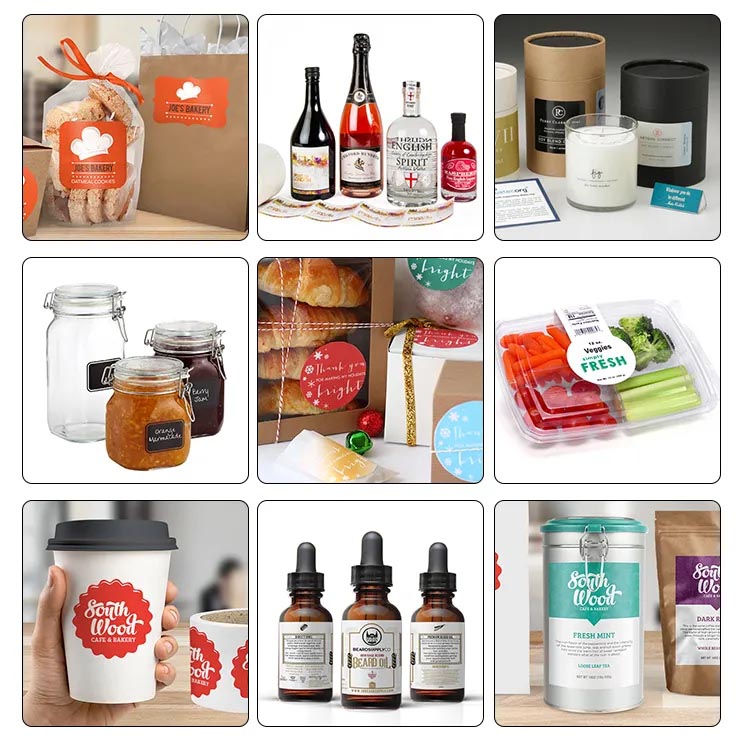
| Application | Food packaging, cosmetics, wine bottles, organic products and fresh produce |
| Certification & Documentation | EN 13432, FSC and other documentation options depending on selected material and finished construction |
| Custom Development | Size, shape, adhesive, printing and roll specification can be matched to the project |
For cellulose biodegradable labels and compostable transparent labels, the final specification should be confirmed according to the packaging surface, storage conditions, application method and required environmental claim.
Applications for Biodegradable and Compostable Labels
Biodegradable and compostable label structures can be developed for different packaging surfaces and product categories. The material and adhesive should be selected around the real package rather than the application name alone.
Food packaging labels may need to perform under refrigeration, moisture or condensation, while fresh produce labels often require reliable adhesion on fruit surfaces, clamshells, punnets or flexible produce packaging.
For cosmetic labels and wine bottle labels, print quality, transparency and resistance to handling can be equally important. Transparent cellulose-based structures can be considered where brands want the appearance of conventional clear film while reducing the use of fossil-based plastic.
Organic product labels and other sustainable packaging labels can also use cellulose, paper or compostable film structures where the environmental positioning is supported by the selected material and documentation.
YiTo Pack can develop cellulose biodegradable labels, wood-pulp-based transparent labels, plastic-free label options and compostable transparent labels according to the packaging application and required claim.
Supplier Review Before Bulk Production
A supplier does not need to overwhelm the buyer with technical paperwork, but several points should be clear before a large order is approved.
|
Buyer Should Review |
Why It Matters |
| Material specification | Confirms what the sticker is made from |
| Certificate or test report | Supports the environmental requirement |
| Certificate scope | Shows exactly what has been assessed |
| Adhesive information | Helps match the packaging surface |
| Printing specification | Confirms the finished construction |
| Sample roll | Allows real application testing |
| MOQ and lead time | Confirms commercial feasibility |
| Roll specification | Supports labelling equipment compatibility |
The production quotation should also reflect the final specification.
Changing from paper to transparent film, increasing ink coverage, changing the adhesive or moving from manual to machine application can all affect both cost and performance.
YiTo Pack's wider biodegradable sticker and tape range allows different facestocks, adhesive systems and converting formats to be reviewed around the actual project rather than forcing every application into the same standard label.
Why Choose YiTo Pack for Biodegradable Labels?
With more than 10 years of packaging experience, YiTo Pack works with experienced project managers who understand the practical requirements behind biodegradable and compostable label projects.
From material selection and adhesive matching to printing, converting and application, our team helps customers review the full label structure before production.
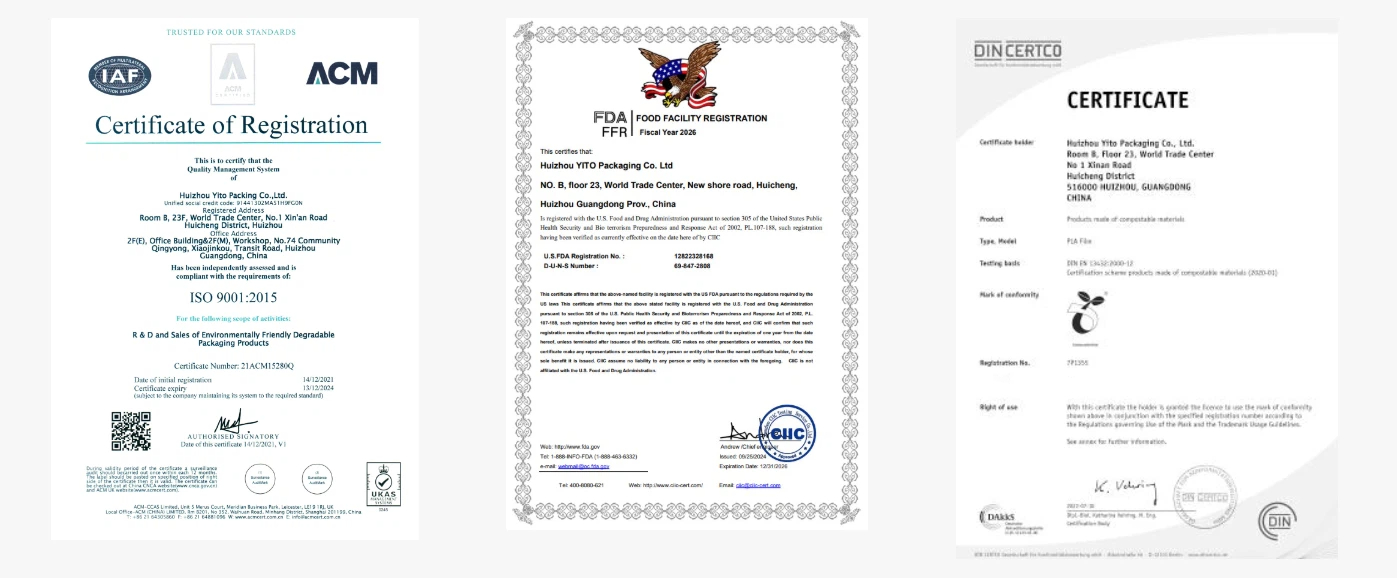
Depending on the selected material and finished construction, available certification and compliance support may include EN 13432, ASTM D6400, OK Compost, BPI, AS 4736/5810, FDA, EU 10/2011 and LFGB.
Rather than applying one certificate to every product, we match the available documentation to the actual material and label structure being supplied.
This combination of project experience, technical review and certification support helps reduce approval risk and gives buyers more confidence before bulk production.
Conclusion
A biodegradable sticker should not be approved from the material name alone. The finished structure needs to match the packaging surface, application conditions, environmental claim and supporting documentation.
For UK buyers, confirming these points before production makes supplier comparison easier and reduces the risk of changing materials, artwork or adhesives after approval.
At YiTo Pack, our goal is to identify these issues early and build the label around the real packaging requirement rather than forcing one standard material into every project.
FAQ
Q: Are biodegradable stickers and compostable stickers the same?
A: They describe different things. Biodegradable is a broad term for biological breakdown, while compostable products are designed to break down under defined composting conditions and normally require more specific performance evidence.
Q: Does EN 13432 mean the sticker is home compostable?
A: EN 13432 is mainly associated with industrial composting. A home compostable label should have evidence that specifically relates to home composting conditions.
Q: Does the adhesive matter if the facestock is compostable?
A: Yes. The adhesive remains part of the finished sticker, so the adhesive, ink and other components should also be considered if the environmental claim applies to the complete label.
Q: Can biodegradable stickers work on refrigerated packaging?
A: Yes, but the structure should be tested. Cold temperatures and condensation can affect adhesive performance, especially on smooth plastic, glass and chilled food packaging.
Q: Can biodegradable stickers go into normal packaging waste?
A: It depends on the sticker and the packaging it is attached to. A compostable label does not make conventional plastic packaging compostable, and compostable materials may not belong in a standard plastic recycling stream.
Q: What information should I send before requesting samples?
A: Packaging material, sticker size, artwork, expected quantity, application method and storage conditions are usually enough to start. Any specific biodegradability or compostability requirement should also be included.
Related compostable fruit label guides
Are Stickers Biodegradable? The Truth About Fruit, Paper & Plastic Stickers
Custom Biodegradable Stickers: A B2B Guide to Materials, Printing & MOQ
Biodegradable Stickers in Australia & NZ: Sourcing & Import Requirements
Send YiTo Pack your packaging material, sticker size, artwork, application conditions and environmental requirements.
Related Products


Post time: Aug-25-2026