
Not every sticker qualifies as a biodegradable sticker, even when it looks like paper. A sticker can behave very differently after disposal because it is more than its visible surface. Facestock, adhesive, coatings, printing and the intended disposal route all matter. Fruit stickers are easy to overlook because they often leave the kitchen with food scraps.
|
Quick takeaway |
What it really means |
| Paper does not automatically mean biodegradable | Adhesives and coatings still matter |
| Fruit stickers vary | Conventional produce labels should not be assumed compostable |
| Biodegradable is not compostable | Compostability depends on defined conditions |
| Adhesive matters | A compostable facestock alone does not prove a compostable label |
| Brands need the finished-label view | Material, glue and real-use performance must work together |
Are Stickers Biodegradable? The Short Answer
Sometimes. Plenty are not.
“Sticker” describes a format, not a material. The visible layer may be paper, cellulose film, PP, PE, PET or something else. Underneath sits an adhesive, and its end-of-life properties may be completely different from the facestock.
Appearance is a poor shortcut. Paper can carry coatings or conventional glue, while clear film may be ordinary plastic or compostable material.
| Part of the label | Question worth asking |
| Facestock | What is the visible label made from? |
| Adhesive | What glue remains after use? |
| Coating and print | Have extra materials been added? |
| End-of-life | Industrial composting, home composting or something else? |
A useful distinction: “biobased” describes origin, “biodegradable” describes breakdown under certain biological conditions, and “compostable” refers to breakdown within a defined composting system.
Are Fruit Stickers Biodegradable?
Fruit stickers are where the question gets practical.
A fruit label is easy to forget when the peel goes into food waste or compost, but that does not make it compostable.
Conventional produce labels may use plastic or paper facestock with pressure-sensitive adhesives designed to stick to waxy, damp, chilled and curved surfaces. That is useful in a packing house, but it tells you nothing by itself about compostability.
For consumers, the rule can stay simple: if the sticker is not clearly identified as suitable for your composting route, remove it before composting and follow local disposal guidance.
For growers and packers, the label must also survive sorting, refrigeration, transport and retail display while carrying PLU, barcode or brand information. Compostability alone is not enough.

Paper Stickers Are Not Automatically Biodegradable
Paper feels like the easy sustainable choice. That is exactly why it can mislead.
The paper may break down, but the finished sticker can still contain coatings and adhesives that change the answer.
Real use matters too. A label on chilled or damp produce may need extra protection, and that protection becomes part of the structure.
So when we look at biodegradable label paper, we do not stop at “paper.” We look at facestock, adhesive, printing, coatings and application.
What About Plastic Stickers?
Traditional PE, PP or PET plastic stickers are not biodegradable simply because they are thin or small.
Clear labels can be misleading because conventional and compostable films may look almost identical.
Plant-based is not the same as biodegradable either, and biodegradable materials may still need specific conditions to break down.
For buyers, vague phrases such as “eco film” or “green label” are far less useful than the exact material grade.

Biodegradable vs Compostable Stickers
When comparing biodegradable stickers and compostable labels, these claims may sound similar, but they answer different questions.
|
Claim |
What it actually tells you |
| Biodegradable | Can break down biologically under certain conditions |
| Industrial compostable | Designed for controlled industrial composting |
| Home compostable | Intended for lower-temperature home composting |
| Biobased | Made partly or fully from biological resources; not automatically compostable |
| Recyclable | Belongs to a different end-of-life route |
The useful question is not just “Does it biodegrade?” It is “Where, under what conditions, and does the claim apply to the whole sticker?”
The Adhesive Matters More Than You Think
For compostable labels, the adhesive matters just as much as the facestock.
A compostable facestock paired with a conventional adhesive does not automatically become a compostable finished label. Whether you are sourcing biodegradable adhesive labels or compostable adhesive labels, the finished construction needs to be reviewed as a whole.
The produce sticker adhesive still has to perform on curved, waxy, cool or damp produce. Poor adhesion can create waste and traceability problems.
| Produce-label test | Why it matters |
| Initial tack | The label must grip quickly |
| Curved surfaces | Fruit rarely gives you a flat surface |
| Moisture | Cold-chain handling can introduce condensation |
| Refrigeration | Adhesion can change at low temperatures |
| Print quality | PLU, barcode and branding must stay readable |
| Applicator fit | Roll format and release behaviour affect line speed |
Sustainability only works commercially when the label still does its basic job.
A Quick Sticker Compostability Check
When a label claim feels vague, work through the finished product rather than relying on the name.
| Question | If yes | If no or unknown |
| Is the facestock supported for composting? | Check the next component | Do not assume compostability |
| Is the adhesive covered too? | Keep reviewing | More evidence is needed |
| Is the route industrial or home composting? | Follow that route | Ask the supplier |
| Does evidence apply to the finished sticker? | Use the claim within scope | Avoid broad claims |
| Does the local waste system accept it? | Follow local instructions | Remove or dispose separately |
For procurement teams, the same table also works as a supplier-audit starting point.
Fruit Labels Are Becoming a Bigger B2B Issue
If you are removing one sticker from an apple at home, the decision is small. If your packing line applies millions of them every year, the same question becomes a sourcing and compliance issue.
The EU Packaging and Packaging Waste Regulation makes this more relevant. From 12 February 2028, sticky labels on fruit and vegetables sold in the EU need to be compatible with the applicable industrial composting standard, with home-composting compatibility relevant where a Member State requires it.
That gives growers, exporters and packing centres a reason to test early, because new materials can affect tack, print quality, machine speed and refrigeration performance.
The direction may be toward compostability, but the packing line still has to run smoothly.

What Should Produce Buyers Ask a Label Supplier?
The useful supplier conversation starts after “Do you offer compostable labels?”
|
Check |
What to ask |
| Facestock | Exact material, grade and thickness |
| Adhesive | Type and compostability scope |
| Finished label | Does evidence cover the complete construction? |
| Food use | Is it suitable for the intended produce application? |
| Moisture | How does it perform on humid surfaces? |
| Temperature | Can it handle ambient and chilled supply chains? |
| Printing | Can it support logos, PLU codes, barcodes and variable data? |
| Machinery | What roll width, core size and winding direction are available? |
| Disposal | Industrial composting, home composting or another route? |
At this point, you are approving a small packaging system, not simply buying a “green sticker.”
Why Choose YiTo Pack?
YiTo Pack supports supermarkets, produce packers, wholesalers and private-label projects with custom compostable labels and other biodegradable packaging solutions. For compostable sticker labels, we can tailor facestock, adhesive, size, shape, printing and roll format, with OEM and ODM support from prototype review to commercial production. With more than ten years of manufacturing experience, samples typically take around 7 days, while standard bulk production can usually be arranged in about 15–20 days after final approval.
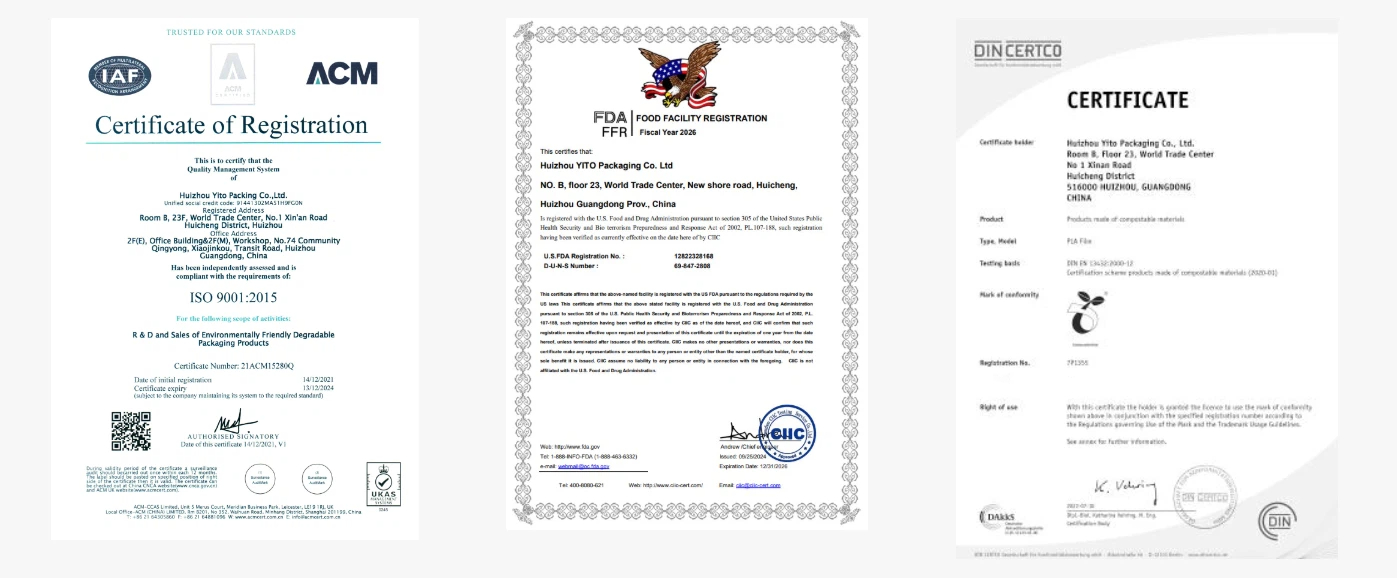
Document support is handled project by project. Depending on structure and destination market, it may involve EN 13432, ASTM D6400, BPI, OK Compost, AS 4736 / AS 5810, FDA-related food-contact requirements, EU 10/2011 where applicable, and ISO 9001 quality management. We also check whether evidence applies only to the facestock or to the adhesive, ink and finished construction.
We connect sustainability targets with produce surface, refrigeration, printing, dispensing and repeat-order consistency, so the label works both in the sustainability file and on the packing line.
Conclusion
So, are stickers biodegradable? Some are. The real answer belongs to the whole sticker, not just the visible material.
When choosing biodegradable stickers, consumers should look beyond a paper appearance or broad green claims. Farms, packers and food brands should check facestock, adhesive, printing, application conditions and disposal route together.
With EU fruit-label requirements moving toward compostability from February 2028, early testing gives businesses more room to balance sustainability with tack, refrigeration, print quality and packing-line efficiency.
That is also how we approach biodegradable stickers at YiTo Pack: start with the finished label, test it in the real application, and make sure the supporting evidence matches what is actually supplied.
FAQ
Are paper stickers biodegradable?
They can be, but paper facestock alone does not prove that the whole sticker is biodegradable. Adhesive, coatings and printing still matter.
Are fruit stickers compostable?
Some are designed as compostable fruit labels. Conventional fruit stickers should not automatically be treated as compostable.
Is sticker adhesive biodegradable?
It depends on the formulation and supporting evidence. A compostable facestock paired with an unsupported adhesive does not automatically make a compostable finished label.
Are biodegradable stickers the same as compostable stickers?
No. Biodegradability is broader. Compostability refers to breakdown within defined composting conditions.
Can compostable stickers go into home compost?
Only when the finished label is supported for home composting and the local disposal route accepts it. Industrial compostability should not be read as home compostability.
Related Products


Post time: Aug-14-2026