
As brands move toward sustainable packaging, biodegradable stickers are becoming an alternative to traditional plastic labels. YiTo Pack provides customized biodegradable sticker solutions using compostable and bio-based materials for food, cosmetic and retail applications.
Custom biodegradable stickers may look like a simple sourcing item, but the wrong material, adhesive or printing structure can quickly create problems during real use.
A sticker may not bond properly to the packaging surface, transparent artwork may lose visibility, or the environmental claim may only apply to part of the label structure.
For B2B buyers, the specification should therefore be based on the actual packaging, application method and compliance requirement, not just the sticker size and artwork.
At YiTo Pack, we work from a simple principle:
Labels should be specified for real packaging, not just artwork and material datasheets.
Key Takeaways
- · Biodegradable and compostable are different purchasing requirements.
- · Cellophane, PLA and paper suit different packaging structures.
- · Clear round stickers are useful when branding needs to stay visible without covering the product.
- · Adhesive matching and white ink are two common failure points in clear-label projects.
- · MOQ should be confirmed from the finished production specification, not from sticker size alone.
Define the Environmental Requirement First
|
Project Goal |
What Buyers Need to Clarify |
| Biodegradable material | Which component carries the claim |
| Compostable packaging | Required standard and document scope |
| Bio-based material | Which component comes from renewable feedstock |
| Plastic reduction | Whether cellophane, PLA or paper fits the project better |
One issue appears repeatedly in sustainable packaging projects: the face material gets all the attention.
The adhesive, ink and release liner do not.
A compostable or biodegradable facestock does not automatically mean the complete pressure-sensitive label carries the same environmental property. When the claim matters commercially, the supporting documents need to match the structure being purchased.
That check belongs near the beginning of the project, not after the artwork has been approved.

“Eco-friendly sticker” is not a technical specification.
A buyer may want to reduce conventional plastic. Another project may specifically require a bio-based film. A compostable packaging program can involve a much stricter review of material claims and supporting documents.
A Sticker Is More Than the Material You Can See
Most sourcing conversations start with the visible layer.
“Can you make it in cellophane?”
“Do you have PLA?”
“Can the film be transparent?”
Those are useful questions, but they do not tell us whether the sticker will actually work.
A finished pressure-sensitive label normally includes the facestock, printing ink, adhesive, release liner and sometimes an additional coating or surface treatment.
We have seen clear labels with perfectly acceptable film become unusable because the adhesive created haze around the edge. We have also seen removable-label requests where the real challenge was not removability itself, but how the adhesive behaved on a coated carton.
For the first technical review, three pieces of information usually tell us more than a long material brief:
What is the packaging surface?
Should the sticker stay permanently or peel away?
What environmental claim does the project need to support?
Once those are clear, material selection becomes much easier.
Cellophane, PLA or Paper?
There is no universal best material for a biodegradable sticker.
The package decides.
| Facestock | Appearance | Typical Fit |
| Cellophane | Clear, premium | Bottles, jars, transparent packs and sealing labels |
| PLA Film | Clear, smooth | Plant-based transparent label projects |
| Paper | Opaque, natural | Cartons and packs where transparency is unnecessary |
Why Cellophane Works Well for Clear Round Stickers
Cellophane, or regenerated cellulose film, is useful when the package itself is part of the visual presentation.
A clear jar of food, a transparent retail box or a premium carton may lose impact if too much of the surface is covered by a white label. A clear round sticker occupies less visual space while still carrying a logo, seal or small amount of product information.
It is a simple format, but the specification still matters.
Sticker diameter alone does not tell us enough. We also need to know where the sticker will sit, what surface it will touch and how much of the artwork needs to remain opaque. For buyers looking for sustainable stickers or reduced-plastic label structures, regenerated cellulose can be worth evaluating, particularly where transparency is important.
MOQ Is a Production Question
“What's your MOQ?” is often the first sourcing question.
The useful answer comes after we know what is being produced.
| MOQ Driver | What It Changes |
| Material | Stock and master-roll availability |
| Size | Material use and die-cut setup |
| Artwork versions | Setup and production changeovers |
| White ink | Additional printing requirements |
| Roll configuration | Slitting and converting |
| Quantity | Production efficiency and unit cost |

One design at 10,000 pieces and ten designs at 1,000 pieces each may have the same total quantity, but they are not the same production job.
For selected standard YiTo Pack clear round sticker formats, MOQ starts from 5,000 pieces per artwork.
That applies to regular specifications. Special materials, non-standard diameters, multiple artworks or customised converting can move the minimum higher.
The safest sequence is simple: lock the basic specification first, then confirm the MOQ against the production setup.
It avoids an unpleasant conversation later when an attractive “minimum order” turns out not to apply to the actual project.
Why Choose YiTo Pack
YiTo Pack is a biodegradable sticker manufacturer supporting custom B2B label projects in cellophane, PLA, paper and other project-matched materials. We develop custom biodegradable labels and compostable labels around the actual packaging surface, adhesive requirement, printing structure and environmental claim rather than treating the facestock as an isolated component.
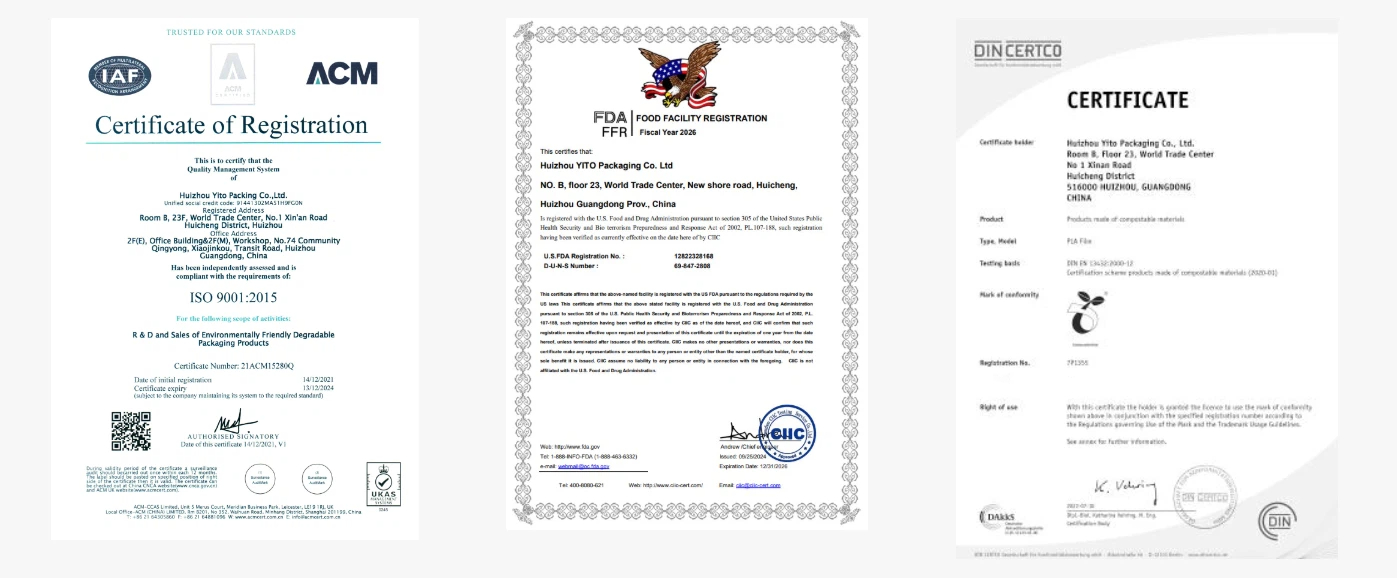
We also support customers with the quality and compliance documentation required for different markets and applications. Depending on the selected material and finished packaging structure, projects can be supported with relevant standards and documentation such as AS 4736, AS 5810, EN 13432, ASTM D6400, BPI, FDA, EU 10/2011, LFGB, FSC/PEFC and ISO 9001.
From specification confirmation and sampling to bulk production and export, YiTo Pack provides coordinated support throughout the project. Our experience serving international B2B customers helps reduce sourcing risks, simplify communication and move packaging projects more efficiently from concept to approved production.
Conclusion
Choosing a biodegradable sticker is not only a material decision. The packaging surface, adhesive, printing, environmental requirement and application method all affect whether the finished label will perform as expected.
For you projects, the most reliable approach is to confirm the complete specification before bulk production rather than selecting a facestock first and solving compatibility issues later.
For selected standard projects:
MOQ: from 5,000 pcs per artwork
Sample: typically 5–7 days
Bulk production: from 15 business days after artwork approval
Quotation: within 24 hours after receiving the main project details
Send YiTo Pack your packaging material, sticker size, artwork, adhesive requirement, application method and expected quantity. We can review the label structure around the real packaging application and recommend a suitable specification for sampling.
FAQ
Are biodegradable and compostable stickers the same?
No. 'Biodegradable' and 'compostable' describe different environmental properties. Compostable claims usually relate to defined standards and disposal conditions, so buyers should confirm what the available documentation actually covers.
Can the whole sticker be compostable?
Potentially, but the facestock alone does not prove it. Adhesive, ink, coatings and release liner may have different environmental properties. If complete sticker compostability is required, it should be stated before the structure is selected.
Is cellophane better than PLA for clear stickers?
Not automatically. Cellophane is useful for renewable cellulose-based transparent labels, while PLA can suit projects specifically seeking a plant-based clear film. Packaging surface, appearance, printing and documentation requirements determine the better fit.
Do clear round stickers always need white ink?
No. White ink becomes useful when pale colours, logos or text need stronger opacity. It is especially important when the sticker will sit over a dark, coloured or visually busy background.
What is the MOQ for custom clear round stickers?
For selected standard YiTo Pack formats, MOQ can start from 5,000 pieces per artwork. Special sizes, materials, multiple artwork versions or custom converting may require a higher minimum.
Related Articles
Are Stickers Biodegradable? The Truth About Fruit, Paper & Plastic Stickers
Biodegradable Fruit & Produce Stickers: Food-Safe Materials for B2B Packaging
Biodegradable Sticker Materials Compared: PLA vs Cellophane vs Paper vs Vinyl
Not sure which biodegradable sticker structure fits your packaging? Send YiTo Pack your packaging material, sticker size, artwork, adhesive requirement, application method and target market for an initial recommendation.
Related Products


Post time: Aug-20-2026