
Biodegradable fruit stickers are not automatically a food-safe produce label. For growers, farms and packhouses, the real question is whether the complete label—including facestock, adhesive, printing and backing—can withstand produce contact, moisture, refrigeration and the intended end-of-life route.
| Key takeaway | What buyers need to confirm |
| Biodegradable ≠ food-safe | Food-contact evidence must match the application |
| Facestock is only one part | Adhesives, inks and coatings also matter |
| Produce labels face challenging conditions | Moisture and refrigeration can affect adhesion |
| Compostability has specific conditions | Industrial and home composting are different |
| Finished-label evidence matters | Documentation should match the actual label |
What Makes a Fruit Sticker Suitable for Produce Packaging?
When a produce label is applied directly to fruit or vegetables, simply calling it “biodegradable” is not enough.
The label may face curved surfaces, moisture, condensation, refrigerated storage, transportation and retail display. It may also need to carry PLU codes, barcodes or brand information clearly.
A commercial produce label usually consists of a facestock, adhesive and printing, and may also include coatings or a backing liner. For this reason, buyers should evaluate the complete finished structure, rather than looking only at the raw material.
| Material | Main consideration | Potential application |
| Paper | Natural appearance and printability | Produce and relatively dry applications |
| PLA | Plant-based material positioning | Compostable packaging projects |
| Cellulose | Transparency and renewable origin | Fresh produce and food applications |
| Conventional plastic | Established processing performance | Conventional applications |
| Adhesive | Tack and temperature compatibility | Directly affects application reliability |
There is no single “best” material for every project. The right choice depends on the product surface, storage conditions, application method and end-of-life requirements.

Should You Choose Paper, PLA or Cellulose for the Facestock?
While biodegradable label sticker can work well when natural appearance and printability are priorities, humidity still needs to be taken into account. PLA can be suitable for projects focused on plant-based materials, but its end-of-life routes and processing conditions still need to be evaluated. Cellulose can provide transparency and renewable-material positioning for biodegradable produce labels, but the adhesive and any functional coating remain part of the final decision.
So instead of asking, “Which material is the greenest?”, a more useful question is:
Which material provides the right balance of food-contact suitability, practical performance and end-of-life characteristics for this application?
The Finished Label Is More Than the Facestock
This is one of the easiest points to overlook during procurement.
A supplier may provide a compostability certificate for the film or a specification for the paper, but the finished label may also contain adhesive, ink or coatings. Evidence covering the base material does not automatically prove that the entire compostable sticker label has the same properties after conversion.
For B2B buyers, the full structure should be clearly defined in the specification. This makes sampling, quality inspection and repeat orders much easier to manage.
Are Biodegradable Fruit Stickers Food Safe?
Not necessarily.
Food-contact suitability and biodegradability are two separate questions.Before approving food-safe produce labels, buyers should confirm the material, adhesive, intended food-contact conditions and supporting documentation.
|
Check |
Why it matters |
| Facestock | Confirms the base material |
| Adhesive | May come into contact with the produce |
| Ink | Forms part of the finished label structure |
| Coating | Can affect compliance and end-of-life properties |
| Documentation | Supports supplier and product qualification |
| Intended use | Defines the conditions that need to be assessed |
So when a supplier says a label is “food safe,” that should be the beginning of the discussion, not the end. The key question is: for which material, which food, which conditions and which finished structure?
Food-Safe Does Not Mean Compostable
These requirements need to be verified separately.
Food-contact suitability asks whether a material or finished article is appropriate for the intended food-contact conditions. Compostability asks whether the relevant product meets the requirements of a particular composting route.
Keeping the two questions separate makes procurement clearer and helps prevent one certificate from being used to support claims it was never intended to cover.
Why Produce Sticker Adhesive Matters
The adhesive is often the most overlooked part of a label.
A produce sticker adhesive may need to bond quickly to a curved, waxy or damp surface, remain attached during refrigeration and survive transport. For biodegradable adhesive labels and compostable adhesive labels, the adhesive should also be reviewed as part of the overall environmental claim.
|
Condition |
What to test |
| Curved fruit | Initial tack and conformability |
| Moisture | Stable adhesion |
| Refrigeration | Low-temperature performance |
| Condensation | Resistance to lifting |
| Handling | Peel resistance |
| Removal | Clean release where required |
The same principle applies to compostable pressure-sensitive labels. A compostable facestock combined with an unsuitable adhesive does not automatically result in a compostable finished label.
How Should Compostability Documents Be Evaluated?
Certificates should never be reviewed without considering their scope.
A document covering a base film does not automatically cover a printed or converted label containing adhesive, coatings or other components. Buyers should confirm whether the evidence applies to the complete finished label structure.
Industrial compostability and home compostability should also be treated separately.
For fruit and vegetable labels, especially compostable fruit labels, this distinction is becoming increasingly relevant. Under EU Regulation (EU) 2025/40, sticky labels attached to fruit and vegetables placed on the EU market must meet the applicable industrial compostability compatibility requirements from 12 February 2028. Where required by Member States, compatibility with the relevant home-composting standard also applies.
So the key purchasing question is not simply:
“Does it have a certificate?”
It is:
“Does the evidence cover the finished label I am actually purchasing?”

Can Biodegradable Stickers Survive the Cold Chain?
For commercial biodegradable produce labels, sustainability only matters if the label continues to work from farm to shelf.
A typical supply chain may look like:
Farm → Packhouse → Cold Storage → Refrigerated Transport → Retail
Cold surfaces, condensation and handling can all affect adhesion. A label that performs well at room temperature may behave differently after several hours in refrigeration.
For this reason, real-product testing is more useful than relying on a technical sheet alone. Check the label after application, refrigeration, handling and simulated transport. PLU codes, barcodes and brand information should also remain readable throughout the process.
Can the Label Run on Automatic Produce Labeling Lines?
A useful supplier conversation should go beyond:
“Do you have compostable labels?”
|
Question |
Why it matters |
| What is the exact facestock? | Confirms material identity |
| What adhesive is used? | Affects adhesion and compliance |
| Is the adhesive compostable? | May affect the finished claim |
| Is the label suitable for produce contact? | Supports food-use qualification |
| What documents are available? | Helps with supplier approval |
| Industrial or home compostable? | Defines the disposal route |
| Can it handle refrigeration? | Confirms cold-chain performance |
| Can it run on automatic applicators? | Confirms production compatibility |
| Can you provide samples? | Enables real-product testing |
The goal is not simply to purchase a “green sticker,” but to approve a complete and verifiable packaging specification.
How to Select the Right Biodegradable Fruit Stickers
Start with the actual application.
First, confirm whether the label will directly contact produce. Then define the storage environment, including refrigeration, high humidity or condensation, and determine whether application will be manual or automatic.
Next, clarify printing requirements and the intended composting route. Only after these points are clear should you finalize the facestock, adhesive and complete finished structure.
The best label is not necessarily the one with the strongest environmental claim. It is the one that meets the sustainability objective without creating performance or compliance problems elsewhere in the supply chain.

Printing Is Part of the Product, Not a Final Decoration
Custom printing affects more than appearance. The ink system, print coverage and environmental wording may all influence whether the final artwork remains within the applicable certification scope.
For private-label projects, the customer should also confirm whether the certification mark can be used with its own brand. A supplier’s certified product does not automatically give every private-label customer the right to place the same logo on a new SKU.
YiTo Pack reviews the proposed colours, printing area, certification wording and mark authorisation before production. When changes are needed, they can be made while the artwork and ink selection are still flexible rather than after printed inventory has been produced.
We support one-color and multicolor printing for roll produce bags, individual bags and handle fruit bags. Final printing options are confirmed according to the selected bag structure, certification direction and destination market.
Why Choose YiTo Pack?
YiTo Pack supports supermarkets, produce packers, wholesalers and private-label projects with custom compostable labels and other biodegradable label solutions. We can customise facestock, adhesive, size, shape, printing and roll format according to the application, while providing OEM and ODM support from specification review and sampling through commercial production. With more than ten years of packaging manufacturing experience, samples can typically be completed in about 7 days, while standard bulk production can generally be arranged within around 15–20 days after final approval.
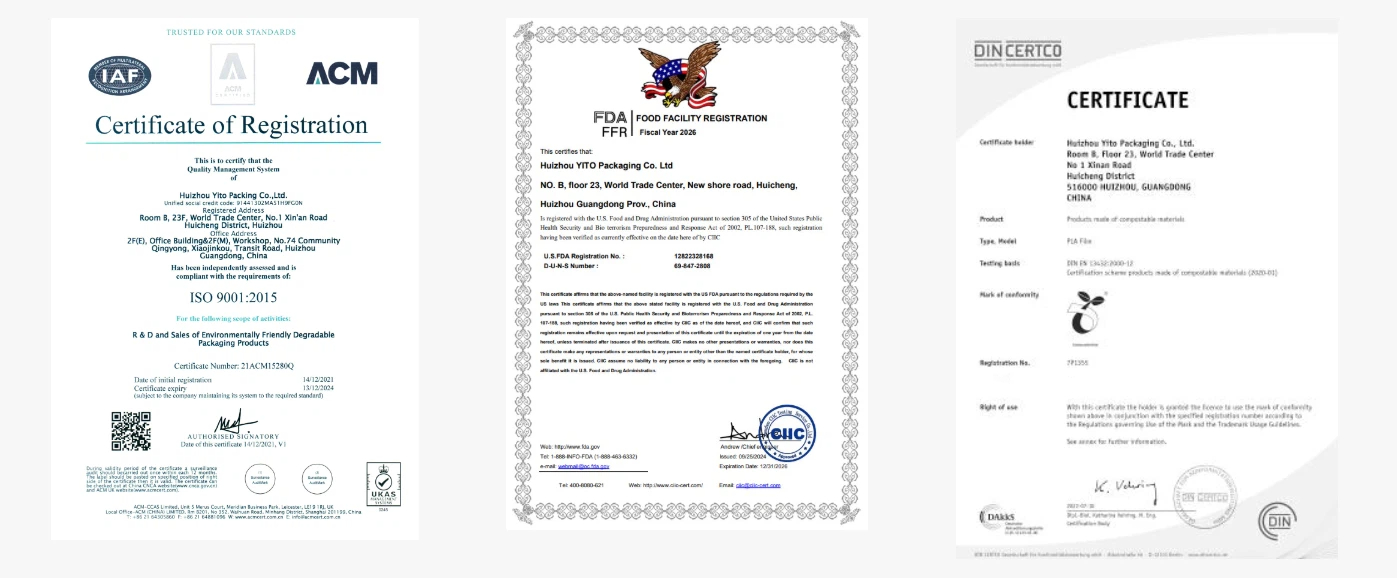
Depending on the material structure and target market, our documentation and compliance support may include EN 13432, ASTM D6400, BPI, OK Compost, AS 4736 / AS 5810, FDA-related food-contact documentation, EU 10/2011 where applicable, and ISO 9001-related quality records. We also check whether the evidence matches the facestock, adhesive, ink, coating and finished label, rather than treating one certificate as universal proof.
We connect material selection with the actual produce application, including surface conditions, refrigeration, moisture, printing and dispensing. The objective is simple: develop a label that works in the real packaging process, not just on a product sheet.
Conclusion
The right biodegradable produce label isn't just the greenest label. Its dough materials, adhesives, food suitability, application properties and end-of-life routes all need to be suitable for the same practical application. For farms, growers and packaging plants, that means moving beyond the term "biodegradable." Labels should be firmly affixed, carry the required information, survive the cold chain, and supported by documentation that matches the finished structure.
YiTo Pack approaches these projects from the finished-label level: select the material, match the adhesive, test the real application, verify the supporting documents and then lock the specification for repeat production. The goal is not simply a greener label, but a dependable one.
FAQ
Are biodegradable stickers food safe?
Not automatically. Food-contact suitability depends on the material, adhesive, finished structure, intended food and applicable conditions.
Are compostable labels safe for fresh produce?
They can be, provided the finished label and its components meet the applicable food-contact requirements and are suitable for the intended application.
Is the adhesive on a biodegradable label also compostable?
Not necessarily. A biodegradable or compostable facestock does not automatically make the adhesive or complete finished label compostable.
Can biodegradable fruit stickers survive refrigerated storage?
They can be designed for chilled applications, but real-product testing is recommended because temperature, moisture and condensation can affect adhesion.
Related Articles
Are Stickers Biodegradable? The Truth About Fruit, Paper & Plastic Stickers
Custom Biodegradable Stickers: A B2B Guide to Materials, Printing & MOQ
Biodegradable Stickers in the UK: Supplier Guide & Compliance Overview
Tell us your target market, produce type, preferred bag format, dimensions, thickness and printing requirements. YiTo Pack will help you review the proposed structure, certification direction and supporting-document scope before production.
Related Products


Post time: Aug-20-2026