
A compostable cellophane cone bag can look perfect in a supplier photo and still fail when you fill it. The opening may be too narrow, the logo may stretch around the taper, the closure area may disappear once the product is inside, or the “cellophane” may turn out to be OPP or BOPP rather than regenerated cellulose.
These issues affect filling efficiency, shelf presentation, environmental claims and customer approval. At YiTo Pack, we start with the product itself: its dimensions, fill weight, closure, shelf-life requirement and target market. From there, we work backwards to a practical cone shape, film grade and wholesale specification.
Confirm the Material Before Comparing Prices
Clear cellophane bags made from regenerated cellulose, OPP and BOPP can look almost identical online. They are not equivalent.
True cellophane is regenerated cellulose film, generally derived from wood-pulp cellulose. OPP and BOPP are polypropylene films. They can be clear and heat sealable, but they should not be treated as biodegradable cellulose packaging.
Ask the supplier to state the exact material, film grade, thickness, coating type and available food-contact or compostability documents. For printed projects, also check whether the paperwork covers the ink, adhesive, label and closure used in the finished pack.
Buyers reviewing other transparent cellulose formats can explore YiTo Pack’s biodegradable clear cellophane bags for custom dimensions, printing and heat-sealable options.

Choose the Cone Shape Around the Product
Cellophane cone bags are usually supplied in different widths and lengths rather than formally classified as “narrow”, “wide” or “soft-tapered” styles. For B2B projects, the useful distinction is how the opening width and taper affect filling, capacity and product presentation.
Small Cellophane Cone Bags for Candy and Samples
Smaller cellophane cone bags create a slim, concentrated presentation for hard sweets, chocolate beans, mini-wrapped candies, and lightweight sample packs.
A relatively narrow opening keeps small products visually grouped, but it can slow down filling when the contents are large or irregular. Products may become caught near the opening instead of settling naturally into the bottom of the bag.
This format is most suitable for small, consistently shaped products and lower fill weights.
Larger Cellophane Cone Bags for Chocolates and Gift Packs
Larger cellophane cone bags provide more opening space for wrapped chocolates, nuts, mixed sweets, popcorn and irregular gift assortments.
The wider filling area reduces product jamming and can improve manual packing efficiency. It also provides more usable capacity for lightweight or bulky products, although the larger dimensions increase film consumption.
For example, a 150 × 300 mm cone bag may suit a smaller candy pack, while a 190 × 420 mm format provides more space for larger sweets, popcorn or gift items. These dimensions are common reference formats in the current cone-bag market, although YiTo Pack should confirm the final size with the actual product.

Cone Bags vs Cellulose Side-Gusset Bags
A cone-shaped bag works best when the tapered presentation is part of the desired shelf appearance. However, the narrowing lower section reduces usable capacity compared with a rectangular bag.
When your product needs expandable side space, a flatter filling area or more efficient use of volume, cellulose side-gusset bags may provide a more practical alternative. They are better suited to bread, larger confectionery packs, gift products and other bulky items that do not settle efficiently into a tapered bag.
Match Film Thickness to Weight and Handling
YiTo Pack can evaluate cellulose films across approximately 19.3–41.4 μm, depending on the grade and application.
| Film Thickness | Practical Starting Use |
| 19.3–23 μm | Lightweight samples and low-load decorative packs |
| 25–31 μm | Most confectionery cones requiring balanced clarity and stiffness |
| 34–41.4 μm | Larger fills, stronger handling or premium presentation |
For a 150–250 g confectionery cone, 25–31 μm is usually the most balanced starting range. For heavier, sharper or more irregular products, we normally begin at 34 μm or above and confirm the result through filling and transport tests.
The best gauge is the lightest one that still performs reliably in your application.

Use Real Sizes, Not Generic Labels
A useful cone-bag specification should be written as opening width × total length. It should also include usable filling length, closure allowance, film thickness and taper.
|
Reference Size |
Typical Starting Application |
Closure Allowance |
| 130 × 250 mm | 80–150 g of small sweets or samples | 40–50 mm |
| 160 × 300 mm | 150–250 g of wrapped sweets or chocolates | 50–70 mm |
| 180 × 370 mm | 250–400 g of mixed confectionery or light snacks | 60–80 mm |
| 250 × 460 mm | Larger gift assortments or lightweight, bulky products | 80–100 mm |
For example, 160 × 300 mm is a reasonable first sample for 200 g of small-wrapped sweets. Reserving 50–70 mm for a ribbon, twist tie or heat seal leaves approximately 230–250 mm of working length.
If the same 200 g consists of pillow-wrapped sweets, marshmallows, or popcorn, 180 × 370 mm may be more realistic. Dense hard candy may fit the smaller size.
Start with the Largest Piece
The opening must comfortably accept the largest item. For manual filling, allow extra room for the operator’s hand, funnel, or loading tool.
If every piece must be pushed or rotated, the bag will slow production and increase labor costs.
Leave Enough Space for the Closure
The top section should be reserved for closure rather than treated as usable filling capacity.
A twist tie or narrow heat seal normally needs less room than a decorative ribbon, folded label or header card. For most small and medium cones, 40–80 mm of clear top space is a sensible starting range. Larger gift formats may require 80–100 mm.
Keep Products Looking and Tasting Their Best
A clear cone bag should do more than display the product. It also needs to protect the colour, aroma and texture that customers expect when they open the pack.
Different cellulose films provide different levels of protection. For one selected double-sided coated film, the technical data sheet lists an oxygen transmission rate of 5 cc/m²/24h and a water-vapour transmission rate of 35 g/m²/24h under the stated test conditions.
This makes it a practical option for sweets, chocolates, tea, scented gifts, soap and selected dry bakery products. It provides useful oxygen and aroma protection, while offering moderate resistance to moisture.
For products sold quickly or stored in controlled conditions, this balance is often sufficient. If your sweets, biscuits or snacks must stay crisp for a long time in a humid market, we may recommend a higher-barrier cellulose film or a different packaging structure.
Double-sided heat-sealable cellulose cone bags normally use 115–120°C as a starting sealing range. The final temperature, pressure and sealing time can then be adjusted to suit the film thickness and your equipment.
Make Sure the Print Still Looks Right After Filling
A design that looks perfect on an empty cone bag can change once the sweets or gifts are added. The wider upper section expands around the product, while the lower section narrows towards the tip. This can make a logo appear stretched, curved or slightly off-centre.
For a cleaner-finished appearance, place the main logo in the upper-middle area of the bag. Keep important text away from the lowest 25% of the cone, leave around 10–15 mm between key artwork and the side seams, and avoid placing small text inside the closure area.
Simple logos, vertical layouts and compact graphics normally work better than long horizontal borders or detailed artwork near the tip.
At YiTo Pack, we check the design on a sample filled to the intended weight before approving the final artwork. This allows us to adjust the logo size and position so the finished pack looks balanced on the shelf, not only when the bag is empty.
Why Choose YiTo Pack
YiTo Pack combines cellulose-film expertise, custom converting and project-level compliance support for biodegradable cellophane cone bags. We can customise the opening width, total length, taper, film thickness, heat-sealing grade, logo printing and export packaging according to your product size, fill weight and destination market.
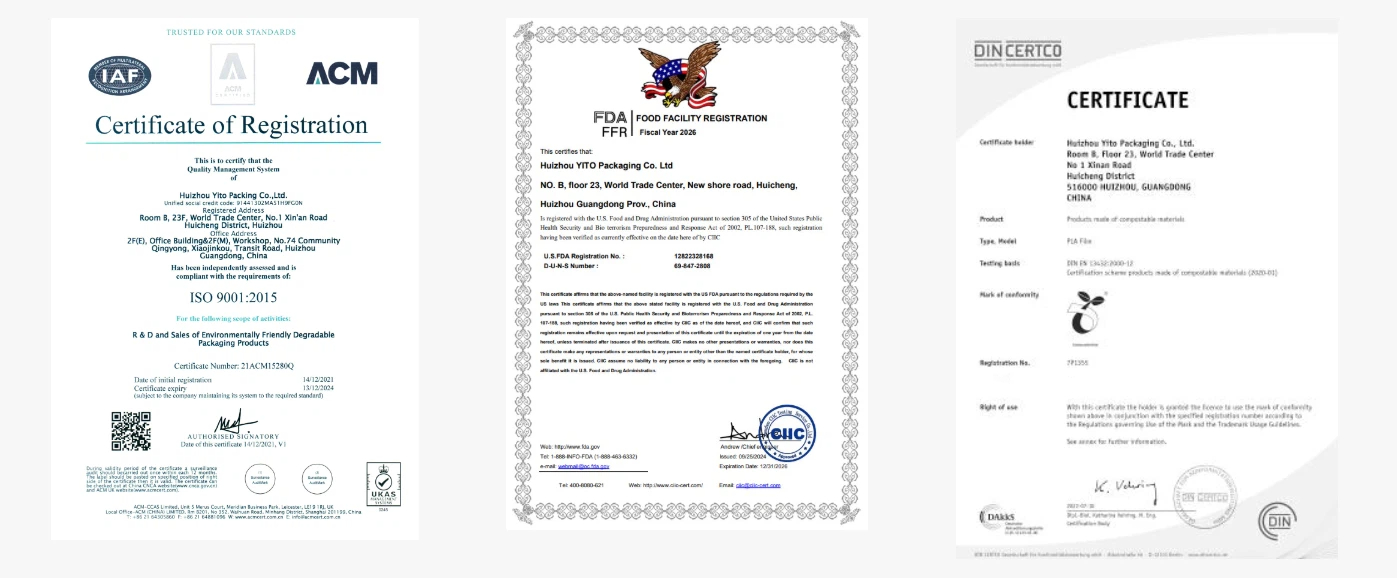
Depending on the selected material and final bag structure, available certification and compliance support may include EN 13432, ASTM D6400, BPI, OK Compost, AS 4736, AS 5810, FDA, EU 10/2011, LFGB, ISO 9001, FSC and PEFC documentation. Because certification scope can vary by film grade, thickness, printing, ink and closure accessory, our team checks the applicable documents against the final specification rather than relying only on a base-film certificate.
For European projects, we can also develop a more consistent compostable packaging set by matching regenerated cellulose cone bags with paper twist ties or cellulose-based stickers instead of conventional plastic accessories. This reduces mixed-material components and supports packaging projects preparing for EU PPWR requirements, subject to the final structure and destination-market review.
Selected unprinted or simple custom projects can start from approximately 1,000 pieces, while custom-printed cellophane bags normally start from approximately 10,000 pieces. Samples can usually be prepared in around 5–7 days, with standard mass production completed in approximately 15–20 days after sample, artwork and specification approval.
Send us your product photograph, largest item dimensions, target fill weight, preferred closure, printing requirements, destination market and annual demand. YiTo Pack will help you review the cone shape, film grade, documentation and sample specification before bulk production.
Conclusion
Before bulk production, fill the sample using the normal packing method. Check loading speed, product settling, pressure at the tip, closure allowance, seal strength, print position and carton fit.
A suitable biodegradable cellophane cone bag should be defined by measurable values: regenerated cellulose film, a specific width and length, a selected taper, 19.3–41.4 μm thickness, a stated closure allowance, a suitable barrier grade and a realistic MOQ.
Send YiTo Pack your product details and target quantity. We will help you review the cone shape, sample size, film grade and printing layout before wholesale production.
FAQ
Q: Are all clear cone bags biodegradable?
A: No. Many clear cone bags are made from OPP or BOPP. Ask for the exact material grade and supporting documents before purchase.
Q: Can cellulose cone bags package moisture-sensitive products?
A: They can suit many sweets and dry goods, but long-term crispness may require a higher-barrier film and shelf-life testing.
Q: Can the entire packaging set be compostable?
A: Yes, when the bag, ink, label and closure are selected as a compatible system. Paper ties and cellulose-based stickers can replace plastic accessories.
Q: Will custom printing distort after filling?
A: It can. YiTo Pack checks logo position on a filled mock-up before approving the final artwork.
Q: Are standard and custom sizes both available?
A: Yes. Standard references can shorten sampling, while custom widths, lengths and tapers are available for product-specific projects.
Related compostable fruit label guides
Biodegradable Cellophane Food Bags: Material Specs & Compliance for B2B Buyers
Biodegradable Cellophane Gift Bags: Custom Options for Retail & Brand Packaging
Biodegradable Cellophane Bags Size Guide: A3/A4/A5/A6/5x7/9x12 Complete Reference
Need a Custom Cellophane Cone Bag Specification?
Related Products


Post time: Aug-06-2026