
Biodegradable cellophane bags can look surprisingly simple. Customers see the product through it, notice an environmental claim, and move on. From a seller’s side, however, that is where the real work starts.
The film has to suit the product. The bag must open easily, seal properly, survive storage and still look good on the shelf. The documents should relate to the finished bag, not only the raw film. And once words such as “biodegradable” or “compostable” appear on the packaging, the claim needs to make sense in the UK market.
As global brands accelerate plastic reduction strategies, traditional PE packaging is facing increasing pressure from regulations and consumers. Transparent cellulose bags provide a sustainable alternative with the same visibility and premium appearance while reducing plastic dependency.
In our experience, the better biodegradable cellophane bags rarely begin with “What is the lowest price?” A more useful question is: can this bag protect the product, support the brand and remain consistent when the next order arrives?
This guide is written mainly for UK food brands, produce packers, importers, wholesalers and private-label projects. Some points will also help smaller consumer-facing sellers. It is a practical sourcing overview rather than legal advice.
|
Quick check |
What needs to be confirmed |
| Sales market | Great Britain, Northern Ireland or both |
| Material | Polymer, grade, thickness, coating and composition |
| Documents | Evidence relating to the finished bag |
| Product fit | Protection, sealing, storage and shelf appearance |
| Supply control | Approved sample, tolerances and repeat-order consistency |
Approve the Finished Bag, Not the Green Label
“Cellophane,” “biodegradable” and “compostable” are useful search terms. They are not complete specifications.
One supplier may use “cello bag” to mean regenerated cellulose. Another may apply the same name to PLA or conventional transparent plastic. Even when two quotations both mention regenerated cellulose, the films may differ in thickness, coating, sealing behaviour, print system and document scope.
Before comparing custom cellophane bags wholesale quotations, make sure every supplier is quoting the same thing. Give them identical dimensions, thickness, bag style, artwork, closure, quantity, packing method, delivery terms and document requirements.
Otherwise, a cheaper quotation may simply describe a thinner film, a simpler bag or a product with less supporting evidence.
A quick review of the cellophane bags manufacturer can prevent problems later. Has the supplier named the polymer in writing? Have they explained the whole structure? Did they ask what you are packing? Can they connect the documents to the quoted bag? Can the approved sample be reproduced in bulk?
When those answers remain vague, the project is still at the enquiry stage.

Confirm Where the Bags Will Be Sold
“Suitable for the UK” sounds reassuring, but it is still too broad for a proper sourcing file.
You need to confirm whether the bags will be supplied in Great Britain, Northern Ireland or both. The relevant food-contact route may differ, so this should be settled before artwork and production are approved.
It also matters who places the packaging on the market. That may be the brand owner, importer, retailer, wholesaler or contract packer. The manufacturer can provide technical information, but the UK business still needs to check whether the bag, documents and marketing wording suit the actual product and sales route.
For projects covering both Great Britain and Northern Ireland, include both document paths in the RFQ from the beginning. Rebuilding the file after printing is rarely convenient.
Turn the Product Into a Clear Bag Specification
A common enquiry says: “We need a transparent biodegradable bag, roughly this size.”
That is a reasonable starting point, but it is not enough to recommend the finished structure.
Biodegradable biscuits bags do not face the same conditions as one for fresh produce. A hand-packed compostable gift bags behaves differently from a bag running on a semi-automatic line. One brand may care most about shelf clarity, while another needs moisture protection, aroma retention or easier opening.
|
Project area |
Useful information |
| Product | Contents, fill weight, oil, moisture, aroma and sharp edges |
| Distribution | Shelf life, temperature, humidity, transport and display |
| Bag | Material, thickness, dimensions, gusset and closure |
| Packing | Manual or automated filling, sealer settings and line speed |
| Branding | Print coverage, labels and disposal wording |
| Approval | Seal strength, clarity, odour, appearance and tolerances |
This information also helps determine the right supply model.
UK stock bags may suit urgent orders, smaller volumes and early trials. Direct custom production usually makes more sense when you need custom printed cellophane bags, several sizes, a closer product fit or regular annual supply.
Some buyers combine both approaches. They test the concept with a standard bag, then move to custom sizing and printing once the product and packing process are confirmed.
Check What “Cellophane” Actually Means
A transparent bag does not reveal its polymer.
Regenerated cellulose, PLA, OPP, BOPP, CPP and PE can all look clear in a photograph. Put them on a production line, expose them to humidity or test their sealing behaviour, and the differences become much more obvious.
A reliable cellulose film packaging supplier to identify the polymer, film grade, product code, thickness, tolerance, coating and finished composition. The quotation should also state whether the bag is uncoated cellulose, coated cellulose or a structure containing several materials.
For biodegradable cellophane bags, this matters to performance, environmental claims and possible UK Plastic Packaging Tax assessment. A plant-derived film is not automatically outside the tax definition, while a compostable plastic may still be treated as plastic. The documented material is more useful than a broad green description.

At YiTo Pack, we connect the selected grade and thickness to the quotation, approved sample and production record, keeping the project consistent from enquiry to repeat order.
Product Specifications and Comparison with PE Bags
For B2B buyers, the material itself is only part of the purchasing decision. Dimensions, thickness, printing options, MOQ and available certification support should also be confirmed before sampling or bulk ordering.
| Item | Details |
|---|---|
| Material | Cellulose / Wood Pulp Film |
| Thickness | 30–80 μm |
| Transparency | >90% |
| Width | Customized |
| Length | Customized |
| Printing | Flexo / Gravure / Digital |
| MOQ | Customized |
| Certification | FSC / EN 13432 / ASTM D6400 |
Cellulose bags and conventional PE bags may both provide a clear packaging appearance, but they differ significantly in raw material source, plastic reduction, compostability and sustainability positioning.
| Item | Cellulose Bag | PE Bag |
|---|---|---|
| Material | Plant-based | Fossil-based |
| Plastic reduction | ★★★★★ | ★ |
| Transparency | ★★★★★ | ★★★★★ |
| Compostability | Optional | No |
| ESG value | High | Low |
| Brand image | Premium | Standard |
Match Food-Contact Evidence to the Finished Bag
When sourcing food grade cellophane packaging, the phrase “food grade” should lead to another question: for which material, food type and finished structure?
Regenerated cellulose has material-specific food-contact requirements. Projects serving Great Britain should follow the relevant UK route, while Northern Ireland should be checked separately where necessary.
The practical rule is straightforward: the supporting documents should match the material, intended food, contact time, temperature and final bag construction.
This is where confusion often begins. The base film may have supporting evidence, while the finished bag also contains ink, a moisture-barrier coating, a heat-seal layer or an adhesive strip.
Those additions matter.
Ask whether the documents cover the printed or converted food grade cellophane packaging you actually intend to purchase. The goal is not to collect the largest folder of certificates. It is to ensure the specification, evidence and delivered product all describe the same bag.

Read Compostability Evidence in Context
A compostability certificate is useful only when its scope is clear.
A finished bag may include film, coating, ink, primer, adhesive, label, tie or another closure. If those parts remain attached when the customer disposes of the packaging, they become part of the claim.
BS EN 13432 relates to industrial compostability under controlled conditions. It considers biodegradation, disintegration, the treatment process and the quality of the resulting compost.
It does not automatically prove home compostability, marine degradation or rapid breakdown after littering.
Where several materials are used in compostable cellophane bags, the finished package should be considered as a whole unless a non-compostable part can be removed easily before disposal.
For YiTo Pack projects, we review the film, coating, ink, adhesive and closure together, then explain what the available evidence covers and what still needs confirmation.
Keep Environmental Claims Clear and Useful
Customers prefer simple wording. Packaging compliance is rarely simple.
That creates a familiar problem: a careful technical statement can become “100% eco-friendly” by the time it reaches the product page.
Broad claims such as “fully biodegradable” may suggest more than the evidence supports. A clearer statement explains the material, whether the claim covers the complete bag and which disposal route is intended.
The packaging story does not need to become dull. Brands can still talk about transparency, plant-derived cellulose, reduced conventional plastic use or industrial compostability where those points are supported.
It helps when procurement, compliance and marketing review the final wording together. Otherwise, the technical file, website and printed bag may end up telling different stories.

Test the Finished Bag Before Mass Production
|
Approval area |
What should be ready |
| Market | Great Britain, Northern Ireland or both are defined |
| Material | Polymer, grade, thickness, coating and composition are confirmed |
| Evidence | Food-contact and compostability files match the bag |
| Claims | Marketing wording reflects the available evidence |
| EPR data | Finished weight and material information are available |
| Performance | Real-product and equipment testing has passed |
| Production | Tolerances, reference sample and change control are fixed |
A film sample tells you something about the material. A finished bag tells you whether the packaging works.
Test it with the real product, normal fill weight and intended equipment. Check opening, filling, static, sealing, odour, print adhesion, shelf appearance, storage and transport.
For automated or semi-automated lines, record line speed, feeding behaviour, sealing settings and reject rate. A bag that works during a slow hand test may behave differently at production speed.
Once the sample is approved, fix the film grade, thickness tolerance, dimensions, coating, artwork, sealing range, packing method, document version and reference sample.
Any change should be communicated and approved before production. This is one of the simplest ways to reduce the gap between an attractive sample and an inconsistent bulk order.

Why Choose YiTo Pack?
YiTo Pack develops custom packaging for UK food brands, produce packers, wholesalers, importers and private-label projects. We offer gusseted, self-adhesive, heat-sealable and other custom bag formats, with dimensions, thicknesses, closures and printing adapted to the project.
With more than ten years of packaging manufacturing experience, we support OEM and ODM projects from specification review and sampling to real-product trials, print approval and commercial production. Custom samples normally take around seven days. Once the artwork, sample and specification are approved, standard production generally takes about 15–20 days, depending on material, format, printing and quantity.
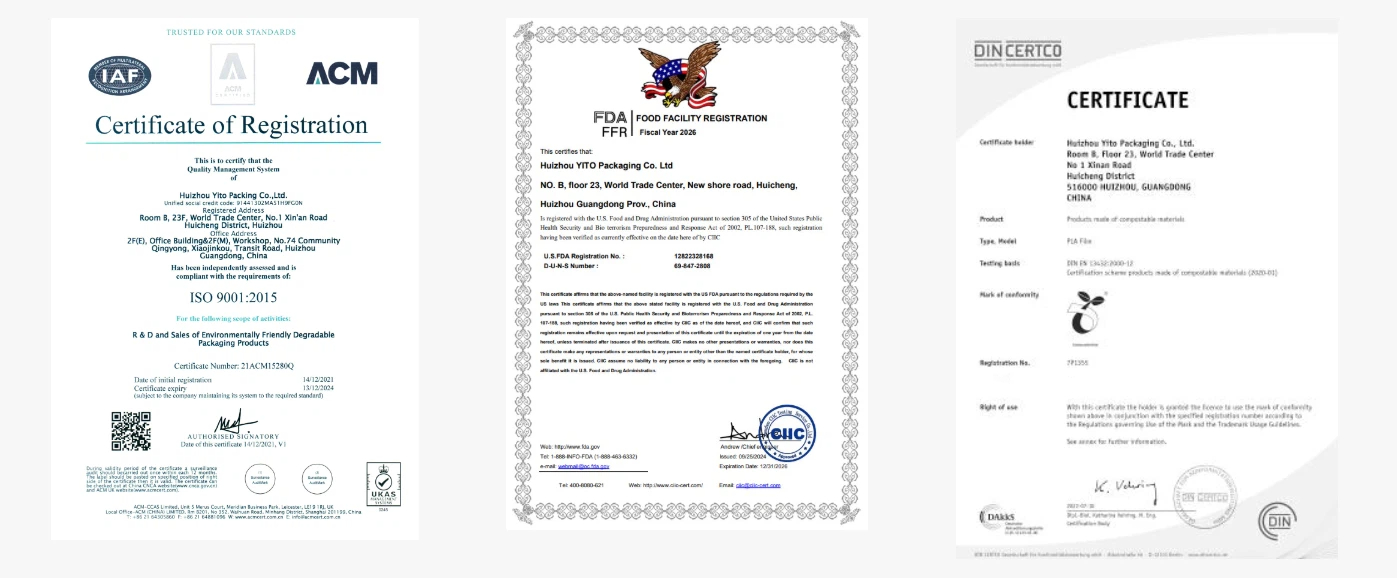
Project files may include applicable food-contact documents, BS EN 13432 industrial-compostability evidence and ISO 9001-related quality records. We also review coatings, inks, adhesives and closures instead of treating one base-film certificate as proof for every finished bag.
Our value is not simply producing a transparent bag. We help connect the product, bag structure, documents, testing and repeat-order controls within one project. This reduces unclear claims, packing-line problems and variation between samples and mass production.
Conclusion
A successful biodegradable cellophane bag project needs to do three things at once: protect the product, support the brand and stand up to purchasing and compliance checks.
That means looking beyond the green label. Confirm the material, market, evidence, performance, packaging data and production controls. Then test the finished bag before committing to volume.
From our side as a packaging seller, the aim is not to push every buyer toward the same bag. It is to develop a structure that suits the product and can be produced consistently when the next order arrives.
YiTo Pack supports that process from material review and sampling through production-line testing and bulk supply. In the end, a reliable packaging decision should rest on two things: what the bag can prove and how well it performs in real use.
FAQ
Does BS EN 13432 Cover the Entire Finished Bag?
Not automatically. The evidence must be checked against the finished structure, including the film grade, thickness, coating, printing, adhesive and closure. If a non-compostable component remains attached and cannot be easily separated before disposal, the whole package should not automatically be described as compostable.
Is Regenerated Cellulose Subject to UK Plastic Packaging Tax?
It depends on the actual material. Cellulose-based polymers that have not been chemically modified, such as viscose, are not treated as plastic for the tax, while chemically modified cellulose materials may be. Biodegradable or compostable wording alone does not determine the tax treatment.
Does EU Regulation 10/2011 Apply to Every Cellophane Bag?
No. Regulation 10/2011 primarily covers plastic food-contact materials. Regenerated cellulose film has material-specific requirements, so buyers should identify the exact polymer and check the relevant Great Britain or Northern Ireland regulatory route.
Can Compostable Cellophane Bags Go in UK Food-Waste Bins?
Not automatically. Collection rules depend on the local authority and waste contractor. Current guidance for workplaces in England says packaging labelled biodegradable or compostable should not be placed in ordinary food-waste collections unless a dedicated collection route accepts it. Buyers should confirm the disposal route before printing disposal instructions.
Does Compostable Packaging Avoid UK EPR Reporting?
No. Compostability does not automatically remove UK packaging EPR obligations. Businesses within the relevant scope may still need to record and report the finished bag’s material, weight, components and packaging activity. The UK buyer should check the latest official requirements for its organisation.
Related Reading
Are Cellophane Bags Biodegradable? The Complete Material Science Answer
Biodegradable Cellophane Bags Wholesale: A B2B Sourcing Guide
Biodegradable Cellophane Bags in Australia: Import Requirements & Sourcing
Related Products


Post time: Aug-07-2026