
Bulk buying biodegradable cellophane bags looks simple. The bags are clear, the supplier mentions sustainability, and the quotation seems easy to compare. Yet many projects go wrong here: vague material descriptions, base-film-only certificates, and samples that do not match production.
A sound decision comes down to material identity, finished-bag evidence, application performance, sample repeatability, and supplier control. YiTo Pack checks these points before the order is finalized.
|
Buyer check |
What a reliable supplier provides |
| Material | Polymer, grade, thickness, coating, and structure |
| Evidence | Documents matching printing, adhesives, and seals |
| Application | Advice based on product, packing, storage, and transport |
| Trials | Samples or pilot orders for line tests |
| Repeatability | Approved specifications and change control |
Are the Quoted “Cello Bags” Genuine Regenerated Cellulose?
“Cello bag” is used very broadly. One supplier may mean regenerated cellulose; another may be quoting OPP, BOPP, CPP, PE, or another clear film. They may look alike on screen, yet behave differently in sealing, moisture resistance, printing, and disposal.
Before comparing price, ask for the polymer name in writing. The quotation should state the film grade, thickness, tolerance, coating, and film source, making clear whether extra layers are present.
YiTo Pack starts with this check. When buyers compare cellulose film bags and conventional plastics, we explain the trade-offs in clarity, sealability, moisture protection, machine handling, certification, and end-of-life routes.

Does the Compostability Evidence Match the Finished Bag?
A certificate for an unprinted base film does not automatically apply to a finished package. Printing inks, coatings, heat-seal layers, adhesive strips, labels, ties, zippers, and sealants all become part of the structure.
The useful question is not, “Does the supplier have a certificate?” It is, “Does the evidence cover the exact bag I am buying?”
Check the grade, thickness range, coating, printing system, adhesive, closure, and bag format. Industrial compostability, home compostability, soil biodegradation, and marine biodegradation are separate claims.
For custom compostable cellophane bags, YiTo Pack reviews the film together with printing, coatings, sealing, and accessories. We clarify what is supported and which claim suits the market. This matters especially for compostable cellophane bags for food packaging, where food-contact and compostability files must both match the final structure.
Can the Bag Protect Products and Run on Existing Lines?
A bag can look excellent in a photo yet cling, open slowly, seal poorly, or lose shape on the line.
Bakery products may need clear display and moisture control. Oily foods need grease resistance. Aromatic products need aroma retention. Sharp items may require stronger puncture performance.
|
Input |
What buyers should provide |
| Product | Type, shape, pack weight, and filling method |
| Storage | Temperature, humidity, duration, and protection target |
| Line | Manual, semi-automatic, or automatic |
| Sealing | Equipment, temperature, pressure, and speed |
| Transport | Distance, stacking, and handling |
YiTo Pack reviews these conditions before recommending material, thickness, size, gussets, seals, or print positions. For cellulose bags for bakery products, easy opening, clarity, and moisture behavior may matter most. For an eco-friendly cellophane bag on a semi-automatic line, feeding stability may be the bigger issue.
The practical rule is simple: test the real product in the real bag, on the real equipment.

How to Choose a Reliable Supplier
A reliable supplier does not rush straight to price. It first asks what you are packing, how much goes into each bag, how it will be closed, how long it must remain protected, and where it will be sold.
Material descriptions should be specific, certificates traceable, and the approved sample converted into a written production standard.
|
Area |
Reliable supplier |
Warning sign |
| Material | States polymer, grade, thickness, and coating | Uses only “cello” |
| Documents | Matches evidence to the finished bag | Sends generic certificates |
| Application | Reviews product, sealing, and storage | Quotes without questions |
| Replication | Converts samples into specifications | Cannot define tolerances |
| Quality | Checks dimensions, seals, print, and packing | Has no written criteria |
| Commercial | Explains MOQ, fees, lead time, and reorders | Shows only unit price |
| Changes | Seeks approval before changes | Changes materials silently |
YiTo Pack uses these checks during specification review, OEM and ODM development, printing, sampling, and heat-seal trials. The aim is to repeat the approved result when the order grows.
What Should Be Defined Before Requesting a Quote?
Quotations only become useful when suppliers are pricing the same thing.
|
RFQ item |
Details to define |
| Material | Substrate, coatings, and functions |
| Size | Gauge, tolerance, width, length, gusset, and seal area |
| Bag | Flat, gusseted, center-seal, adhesive, or heat-sealed |
| Printing | Colors, coverage, location, and registration |
| Packing | Quantity, labels, cartons, and pallets |
| Delivery | Destination, Incoterms, timing, and required files |
Also define odor, clarity, opening, seal strength, food-contact needs, and machine compatibility. YiTo Pack turns these inputs into a measurable RFQ.
How Should Wholesale Quotes Be Compared?
The lowest unit price is not always the lowest project cost. Separate one-time charges—plates, samples, tooling, inspection, and artwork—from repeat-order pricing. Then add freight, labor, rejects, repacking, idle inventory, product loss, and after-sales risk.
A slightly more expensive sustainable cellophane bag may cost less overall if it opens consistently, seals cleanly, and keeps rejects low.
YiTo Pack states specifications, packing assumptions, lead time, and reorder conditions clearly.
Can the Supplier Reproduce the Approved Sample?
A sample is useful only when it becomes a production reference.
|
Sample item |
What to verify |
| Material | Film name, grade, coating, and source |
| Dimensions | Thickness, width, length, gusset, and tolerance |
| Opening and seal | Ease of opening, seal width, and strength |
| Printing | Color, position, registration, and adhesion |
| Appearance | Clarity, odor, cleanliness, and packing |
Keep an approved reference sample, and require approval for changes to film, coating, ink, adhesive, equipment, or process.
YiTo Pack connects the sample to formal specifications and inspection points. Film receiving, printing, slitting, sealing, counting, and cartoning are checked against that reference.
Which Applications Suit Regenerated Cellulose Bags?
Regenerated cellulose suits products that benefit from transparency, a crisp premium feel, and plant-based positioning. Typical uses include bakery, confectionery, tea, dry food, flowers, gifts, apparel, stationery, and selected fresh produce.
For buyers searching for transparent compostable bags, the application still comes first. Heavy moisture, severe freezing, sharp contents, or demanding puncture resistance may require a coating, laminate, or another substrate.
The same logic applies to compostable cigar bags, although moisture exchange, aroma protection, size accuracy, and long-term storage become more important. YiTo Pack compares cellulose bags, PLA, and conventional films by performance, certification, cost, processing, and disposal goals.

How YiTo Pack Develops a Wholesale Cellophane Bag Project
YiTo Pack will first comprehensively sort out the customer's packaging product attributes, customized sizes, packaging operations, procurement volume, printing needs, target market compliance standards and environmental protection publicity positioning, and then recommend suitable film material grades and coating solutions, film thickness, bag style and sealing structure.
Customers can test the opening and closing fluency, heat seal stability, printing quality, storage resistance and product protection effect of packaging bags on the spot through sample testing and small batch trial production. Before the official mass production, we will finalize sample standards, product specifications, printed manuscripts, tolerance ranges, packaging, testing standards, qualification documents and delivery rules one by one to ensure the stability of the quality of large-scale goods in an all-round way.
Why Choose YiTo Pack?
Since its establishment in 2017, YiTo Pack has been deeply involved in the field of fresh food and food packaging customization, focusing on providing adaptive packaging solutions for various foods such as fruits and vegetables, baking, and candies. We undertake the whole process of material selection, size customization, printing design, sealing structure, proofing testing, and trial order mass production.
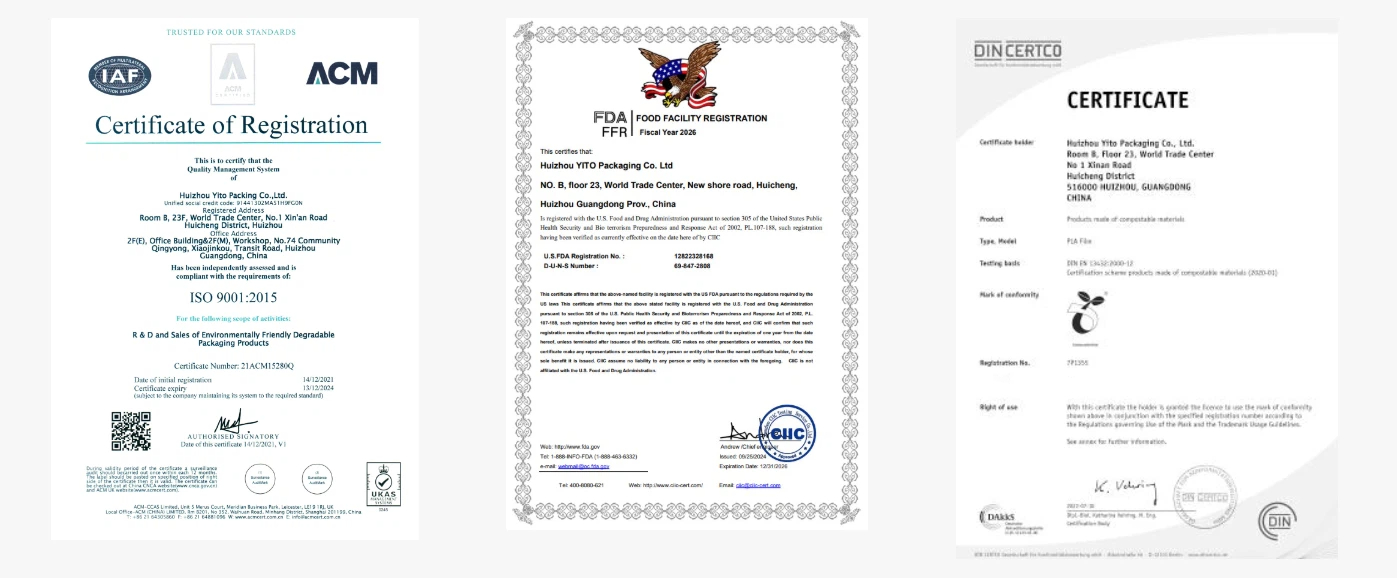
Relying on the ISO 9001 management system, the factory strictly controls the whole process of raw material warehousing, production and processing, printing testing, sealing testing, finished product quality inspection, and batch traceability. For compostable packaging projects, we will comprehensively verify the comprehensive performance of films, coatings, inks, adhesives, labels, and sealing accessories, and strictly comply with international standards such as EN 13432, ASTM D6400, and BPI, while taking into account food safety and actual terminal use needs.
Conclusion
Reliable sourcing starts with a clearly defined finished bag, not a broad environmental label. Material identity, certificate scope, performance, commercial terms, sample repeatability, quality control, and change management all need to line up.
YiTo Pack combines cellulose expertise, customization, document review, trials, quality control, and repeat-order management. Whether the project involves biodegradable cellophane bags, transparent compostable bags, or a custom sustainable cellophane bag, the goal stays the same: build a structure that works in production and can be repeated.
FAQ
Are all wholesale "Cello bags" biodegradable?
Not really. "Cello bag" is only a general name for transparent packaging, and does not represent the specific material. When purchasing, it is necessary to verify whether it is a regenerated cellulose base material, and at the same time verify the degradation qualification of the entire packaging structure, and cannot be judged based on the name alone.
Cellophane bag with print, will it retain compostable properties?
It can be achieved, but only if the ink used, surface coating, adhesive layer and the entire printing structure are all included in the coverage of official compliance qualifications.
Wholesale price of cellophane bags from different suppliers, why is there such a big gap?
Prices are affected by multiple factors, such as film material grade, thickness, coating process, bag style, printing scheme, MOQ, size tolerance, packaging delivery, trade terms, and compliance document requirements, which will directly widen the quotation gap.
Can a qualification certificate cover all sizes and thicknesses of products?
Not necessarily. For procurement, it is necessary to focus on checking the suitable film material model, thickness range, coating requirements and structural restrictions marked in the certificate, and do not default to universal full coverage.
When purchasing new packaging, is it recommended to place a trial order first?
Very necessary. Especially for projects that use new materials, new structures, new suppliers, or adapt to new production lines, trial orders can verify product performance and mass production stability in advance, avoiding the risk of large-scale procurement.
Related Reading
Are Cellophane Bags Biodegradable? The Complete Material Science Answer
Biodegradable Cellophane Food Bags: Material Specs & Compliance for B2B Buyers
Biodegradable Cellophane Bags in the UK: Supplier Guide & Compliance Overview
Contact YiTo Pack to request fruit label sticker samples or get a custom quote for your next fresh produce packaging project.
Related Products


Post time: Jul-28-2026