
PLU codes are managed by IFPS and are mainly used for loose fresh produce identification at retail checkout. They help distinguish product type, variety, size and growing method, but they should not be treated as a full traceability system. For export and supermarket programs, eco-friendly PLU stickers usually need to work together with carton labels, pallet labels, barcodes or GS1 DataBar requirements. A wrong PLU sticker rarely fails at artwork approval. It fails on the packing line, at the distribution center, or during a buyer audit—after production has already started.
For growers, packers, and exporters, the real question is not just "What do the numbers mean?" It's, "Will this sticker work on our fruit, on our line, and in our buyer's system?"
Key points:
- · 4-digit codes = conventional produce; 9-prefix = organic
- · PLU alone does not cover batch traceability, carton or pallet labeling
- · Machine compatibility must be confirmed before sampling, not after
- · Material and adhesive must match the fruit surface and cold-chain condition
What PLU Codes Actually Do
PLU stands for Price Look-Up. It identifies loose fresh produce at retail checkout—variety, size, and growing method. It is not a traceability system, and it does not cover everything a produce supply chain needs.
For B2B programs, three things must be confirmed before ordering:
1. Does the code match the correct fruit, variety, size, and growing method?
2. Will the sticker stay attached and readable through cold-chain handling?
3. Will the roll format run on your labeling machine?
Most label problems are not discovered during artwork review. They appear when the product reaches the packing line, distribution center, or retail checkout—after production has already started. That's the risk this article helps you avoid.

What PLU Codes Mean
| PLU Code | Common Meaning |
|---|---|
| 4011 | Banana |
| 4131 | Apple |
| 4032 | Lemon |
| 4065 | Avocado |
4-digit codes cover conventional loose produce — apples, citrus, avocados, bananas, kiwifruit and most common fruit.
One code does not always cover all sizes or varieties. If you pack multiple sizes or two similar-looking varieties, confirm the correct code for each before printing.
5-digit codes starting with 9 indicate organic produce. The base code stays the same; the 9 prefix is added at the front. A wrong organic PLU can cause pricing errors or fail buyer product review.
Note: a PLU code does not replace organic certification documents. It supports identification only.
On the "8 = GMO" rule: older references say 8-prefix codes indicate GMO produce. In current practice, this prefix is rarely used and not mandatory. Do not rely on a leading digit alone to judge growing method — confirm with the buyer and supporting documentation.
Do not create your own PLU numbers. If you need lot tracking, supplier codes or internal traceability, that data belongs on a barcode, QR code, GS1 DataBar or carton label — not the PLU.
From PLU Number to Retail Label
A PLU code is only the first step. To become a working fruit label, it must pass through printing, roll conversion, machine application and retail use.
Typical process:
PLU Number → Printing → Sticker Roll → Labeling Machine → Fruit Application → Retail Checkout
This is why a PLU sticker should not be evaluated only by artwork. A label that looks correct on screen may still fail during roll feeding, automatic application, cold-chain transport or POS scanning.
What Does Your Buyer Actually Require on the Label?
Before finalizing artwork, confirm what information the buyer needs — and in what format.
Some retail programs only require a human-readable PLU number. Others require barcode scanning at POS. If scanning is required, the label may also need a GS1 DataBar or standard barcode.
GS1 DataBar is commonly used on small fruit stickers because it encodes more data in less space than a UPC barcode. This matters on small labels where the PLU number, logo and barcode all need to fit without reducing scan reliability.
Also confirm: Is a GTIN required? Does the label need country-of-origin text, a QR code, or specific brand content? Each element competes for space. If the logo is too large, the barcode becomes too small to scan reliably. If the PLU number is too small, cashiers cannot read it manually.
The safest approach: treat PLU number and barcode as fixed functional requirements. Design branding around them — not the other way around.

PLU Sticker or Full Traceability Label?
This is where many programs have gaps.
A PLU sticker label answers one question at retail: what is this fruit and how should it be priced?
It does not carry a batch number, pack date, supplier code, harvest origin, or logistics data. Those belong on the carton label or pallet label.
For export programs or supermarket supply chains, the labeling system should work in layers:
|
Label |
Purpose |
| PLU fruit sticker | Retail item identification |
| Carton label | Lot, pack date, supplier, case barcode |
| Pallet label | Shipment, warehouse receiving, and distribution |
If your buyer requires POS scanning, a GS1 DataBar or barcode can be added to the PLU sticker. But that still does not replace case-level or pallet-level identification.

Custom PLU Fruit Sticker Options
| Item | Options |
|---|---|
| Label Material | Standard paper, coated paper, BOPP synthetic paper, BOPP film, PLA, cellophane, biodegradable film |
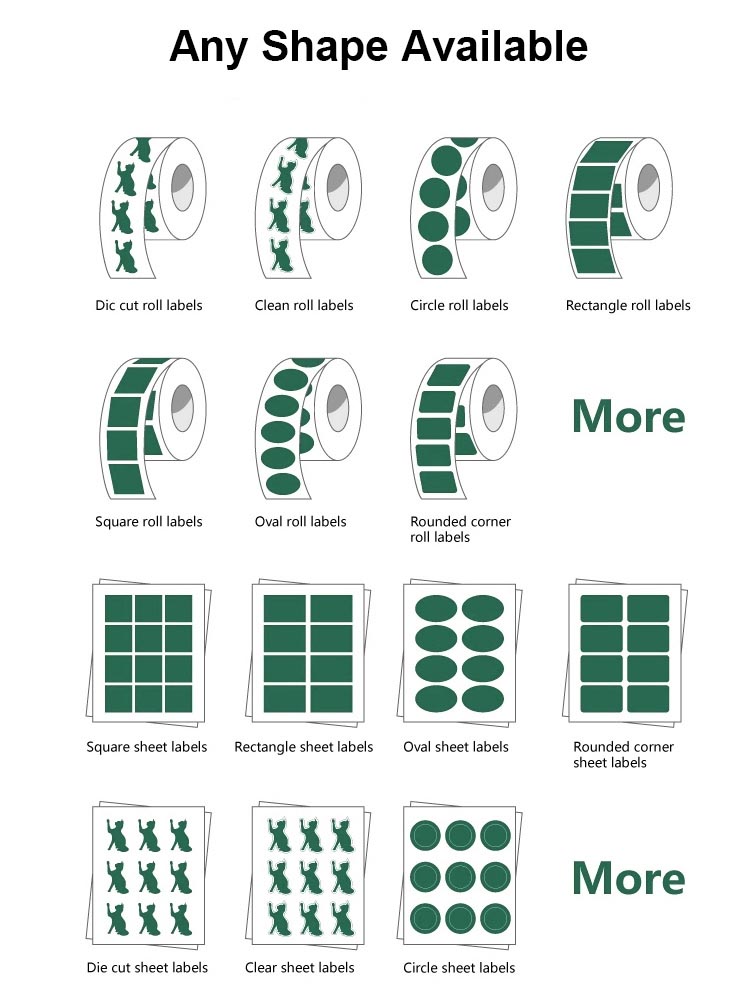
| Label Shape | Round, oval, rectangle, custom die-cut |
| Label Size | 20×20 mm, 25×16 mm, 30×20 mm, 38×25 mm, or custom |
| Print Content | PLU code, barcode, GS1 DataBar, QR code, logo, origin text |
| Roll Core | 76 mm / 152 mm, or matched to the machine |
| Roll Format | Custom winding direction, label gap, liner release, roll diameter |
| Roll Quantity | 2,000 / 5,000 / 10,000 labels per roll, or custom |
| Application Method | Manual or automatic labeling machine |
| Target Produce | Apples, citrus, avocados, mangoes, bananas, pears, kiwifruit and more |
| MOQ | From 5,000 pcs for custom printed rolls |
| Sample Lead Time | 5–7 days after artwork and specs confirmed |
Adhesive should match the fruit surface—waxed apples, citrus, avocados, and mangoes each behave differently. For automatic lines, confirm roll core, winding direction and label gap before sampling.
Turning a PLU Code into a Working Label
Once the code is confirmed, the next question is whether the sticker will actually work in production.
Fruit surface matters. Waxed apples, smooth citrus, curved avocados and rough pears each behave differently. For waxed fruit, adhesive strength needs to be matched carefully — too weak and the label lifts in cold storage; too strong and it leaves residue on the skin. For curved or small fruit, a smaller oval or round die-cut usually performs better than a larger rectangular label.
Cold-chain performance matters. A sticker that holds at room temperature may lift after refrigeration, humidity or long transport. For export programs, we recommend testing under real supply chain conditions — not just checking whether the label sticks on day one, but whether it stays readable after refrigeration, carton handling and retail display.
Label space is limited. When PLU number, barcode, logo and origin text all need to fit on a small sticker, function comes first. Barcode quiet zone and PLU readability should not be sacrificed for design. If a QR code or sustainability message is also required, the layout needs to be planned carefully before artwork is finalized.
Documentation may be required. Fruit stickers are applied directly to produce, so adhesive, ink and face material may need to be reviewed for food-contact compliance. For EU markets or retailer sustainability programs, compostability or recyclability documentation may also be required. The face material alone is not enough — the full system including adhesive, ink, coating and liner must all be covered.
Three Fruit Label Sticker Project Scenarios
Apple exporter — waxed fruit adhesion Edge lifting after cold storage was the main issue. After switching to a smaller oval die-cut with cold-chain adhesive, label lifting during refrigerated transport dropped significantly. The exporter passed retail receiving inspection without label-related rejections.
Mango packing line — roll format mismatch Feeding errors and line stoppages during peak season traced back to an incompatible roll spec. Once the roll core, winding direction, and label gap were matched to the applicator, throughput stabilized and manual adjustment time was reduced.
Organic supplier — barcode layout for retail approval Limited label space caused barcode readability issues when the logo took too much area. Replanning the layout around PLU and barcode function first — with branding adjusted to fit — resulted in single-round buyer artwork approval, compared to three rounds with the previous supplier.
Regulatory Readiness: Confirm Before Bulk Production
For export or EU-bound produce programs, PLU stickers may need more than good adhesion and clear printing. Buyers may also ask for food-contact, compostability, recyclability or PPWR-related documentation.
Before bulk production, confirm:
- Target market and buyer requirements
- Food-contact status of material, adhesive and ink
- Whether paper, coated paper, BOPP, PLA, cellophane or biodegradable film is used
- Whether compostable claims cover the full label system, not only the face material
- Whether EN 13432, ASTM D6400, FDA, EU 10/2011 or LFGB documents are needed
At YiTo Pack, we review these requirements before production so buyers can reduce approval delays, repeated sampling and sustainability-claim risks.
Why Work with YiTo Pack
Our process starts before artwork. We review fruit type, buyer requirements, target market and machine specs first — because most label failures are specification problems, not printing problems. A sticker that looks right in a PDF can still fail on a Sinclair-style applicator, lift off waxed fruit after three days in cold storage, or lose scan clarity after transport handling.
For PLU fruit sticker projects, we review the full application path: how the label prints, how it releases from the liner, how it applies on the fruit surface, how it runs on the machine, and how it reads at retail checkout.
We support paper, BOPP, PLA, cellophane and biodegradable film options, with custom content including PLU, barcode, QR code, logo and origin text. For projects with food-safety or sustainability requirements, our materials can be supplied with FDA food-contact compliance documentation, EN 13432 compostability certification or ASTM D6400 certification depending on your target market—and we review the full material system, including adhesive and liner, not just the face material.
Sample delivery within 7 days is available for most projects once artwork and specs are confirmed. For time-sensitive packing programs, this gives growers and packers enough time to test adhesion, print clarity, and roll compatibility before committing to bulk production.
We also support related packaging — clamshells, punnets, tray liners, carton labels and freshness films. When labels and packaging are reviewed together, specification gaps are caught before production, not during it.

Conclusion
PLU labeling problems are almost always preventable—if the right questions are asked before artwork, not after bulk production.
If your packing season is within 60 days, send us your fruit type and labeling machine model. We can confirm material direction and roll compatibility within 24 hours.
Not sure where to start? Ask for our PLU sticker checklist for automatic labeling lines.
FAQ
What does a PLU code on a fruit sticker mean?
A PLU code identifies loose fresh produce at retail checkout by product type, variety, size group and growing method.
Are 4-digit and 5-digit PLU codes different?
Yes, 4-digit PLU codes are commonly used for conventional produce, while organic produce usually adds a 9 prefix.
Are PLU stickers enough for produce traceability?
No, PLU stickers support retail item identification, but batch, supplier, pack-date and logistics data usually need carton or pallet labels.
Do PLU stickers need to match labeling machines?
Yes, roll core, winding direction, label gap, and liner release should be confirmed before sampling to avoid feeding errors or line stoppage.
Can PLU stickers include a barcode or GS1 DataBar?
Yes, a barcode or GS1 DataBar can be added when retailers require POS scanning in addition to the human-readable PLU number.
Which material is best for PLU fruit stickers?
It depends on the fruit surface, cold-chain condition, and buyer requirement. Paper, BOPP, PLA and biodegradable film are common options—selection should be confirmed by the project.
What should I send before ordering custom PLU stickers?
Send your fruit type, PLU code, label size, artwork requirement and labeling machine model so YiTo Pack can review material and roll compatibility.
Related Reading
Are Fruit Stickers Edible? What Produce Packers Need to Know
Fruit Label Stickers: Sourcing Guide for Produce Packers
Edible Stickers for Fruit: What Produce Packers Need to Know Before Switching
If your packing season is within 60 days, send us your fruit type and labeling machine model. We can confirm material direction and roll compatibility within 24 hours.
Related Products


Post time: Jul-01-2026