
Fruit stickers are not designed to be eaten intentionally. If a consumer accidentally swallows one small sticker, that is usually treated as accidental ingestion, not intended consumption. For produce packers, exporters, and fruit brands, the bigger question is different: are your fruit stickers food-contact safe, suitable for direct fruit-surface application, compliant with your target market, and reliable through packing, cold-chain handling, and retail display?
A produce sticker may look simple, but it can carry a PLU code, barcode, QR code, country of origin, organic claim, or brand mark. It also contains multiple layers: face material, adhesive, and ink. Each layer affects safety, performance, and documentation.
Key takeaways:
- · “Food-safe” does not mean “edible.”
- · Fruit stickers are usually made from face material, adhesive and ink, and each part should be checked.
- · EU-bound fruit and vegetable stickers now need closer attention under PPWR 2025/40.
- · Packers should request documentation before switching suppliers or confirming bulk orders.
- · YiTo Pack can help buyers compare food-safe and compostable fruit sticker options for export and retail projects.
Are Fruit Stickers Actually Edible?
No, fruit stickers should be removed before eating fruit. They are not food products, and they are not designed to provide nutrition or be digested. If a consumer accidentally swallows a small fruit sticker, it is usually treated as accidental ingestion, not intended consumption. For produce packers, the key point is that the sticker should be safe for direct fruit-surface contact, but it should not be marketed as edible.
That is the consumer-level answer. For a produce packer, it is not enough.
When your company applies stickers directly to apples, citrus, bananas, avocados, mangoes, or pears, you are not only choosing a small printed label. You are choosing a food-contact component used in a commercial packing system. The label material, adhesive, and ink all need to be suitable for the intended use. A buyer, importer, or retailer may not ask whether the sticker is “edible.” They are more likely to ask whether you can provide documentation that supports food-contact safety and, in some markets, compostability.

Why Produce Packers Need a Deeper Answer
“Food-safe” is a regulatory and material-safety concept. It means the material is suitable for its intended contact use under defined conditions. “Edible” means a product is designed to be eaten. These are not the same thing.
A useful way to explain the difference is:
|
Term |
What It Means for Produce Packers |
| Edible | Designed to be eaten; standard fruit stickers usually should not be marketed this way |
| Food-safe | Suitable under intended use, depending on material and application |
| Food-contact safe | Appropriate for contact with the fruit surface under specified conditions |
| Compostable | Designed to break down under defined composting conditions, not designed to be eaten |
For YiTo Pack customers, we usually recommend avoiding the phrase “edible fruit stickers” unless the entire finished label system has been specifically developed and documented for that claim. For most produce projects, the safer and more professional wording is “food-contact safe produce labels” or “fruit stickers suitable for direct fruit-surface application.”
What Makes a Fruit Sticker Safe for Produce Packing?
A compostable fruit sticker is small, but it is not a single-material item. Buyers should look at the sticker as a system made of three main parts: the face material, adhesive, and printing ink.
Face Material, Adhesive and Ink
A fruit sticker may look simple, but it is usually made of three key parts: face material, adhesive, and printing ink. Each part affects food-contact safety, adhesion, readability, and compliance documentation.
Face material: The face material is the visible top layer of the sticker.
Common options include paper, PLA-based material, cellulose film, or other label stocks.
Paper fruit labels are commonly used for standard retail labeling and brand identification.
PLA or cellulose-based labels are often considered for compostable, biodegradable, or lower-plastic projects.
Adhesive: The adhesive determines whether the sticker stays attached during packing, cold-chain transport, and retail handling.
A strong adhesive is not always better.
The goal is controlled adhesion: enough to stay on the fruit, but not so aggressive that it leaves visible residue after removal.
YiTo Pack can support self-adhesive fruit labels with low-halogen, removable, eco-friendly, and biodegradable options. For refrigerated produce, label options can also be designed to reduce edge lifting under low-temperature conditions.
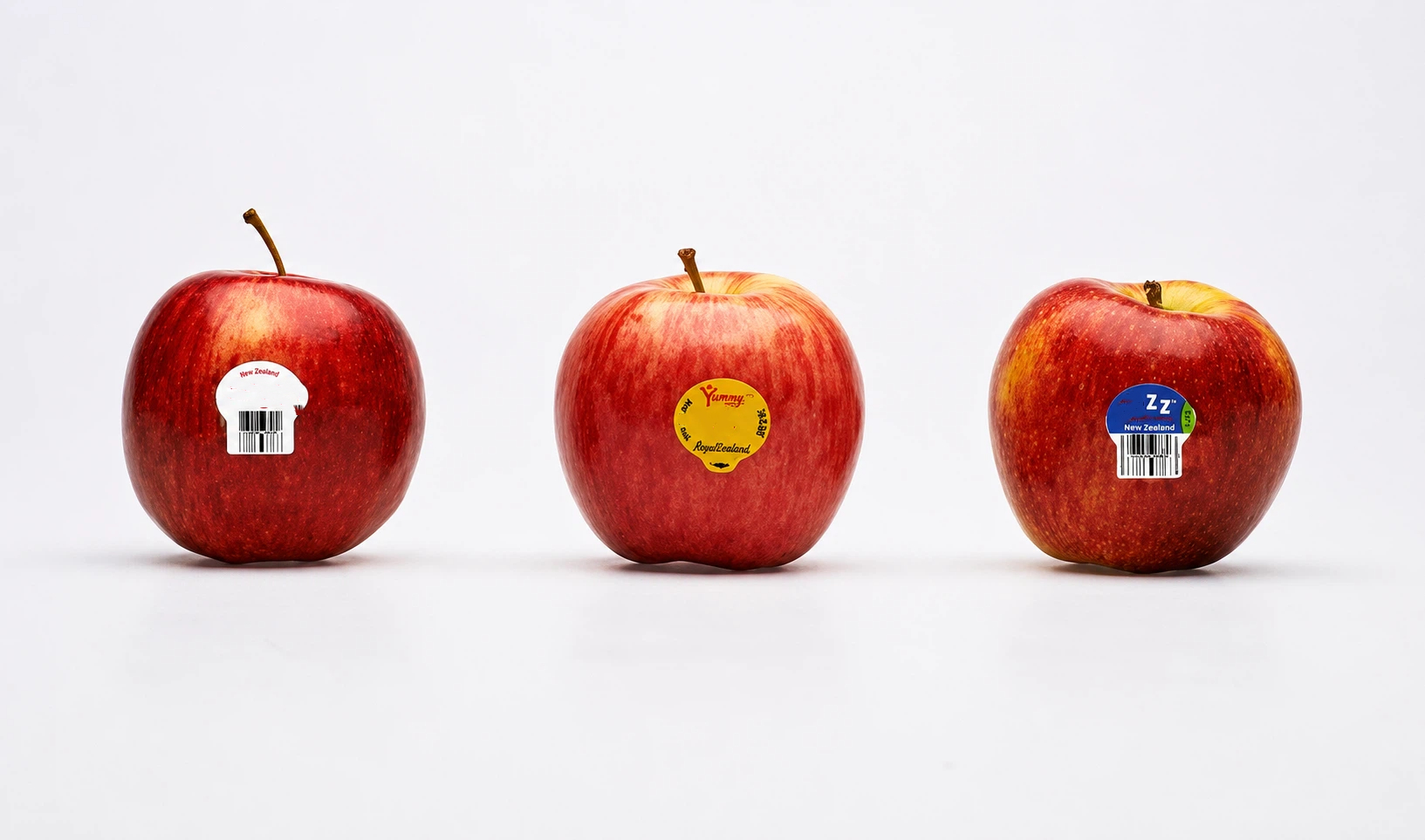
Ink and printing: The ink and printing system affects retail use and traceability. Fruit stickers may carry the following:
PLU numbers
Barcodes
QR codes
Logos
Organic claims
Variety names
Country of origin information
If the ink smudges, fades or fails under cold-chain conditions, the sticker can become useless for retail checkout or traceability.
Custom Fruit Stickers Should Be Matched to the Actual Packing Project
| Custom Option | Available Choices | What Buyers Should Confirm |
|---|---|---|
| Label Material | Paper, PLA, cellulose / cellophane-based material, compostable material options | Target market, compostability requirement, fruit surface and budget |
| Adhesive Type | Food-contact adhesive, removable adhesive, cold-chain suitable adhesive, compostable adhesive options | Fruit skin type, residue control, refrigeration and transport conditions |
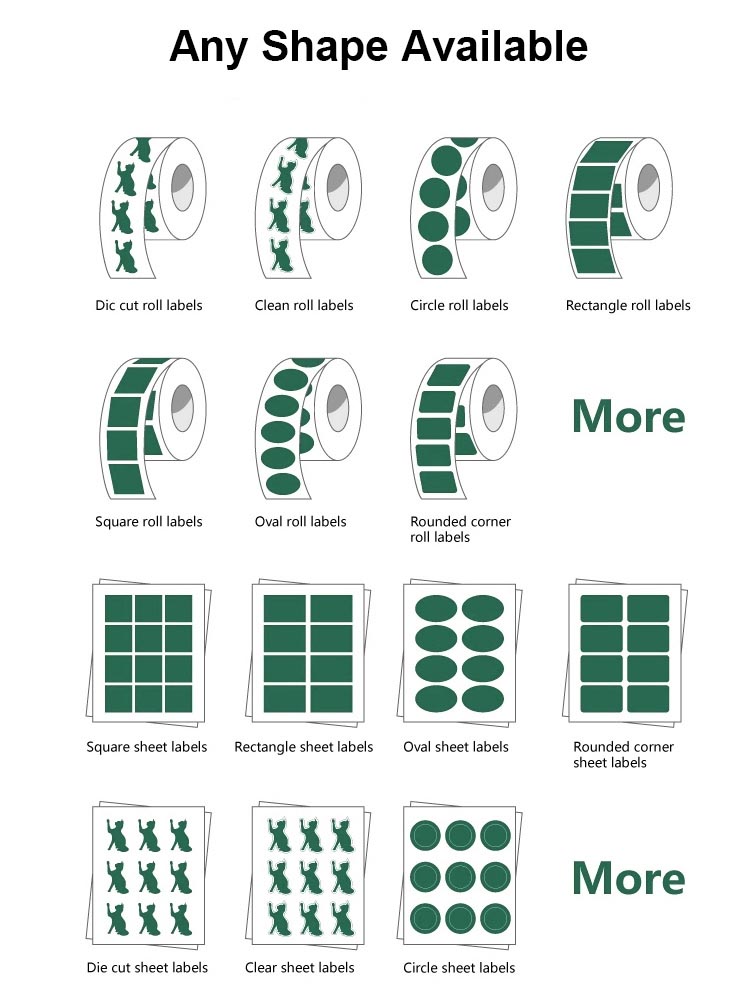
| Label Size & Shape | Round, oval, rectangle, custom die-cut shapes | Fruit size, visible branding area, PLU / barcode space |
| Printing Content | Logo, PLU code, barcode, QR code, origin, variety, organic claim | Retail requirement, traceability need, scan readability |
| Printing Colors | Single-color, multi-color, custom brand colors | Brand design, print clarity, artwork file quality |
Custom fruit stickers should be confirmed based on the actual packing project, not only the artwork. YiTo Pack can help buyers match material, adhesive, printing and roll format according to fruit type, target market and retail labeling requirements.
Why EU PPWR Is Changing Fruit Sticker Sourcing
Food-contact safety is only one part of produce labels' sourcing. For EU-bound produce, compostability is becoming a much bigger sourcing factor.
PPWR 2025/40 Timeline for Fruit and Vegetable Stickers
The EU Packaging and Packaging Waste Regulation, known as PPWR 2025/40, changes how packaging and packaging-related components are evaluated in the EU market. For fruit and vegetable stickers, the most important point is that sticky labels affixed to fruit and vegetables placed on the EU market need to be compatible with industrial composting requirements by the 2028 deadline. In markets where Member States require home composting compatibility, packers may need to check additional local requirements.
For exporters, this changes the sourcing question. It is no longer enough to ask, “Is this sticker food-safe?” You may also need to ask, “Is this sticker compostable under the required standard, and can the supplier provide documentation?”
This requirement affects the whole label system. A compostable face material alone is not enough if the adhesive or ink is not suitable for the intended compostability claim. Buyers should check whether the finished label, or at least the material system being supplied, has documentation that supports the claim.
For more technical comparison, see our guide on compostable produce label specifications.
Compostable Fruit Stickers for Fresh Produce Packaging
For buyers preparing for EU-bound produce programs or sustainability-focused retail projects, YiTo Pack can support compostable fruit sticker options for fresh produce packaging.
✓ Home compostable options for selected projects where home compostability documentation is required
✓ Food-contact safe materials suitable for direct fruit-surface application
✓ Custom shape & printing for PLU codes, barcodes, QR codes, logos and origin information
✓ EU PPWR-ready options for fruit and vegetable sticker projects that require compostability review
✓ Flexible MOQ for brands for sample testing, trial orders and custom label development
YiTo Pack recommends confirming the face material, adhesive, ink, compostability documentation and cold-chain adhesion performance based on your destination market before bulk production.
What Produce Packers Should Check Before Ordering
Before confirming bulk orders, produce packers should check whether the fruit sticker can meet both compliance and real packing requirements.
- Food-contact safety: Can the supplier provide documentation for the label material, adhesive and ink?
- Compostability requirement: If the fruit is sold in the EU or sustainability-focused markets, can the supplier support compostability documentation?
- Fruit-surface fit: Has the sticker been tested on the actual fruit surface, such as waxed, rough, smooth or curved skin?
- Cold-chain performance: Will the sticker stay attached after refrigeration, moisture exposure and transport handling?
- Retail readability: Are the PLU code, barcode or QR code still clear and scannable after packing and display?
A good fruit sticker should not only look correct in the artwork file. It should stay attached, remove cleanly, scan reliably and be supported by the right documentation for your target market.
PLU and barcode performance should not be ignored, because these labels help retailers identify bulk produce, support checkout accuracy and reduce inventory mistakes. At YiTo Pack, we usually ask buyers to share the fruit type, destination market, label size, printing content, application method and compostability requirement before recommending a material. This helps avoid choosing a label that looks good in a sample photo but fails on the packing line.
Why Choose YiTo Pack for Fruit Stickers and Produce Labels?
Choosing food safe fruit stickers is not only about label size or printing design. For produce packers and exporters, the supplier must also understand food-contact safety, compostable material requirements, retail labeling and stable bulk production. When choosing a fruit sticker supplier, buyers should check not only price and label size but also food-contact documentation, adhesive performance, and compostability support.
What YiTo Pack supports:
- 15+ years of packaging experience
- Export service to 50+ countries
- One-stop compostable packaging solutions
- OEM & ODM custom support
- Rapid prototyping and sample development
- Stable supply chain for bulk orders
- Food-grade and compostability documentation support
For fruit sticker projects, we can help you compare suitable label materials, adhesives and printing options based on fruit type, target market, PLU or barcode requirements, and compostability needs. Our team can also support rapid prototyping, sample testing, and document review before bulk production.
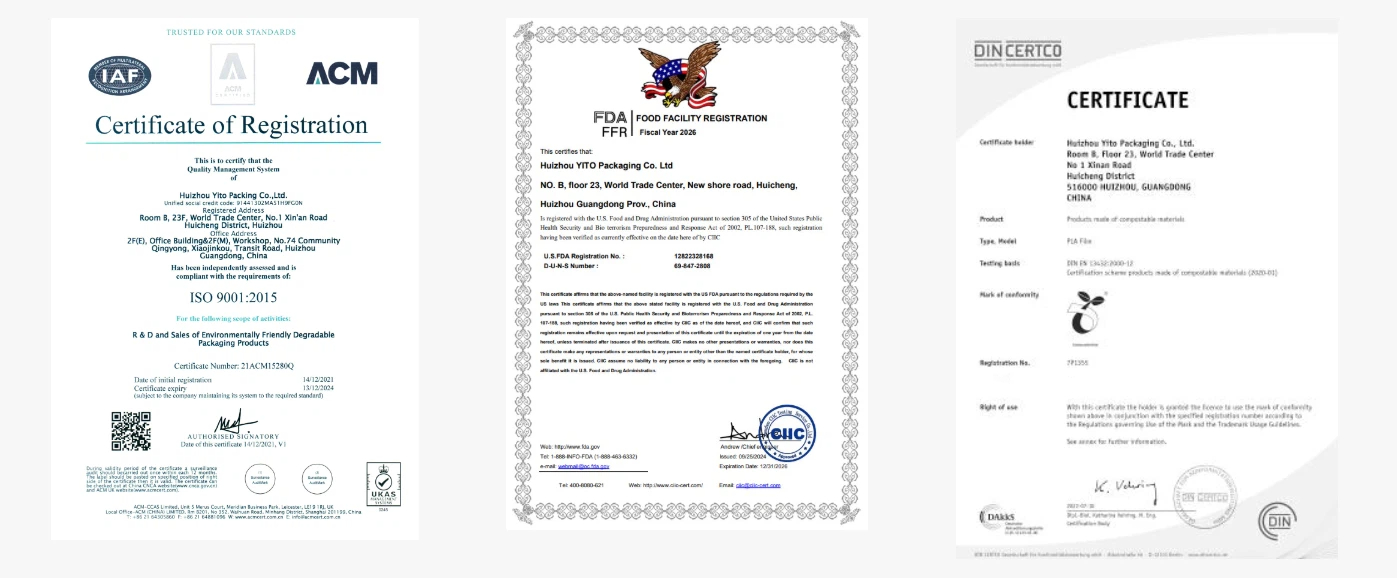
YiTo Pack’s packaging solutions can be supported with food-grade and compostability-related documentation depending on material and project requirements, including options aligned with EN 13432, ASTM D6400, FDA food-contact requirements, and ISO 9001 quality management.
Conclusion
For consumers, the answer is simple: remove the sticker before eating.
For produce packers, the better question has always been different. Can your fruit sticker safely contact the fruit surface, stay attached through cold-chain handling, support retail scanning, and meet your buyer's documentation expectations — including compostability, if your produce is heading to the EU?
If you are not sure, that uncertainty is worth resolving before your next bulk order.
YiTo Pack helps packers and exporters compare food-safe and compostable fruit sticker options based on fruit type, target market, and compliance requirements. Contact us to request a sample or start a material review.
FAQ
Q: Are fruit stickers edible?
A: Fruit stickers are not designed to be eaten intentionally. They may be made with materials suitable for food-contact applications, but “food-contact safe” does not mean the sticker is a food product. Consumers should remove fruit stickers before eating fruit.
Q: What happens if someone accidentally eats a fruit sticker?
A: Accidentally swallowing one small fruit sticker is usually treated as accidental ingestion, not intended use. For produce packers, the more important responsibility is to make sure the label material, adhesive and ink are suitable for direct fruit-surface application and supported by proper documentation.
Q: Are compostable fruit stickers the same as edible fruit stickers?
A: No. Compostable and edible are different concepts. A compostable fruit sticker is designed to break down under defined composting conditions. It is not designed to be eaten. Packers should check whether the face material, adhesive and ink support the compostability claim.
Q: Do EU-bound fruit stickers need to be compostable?
A: For fruit and vegetable stickers placed on the EU market, compostability is becoming an important sourcing requirement under PPWR 2025/40. Exporters should check whether their current fruit stickers can meet industrial composting requirements and whether additional local requirements apply in the destination country.
Q: Can YiTo Pack provide compostable fruit stickers?
A: YiTo Pack can help growers, packers and exporters compare fruit sticker materials based on fruit type, target market, label function and compostability requirements. For export projects, we recommend checking material documentation and testing samples before confirming bulk orders.
Related compostable fruit label guides
Are Fruit Stickers Compostable? How to Tell and Why It Matters
Biodegradable vs Compostable Fruit Stickers: Which Do You Need for PPWR Compliance?
Edible Stickers for Fruit: What Produce Packers Need to Know Before Switching
Need Food-Safe or Compostable Fruit Stickers for Your Export Project? YiTo Pack helps buyers compare food-safe fruit stickers, compostable produce labels, and PLU label options based on fruit type and target market.
Related Products


Post time: Jun-23-2026