
Fruit label stickers may look small, but the wrong specification can create real problems for produce packers. A label may lift after refrigeration, a barcode may fail to scan at checkout, or a roll format may not match the automatic labeling machine. For export, organic produce, or supermarket supply, missing documentation can also delay approval or increase purchasing risk.
At YiTo Pack, we do not treat fruit label stickers as simple printed labels. With over 15 years of packaging experience and export service to 50+ countries, we review fruit type, surface condition, label material, adhesive choice, cold-chain condition, roll format, printing content, and documentation needs before sample production.
If you are sourcing PLA fruit labels, cellophane fruit labels, BOPP fruit labels, biodegradable fruit stickers, or label wrap solutions, this guide will help you choose a safer specification before bulk production.
Why Fruit Label Stickers Are More Than Small Printed Stickers
A compostable fruit label that fails at retail checkout costs more than a branding mistake—a barcode that won't scan means a cashier keying in the PLU manually, a line backing up, and a packer fielding the complaint call. For B2B produce packaging, the sticker carries real operational weight: checkout speed, inventory accuracy, and whether a customer trusts what's on the shelf.
A complete fruit label sticker usually includes the face material, adhesive, printing ink, release liner, roll format, label gap, core size, and supporting documents. If one part is wrong, the full label may fail.
A biodegradable sticker label may look good on artwork but still lift after refrigeration. A barcode may look clear on screen but fail after being applied to a curved fruit surface. A roll may look correct, but still cause problems on an automatic labeling line if the roll direction or label gap is wrong.
That is why we suggest reviewing fruit labels as a system, not as a single sticker. Before quoting, we usually start by reviewing the fruit surface, target market, label material, printed information, and labeling method. These points decide whether the label can work in real packing conditions.

Custom Fruit Label Sticker Solutions
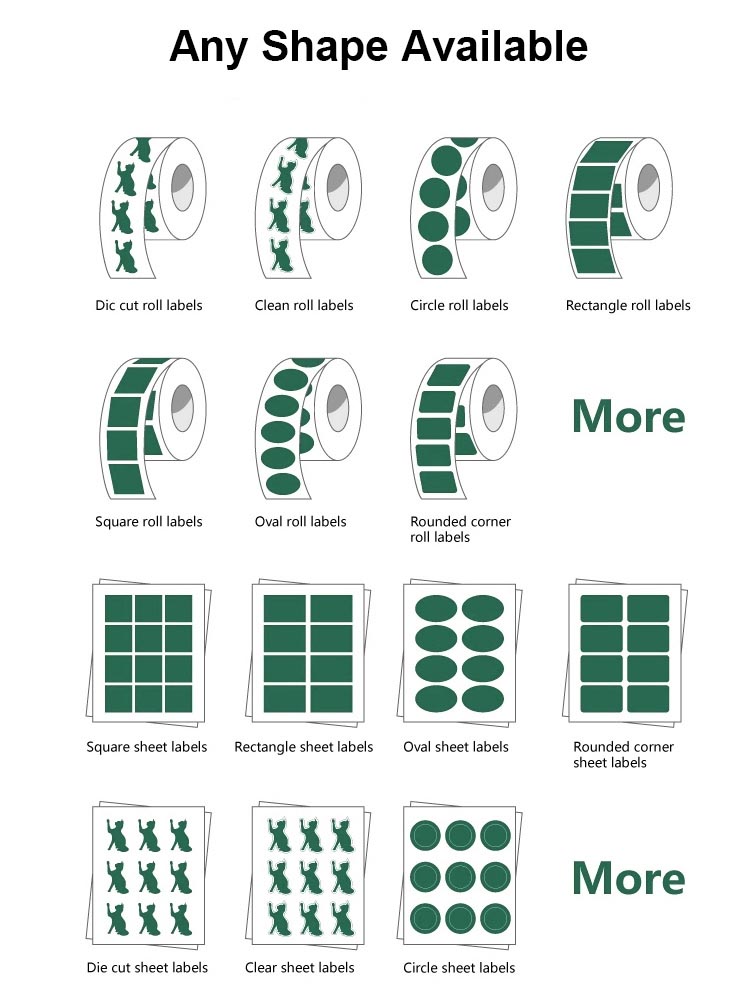
YiTo Pack supports custom fruit label stickers for produce packers, exporters, fruit brands, and supermarket supply programs. Customization is not limited to logo printing. We can help adjust label size, shape, material, adhesive, printing content, roll format, and label wrap structure according to your fruit surface, packaging format, labeling method, and target market.
|
Custom Item |
YiTo Pack Support |
| Label size and shape | Round, oval, rectangle or custom die-cut labels |
| Printing content | Logo, PLU, barcode, QR code, origin text |
| Material options | PLA, cellophane, BOPP, coated paper, art paper, gloss paper |
| Adhesive options | Strong, removable, no-residue, biodegradable |
| Roll format | Roll direction, core size, label gap |
| Sample development | Sample testing on real fruit |
| OEM / ODM support | Custom structure and artwork |
Simple and practical: your fruit label should look good, scan clearly, peel smoothly, and work reliably on the real fruit surface before bulk production.
PLU, Barcode and QR Code Layout
For fruit label stickers, printed information must stay readable after packing, cold storage, and retail display. PLU codes, barcodes, and QR codes support product identification, checkout, inventory management, and traceability.
Before artwork approval, the label should reserve enough space for clear code printing and scanning. For YiTo Pack projects, we usually recommend a 100% scan success target on approved samples before bulk production, especially for supermarket, export, and automatic labeling programs.
For organic produce, the 5-digit organic PLU code may also need to be considered. If the retailer requires GS1 DataBar or GTIN labeling, this should be confirmed before sample production.
Match the Adhesive to the Real Fruit Surface
Strong adhesion alone can be the wrong answer. A label that holds too well on a banana can leave residue when a consumer peels it off at home — and that complaint lands on the retailer, not the supplier. The right adhesive choice depends on the fruit surface, the cold-chain conditions it'll travel through, and how easily it needs to come off.
Smooth or waxed fruit may need stable surface contact. Textured fruit such as citrus may need better initial tack. Curved fruit such as bananas or pears needs a label that can stay flat without edge lifting. Loose supermarket fruit may need clean removal, while export fruit may need stronger adhesion during refrigerated transport.
YiTo Pack can provide biodegradable adhesive options based on your project. We help buyers choose between stronger adhesion, clean removal, no-residue performance and biodegradable adhesive solutions according to the fruit type, target market and packaging claim.
|
Adhesive Factor |
What to Check |
| Fruit surface | Smooth, waxed, textured, curved or rough |
| Handling condition | Retail display, moisture exposure or cold-chain transport |
| Removal need | Strong adhesion, clean removal or no-residue performance |
| Sustainability need | Standard adhesive or biodegradable adhesive option |
Practical targets to aim for include ≥95% label retention, clean removal, and no visible edge lifting — though the exact benchmark depends on the fruit type, storage condition, and sales channel.
A case from one of our citrus export projects over the past two years shows why this matters. A trial batch of an estimated 30,000–50,000 labels passed artwork review without issue, but after the fruit moved through cold storage and into retail display, some label edges began lifting on the textured citrus skin. The cause wasn't print quality — it was condensation during temperature changes reducing the adhesive's initial contact strength on a slightly rough, curved surface. The fix involved adjusting the adhesive direction and trimming the label size slightly for better surface contact, then re-testing on real citrus through refrigerated storage and a 3-day retail-display simulation. The revised label held with no visible edge lifting. It's a reminder that adhesive performance on artwork and adhesive performance on a cold, textured fruit surface are two different tests.
Choose the Right Material: PLA, Cellophane, BOPP or Coated Paper
A cheaper label material that fails a retailer's compostability audit costs far more than the per-unit savings. Material choice needs to start from the target market and packaging story—is this going into an EU compostable program, a conventional supermarket line, or an export cold chain—not from the unit price on a quote sheet.
YiTo Pack supports fruit label stickers in PLA, cellophane, BOPP, coated paper, art paper, gloss paper, and other material options, with biodegradable adhesive solutions available by project.
Quick Material Match by Sourcing Scenario
Different produce programs do not need the same fruit label material. Before choosing PLA, cellophane, BOPP, coated paper, or a label wrap structure, buyers should first confirm the target market, retail channel, cold-chain condition, sustainability claim, and printing requirements.
| Sourcing Scenario | Recommended Material | Buyer Value |
|---|---|---|
| EU compostable produce program | PLA / cellophane | Better aligned with compostable and plastic-reduction requirements, easier to support environmental compliance review |
| Standard supermarket retail | BOPP / coated paper | Stable cost, clear printing performance, suitable for high-volume retail labeling programs |
| High-humidity cold-chain handling | BOPP / special coating | Improved moisture resistance, helping labels stay stable and reduce lifting during refrigerated transport |
| Organic fruit brand | PLA / coated paper with suitable documentation | Supports organic or sustainability positioning while keeping good print quality and brand presentation |
| Premium branded produce | Coated paper / gloss paper / label wrap | Better visual presentation for logos, origin text, PLU codes, barcodes, QR codes, and retail information |
| Fruit clamshells, tubes or gift packs | Label wrap / wrap-around label | Provides more space for branding, PLU, barcode, QR code, origin text and promotional information |
This table is a starting point for narrowing down the direction. The final specification still depends on your retailer's documentation requirements, fruit surface, adhesive choice, labeling method, and how the label performs once production starts.
PLA Fruit Label Stickers
PLA fruit label stickers are suitable for projects that need a compostable or biodegradable packaging direction. They are often used for organic fruit programs, premium produce brands, EU-bound produce, sustainability-focused retail programs, and compostable fruit packaging projects.
If your fruit packaging already uses compostable clamshells, punnets, tray liners, or freshness film, PLA fruit labels can help make the packaging system more consistent. PLA face material being compostable doesn't make the whole label compostable. If the adhesive or ink isn't certified to the same standard, a retailer's sustainability audit can flag the label even though the base film passes — which means the adhesive and ink certifications need to be confirmed before anyone makes a compostable claim on packaging.

Cellophane Fruit Labels
Cellophane fruit labels are a good option when buyers want a cellulose-based biodegradable label material. They are especially suitable for fruit brands that want to reduce conventional plastic use and keep the packaging story closer to natural or biodegradable materials.
For example, if your project already uses biodegradable film, compostable trays or plastic-reduction packaging, cellophane fruit labels can help the label match the same direction. YiTo Pack can support cellophane fruit label options depending on printing, adhesive, roll format and documentation requirements.
BOPP Fruit Labels
BOPP fruit labels are still common in standard retail programs. They offer stable printing, moisture resistance and good handling performance. For conventional supermarket supply, BOPP can still be practical.
But if your project needs biodegradable, compostable, plastic-reduction, or stronger paper-based brand presentation, you should compare BOPP with PLA, cellophane, or coated paper before confirming the final specification.
Coated Paper Fruit Labels
Coated paper fruit labels, also called art paper labels or gloss paper fruit labels, are widely used in standard produce labeling because they support clear printing, good color presentation, and cost-effective production. Many supermarket fruit stickers, PLU stickers, and branded produce paper labels use coated paper as the face material.
For buyers searching for fruit paper labels, paper fruit stickers, coated paper fruit labels, or produce paper labels, this material is often a practical starting point for apples, citrus, pears, bananas, avocados, and other retail fruit programs.
Coated paper labels are especially useful when the project needs stronger brand printing, clear logo presentation, PLU codes, barcodes, QR codes, origin text, or organic marks. They can also be paired with removable, no-residue, or biodegradable adhesive options depending on the fruit surface and target market.
However, buyers should not assume that a paper label is automatically compostable or fully plastic-free. The adhesive, coating, ink, and release liner still need to be reviewed. If the label is used for organic produce, EU-bound fruit, or supermarket sustainability programs, documentation should be confirmed before bulk production.

Regulatory Pressure: PPWR and Compliance
For EU-bound produce, eco-friendly fruit labels should be reviewed together with packaging regulations, not just marketing claims. Under the EU Packaging and Packaging Waste Regulation (PPWR), buyers focus more on waste reduction, recyclability, and compliance.
Fruit labels should match the overall packaging system. If the packaging is compostable or recyclable, the label material, adhesive and ink should also align. A compostable pack with a conventional plastic sticker may create inconsistency.
For compostable projects, labels may need to meet standards such as EN 13432 or ASTM D6400. For labels applied directly to fruit, food-contact compliance should also be checked.
YiTo Pack can support material selection, sample review and documentation for compostable, food-contact, and export requirements.
The key is not just whether a label is “eco-friendly,” but whether it fits the target market and packaging system.
Match Manual or Automatic Labeling
Fruit label stickers also need to match your packing method. For manual labeling, the label should be easy to peel and apply. Workers need stable release from the liner and easy handling.
For automatic labeling, roll format becomes more important, especially for label wrap or wrap-around label applications.Roll direction, core size, label gap, roll width and release performance can all affect machine stability. If these details are wrong, the label may cause feeding errors, inaccurate placement or machine stoppage.
Before sampling, the core information to confirm includes the labeling method, label size, roll direction, core diameter and PLU, barcode or QR code file. If you use automatic labeling equipment, the machine model, label gap, quantity per roll and application direction should also be confirmed before sampling.
For automatic labeling projects, we suggest testing at least 500–1,000 labels in a short machine trial when possible. The goal is not just to apply one label successfully, but to check whether the roll runs consistently during normal packing.

Fruit Label Sticker Sourcing Checklist
Before placing a bulk order, use this sourcing flow to reduce project risk. The goal is to confirm the real application first, test the sample under actual conditions, and then lock the final production details.
Step 1: Request a Quote
Provide basic information: fruit type, label size, artwork, material, adhesive, and barcode or PLU content.
Step 2: Test Samples
Apply samples on real fruit and check adhesion, appearance, moisture resistance, and scan performance. Add cold-chain testing if needed.
Step 3: Confirm Production
Finalize material, artwork, label size, codes, roll details, lead time, and order quantity before mass production.
Why Produce Packers Choose YiTo Pack
Choosing a fruit label sticker supplier is not only about comparing printing prices. The right supplier should understand fruit surface adhesion, cold-chain handling, retail readability, and roll format.
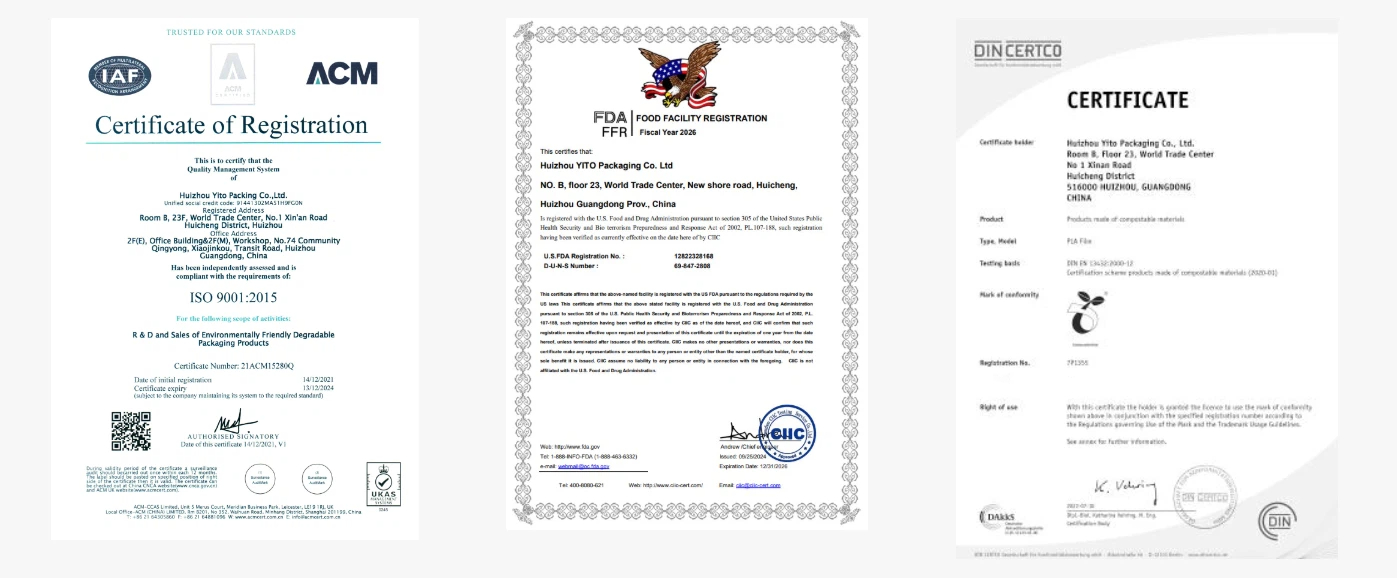
YiTo Pack supports custom biodegradable fruit label sticker projects with 15+ years of packaging experience, OEM/ODM development, rapid prototyping and project-based documentation support. Available documentation may include ISO 9001, FSC options, food-contact documents, compostability-related documents and third-party testing reports depending on the selected material and project scope.
For compostable or plastic-reduction projects, YiTo Pack can also coordinate fruit labels with one-stop compostable packaging solutions, including clamshells, punnets, tray liners, and freshness film. This helps keep the label, adhesive, and main packaging direction consistent from sampling to bulk production.
Before Ordering: Information Suppliers Need From You
One of the most common delays in fruit label sticker projects is incomplete label information. When we receive an inquiry without fruit type, label size, material direction, adhesive requirement or roll format, the sampling timeline can easily be delayed.
Before recommending a label structure, YiTo Pack usually asks for:
✓ Fruit type — apple, banana, citrus, pear, avocado, berries or other produce
✓ Label size and shape — round, oval, rectangle, die-cut, label wrap, or custom shape
✓ Printing content — logo, PLU code, barcode, QR code, origin text or organic mark
✓ Application method — manual labeling or automatic labeling machine
✓ Roll details — roll direction, core size, label gap and quantity per roll
✓ Target market — EU, North America, supermarket program, organic produce or export supply
✓ Compliance needs — food-contact, compostable, biodegradable or retailer documentation
✓ Material direction — PLA, cellophane, BOPP, coated paper, art paper, gloss paper or other project-based options
The more complete the brief is, the faster we can confirm the right material, adhesive, roll format and sample plan.
Conclusion
Fruit label stickers may be small, but they can affect checkout scanning, brand presentation, cold-chain handling, compliance review and real packing efficiency.
A good fruit label should not only look correct in the artwork file. It should stay attached on the real fruit surface, peel smoothly from the liner, keep PLU or barcode information readable, and match the target market’s packaging requirements.
Before bulk production, produce packers should confirm the label material, adhesive, printing content, roll format and documentation scope through real sample testing.
At YiTo Pack, we help buyers review fruit label stickers as part of the full packaging system—from material selection and artwork layout to sample testing, roll format and export documentation.
FAQ
Q: Are fruit label stickers the same as PLU stickers?
A: Not always. PLU stickers are one type of fruit label sticker used for produce identification and retail checkout. Fruit label stickers can also include brand logos, barcodes, QR codes, country-of-origin text, organic marks, and private label information.
Q: Which material is better for fruit labels: PLA, cellophane, BOPP or coated paper?
A: It depends on your target market, fruit surface, labeling method, and packaging claim. PLA and cellophane are better choices when the project needs biodegradable, compostable, or plastic-reduction positioning. BOPP is still practical for standard retail programs where moisture resistance and stable printing are required. Coated paper, art paper, or gloss paper fruit labels are often used for supermarket fruit stickers, PLU labels, and branded produce labels that need clear printing and cost-effective production.
Q: Can fruit label stickers be compostable?
A: The face material can be—PLA and cellophane both pass standard compostability tests. But we've seen samples get rejected at the documentation stage because the adhesive wasn't tested to the same standard as the film or because the print ink hadn't been verified for food contact. If a compostable claim matters for your retailer, ask your supplier for adhesive and ink test reports, not just the face material's certificate.
Related Articles
- PLU Codes on Fruit Stickers: What the Numbers Mean and How to Use Them
- Compostable Fruit Sticker Suppliers: How to Choose the Right One
- Edible Stickers for Fruit: What Produce Packers Need to Know Before Switching
Not sure which fruit label material fits your produce program? Tell us your fruit type, label size, target market and labeling method
Related Products


Post time: Jul-01-2026