
Biodegradable blueberry packaging containers are reshaping how growers and distributors think about freshness—but material sustainability and produce performance don't always align by default. At YiTo Pack, we've had buyers come to us mid-season after a switching decision went wrong—fruit arriving soft, containers deformed, and a retailer relationship on the line. Almost every time, the material wasn't the problem. The validation step was. Before you commit to a new container spec, there are three things your supply chain needs to get right: ventilation design, moisture management, and cold chain compatibility.
If you landed here looking for how to store blueberries at home — the short answer is keep them dry, don't wash them until you're ready to eat, and store them in a ventilated container in the fridge. Most fresh blueberries stay firm for 7–10 days that way.
But if you're a grower, distributor, or packaging buyer asking why blueberries arrive soft, moldy, or underweight after a 10-day cold chain — that's a packaging material and container design question, not a storage tip. That's what this guide covers.
What you'll learn from this guide:
- · Not all biodegradable materials handle cold chain humidity the same way—OTR and WVTR specs matter more than eco-labels
- · The ventilation design of a blueberry container has more impact on shelf life than the base material alone
- · Growers shipping long-haul need different container specs than those supplying local retail
- · A packaging switch checklist can help distributors avoid the most common compliance-vs-freshness trade-off traps
- · How YiTo Pack's approach matches material to route—not just to regulation
Why Blueberries Are Particularly Sensitive to Packaging Material Choices
Most fresh produce can tolerate a degree of packaging variation without immediate consequences. Blueberries are not in that category.
The post-harvest biology behind blueberry spoilage
After harvest, blueberries continue to respire, consuming oxygen and releasing carbon dioxide and moisture. This process doesn't stop at the farm gate. It continues through every stage of your supply chain, and the rate at which it happens is directly influenced by the environment inside your packaging container.
Blueberries need to be held at 0–2°C with relative humidity between 90 and 95%. At those conditions, their respiration rate stays low enough to preserve firmness and surface condition. Push CO₂ above tolerable thresholds—or let humidity fluctuate—and you accelerate softening, grey mold (Botrytis cinerea), and weight loss before any visible damage appears.
This is why packaging material selection is not a secondary decision. The container you choose directly determines whether the micro-environment inside stays within those parameters from packhouse to retailer. We've seen containers pass lab certification and still fail at the receiving dock — usually because the ventilation spec was never validated against the actual route.

What packaging failure looks like at the distribution stage
We hear this from distributors more often than we'd like: "Everything looked fine when it left the packhouse." By the time you see it, the loss has already happened. Soft fruit at the receiving dock, condensation pooling inside containers, premature mold spreading from a single affected berry to adjacent ones — these are the downstream symptoms of a packaging specification that didn't match the distribution environment.
For growers supplying export markets or long-haul retail distribution, the compounding effect is significant. A container that performs adequately in a 24-hour local delivery window may fail entirely in a 14-day refrigerated sea freight scenario. The material, the ventilation design, and the structural performance all need to be evaluated against your actual route—not a laboratory baseline.
Biodegradable Packaging Materials — What's Actually Available for Blueberry Containers
The term "biodegradable" covers a wide range of materials with very different physical properties. For blueberry packaging, what matters is how each material performs under cold chain conditions — not just how it degrades at the end of life.
PLA (polylactic acid) containers — performance under cold chain conditions

PLA is currently the most widely adopted biodegradable option for fresh produce punnets. It offers clarity comparable to PET, reasonable stacking rigidity, and industrial compostability certification under EN 13432 and ASTM D6400.
Why PLA can outperform PET specifically for blueberries
The advantage comes down to atmosphere control. PLA film's lower gas permeability allows blueberries to naturally accumulate the CO₂ they exhale during respiration, creating a high-CO₂, low-O₂ microenvironment inside the container. This modified atmosphere suppresses fungal growth — particularly Botrytis cinerea — without any active gas injection. PET clamshells with open ventilation cannot replicate this effect.
The result: lower weight loss rates, better firmness retention, and in consumer sensory evaluations, higher overall acceptability scores compared to conventional PET vented containers.
The condition that makes this work is consistent cold chain. At 0–4°C, the modified atmosphere stays stable. If temperature control breaks down, the same sealed environment accelerates spoilage rather than preventing it.

Under standard cold chain conditions (0–4°C), PLA performs comparably to PET for most blueberry distribution scenarios. This makes PLA practical for refrigerated retail routes where transparency, stackability, and compostability are required together. The critical limitation is thermal tolerance: PLA begins to soften above approximately 55°C. For most refrigerated retail routes this is not a practical constraint — but any unrefrigerated transit leg in your supply chain, including summer loading bays or ambient consolidation points, needs to be confirmed before committing to PLA.
PLA is best suited for local and regional supply chains with consistent refrigeration, retail display environments where clarity drives purchasing decisions, and export markets where EN 13432 or ASTM D6400 compliance is a buyer requirement.
To see how these material options translate into available container formats, browse YiTo Pack's blueberry packaging containers.
Bagasse and molded fiber trays—moisture management trade-offs
Bagasse and molded pulp containers offer strong natural ventilation characteristics and a clear sustainability narrative. Their structural rigidity has improved significantly in recent years, making them a viable option for certain punnet and tray formats.
The trade-off is moisture sensitivity. Untreated fiber absorbs humidity from the blueberries themselves, which can lead to container deformation under extended cold chain conditions. Most commercial bagasse containers for fresh produce include a moisture-barrier coating—but this coating affects the compostability profile of the finished package. If your sustainability claim or retail compliance depends on a specific compostability certification, confirm that the coating material is included in the certified structure, not just the base substrate.
rPET-blend and certified compostable hybrid options
For export markets where PLA's thermal limitations create risk, or where composting infrastructure at the destination is limited, rPET-blend containers with recycled content claims offer a middle path. They carry the performance characteristics of standard PET—stacking strength, temperature tolerance, and established sealing compatibility—while supporting recycled content claims that satisfy an increasing number of retailer sustainability scorecards.
For buyers targeting multiple export markets simultaneously, a hybrid approach—PLA for EU and North American retail and rPET for markets with limited composting infrastructure—is often more practical than forcing a single material across the entire portfolio.
For buyers operating within standard refrigerated supply chains, PLA performs comparably to PET across most dimensions.
On cost: PLA currently carries a 20–40% premium over standard PET. The total switching cost also includes certification documentation, retailer approval cycles, and label and film alignment — not just per-unit price.
The Three Technical Parameters That Determine Freshness Performance
When evaluating biodegradable blueberry containers, the conversation usually starts with material certification. It should start with these three parameters instead.
Oxygen and CO₂ transmission rate (OTR/CTR) — what the numbers mean for blueberries
Blueberries need a controlled atmosphere inside the container to suppress respiration and extend shelf life. The ventilation design of the container — whether through perforations, laser micro-perforation, or the material's inherent gas permeability — determines how well the atmosphere is maintained.
OTR (oxygen transmission rate) and CTR (CO₂ transmission rate) are the measurable values that tell you whether a container can support the modified atmosphere conditions blueberries need. What matters in practice: the number, size, and placement of ventilation openings often have a greater effect on gas exchange than the base material's permeability. A PLA container with poorly positioned ventilation holes can underperform a bagasse tray with optimized perforation patterns, regardless of which material has the theoretically better gas permeability profile.
The ventilation design of the container — whether through perforations, laser micro-perforation, or the material's inherent gas permeability — determines how well the atmosphere is maintained. A well-designed ventilated fruit punnet manages this balance across the full cold chain journey, not just under lab conditions.
It's one of the first things we check when a buyer sends us a container spec for review, and it's surprising how often this data is missing from supplier documentation.
Water vapor transmission rate (WVTR) — why humidity control is non-negotiable
Moisture management works in two directions for blueberry containers. Too little vapor transmission and condensation accumulates inside the container, creating the surface moisture conditions that accelerate mold. Too much vapor transmission and the blueberries lose weight faster than they should, arriving at retail undersized and soft.
The challenge with cold chain distribution is the temperature differential at transition points — from refrigerated storage to ambient loading docks to refrigerated transport and back again. Each transition creates a condensation event inside the container. A container with appropriate WVTR manages these events without allowing pooling or excessive moisture loss.
Request WVTR test data from your supplier and confirm it was measured under cold chain humidity conditions (85–95% RH), not ambient lab conditions. The difference in results is significant.
Structural load performance under stacking and refrigerated transport
Biodegradable materials — particularly PLA and bagasse — respond differently to sustained compression than PET. Under refrigerated conditions with high humidity, some materials soften or deform over time in ways that are not always visible until a pallet is unstacked at the destination.
Condensation pooling on container walls is one of the most visible signs of WVTR mismatch. This is why anti-fog fruit containers — whether through coating treatment or material selection — are increasingly specified for refrigerated retail display environments where presentation drives purchase decisions.
The practical test: confirm your supplier's stacking load data were generated under cold chain simulation conditions, not ambient temperature testing. For export shipments involving 7–14 days of refrigerated sea freight, the compressive load on bottom-tier containers is sustained for long enough that material behavior under cold, humid conditions is the relevant performance variable—not room-temperature crush resistance.
Matching Container Spec to Your Distribution Route
There is no single biodegradable blueberry container that performs optimally across all supply chain scenarios. The right specification depends on how far your fruit travels, under what conditions, and what your receiving buyer expects at the other end.
Local farm-to-retail (under 48 hours)
Short-chain distribution gives you the most flexibility in material choice. The priority shifts toward presentation quality and stacking efficiency at retail. Compostable PLA clamshells with good clarity, bagasse punnets for premium positioning, and even kraft paper-based formats all perform adequately when cold chain exposure is brief and consistent.
In this scenario, the biodegradable credential itself can function as a point-of-difference at retail—particularly for farm-direct and specialty grocery channels where packaging sustainability is part of the brand story.
Regional distribution with temperature-controlled logistics (2–5 days)
This is where WVTR performance and structural integrity begin to matter more. Containers that perform well in 24-hour delivery windows may show condensation accumulation or corner deformation by day three or four under sustained cold chain humidity.
For this scenario, we recommend requesting a cold chain simulation test from your supplier before placing a bulk order or running a small-batch pilot through your own distribution route before the season begins. The variables that matter most: transition points between cold storage and ambient loading environments and the humidity conditions inside refrigerated transport.
Export and long-haul cold chain (7–14 days)
This is the highest-demand scenario for biodegradable blueberry packaging and the one where the most switching failures occur. At this range, you need:
- · Confirmed OTR/CTR data under modified atmosphere conditions
- · WVTR performance validated under cold chain humidity (not ambient lab conditions)
- · Stacking load data from cold chain simulation, not room-temperature crush tests
- · Sealing film and label compatibility confirmed for the entire packaging system
For export shipments, laboratory certification is necessary but not sufficient. Real-world route validation — either through supplier-provided cold chain simulation or a documented pilot shipment — is the step that separates a reliable specification from one that looks right on paper and fails in transit.

What to Verify Before Switching to Biodegradable Blueberry Containers
Most packaging switches that go wrong don't fail because the material was wrong. They fail because the validation steps were skipped or compressed under seasonal time pressure. Here's the checklist we walk buyers through before every bulk order.
Supplier qualification checklist
This is the checklist we walk every buyer through before bulk production — not because we enjoy paperwork, but because these are exactly the gaps that show up as problems three weeks into your season.
· Compostability certification: EN 13432 (EU), ASTM D6400 (North America), or AS 5810 (Australia/New Zealand) from an accredited third-party certification body. Self-declarations are not sufficient for retail audit purposes.
· OTR and WVTR test reports for the specific container structure, not just the base material
· Cold chain simulation test data showing structural performance at 0–4°C and 85–95% RH
· FDA food contact compliance documentation for markets requiring it
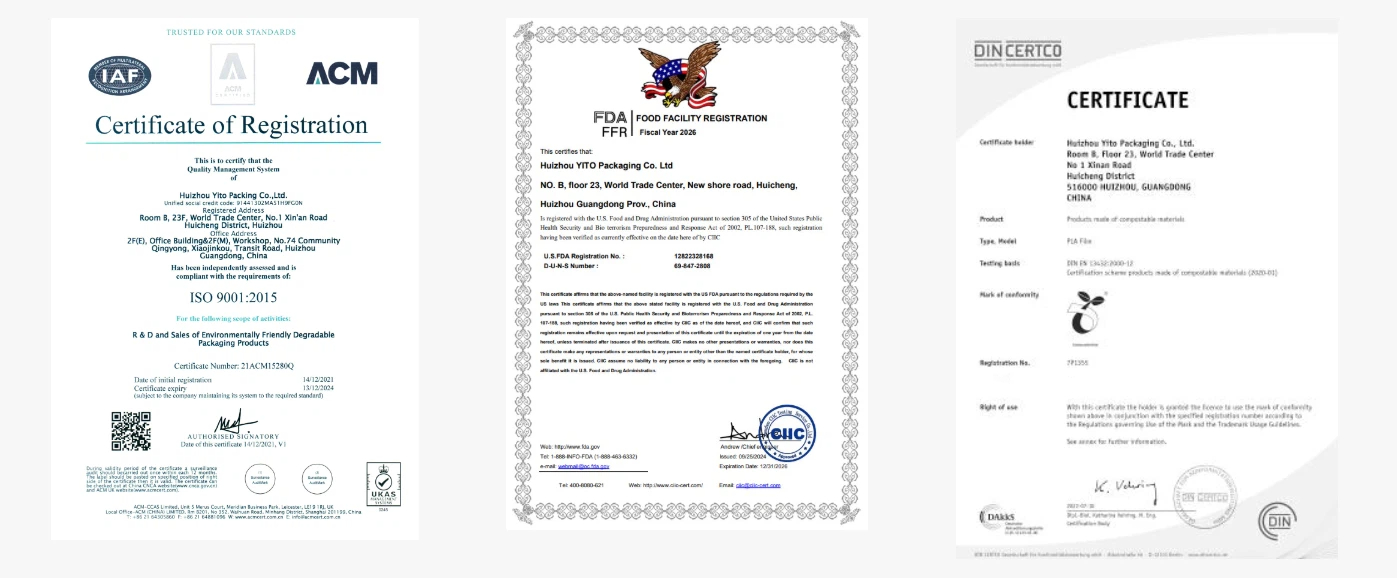
· ISO 9001 quality management certification
If a supplier cannot provide these documents before sample dispatch, that is a risk signal worth taking seriously before your season begins.
Pilot run protocol — how to test before full rollout
A structured pilot run before bulk commitment is the single most effective risk mitigation step available to growers and distributors switching packaging materials.
Key metrics to track during a pilot:
· Defect rate at destination (damaged, moldy, or soft fruit as a percentage of total shipped weight)
· Weight loss rate (arrival weight vs. departure weight)
· Container integrity (deformation, seal failure, corner collapse)
· Condensation behavior at each transition point in the supply chain
Run the pilot through your actual distribution route — not a controlled lab environment — and measure outcomes at the point your buyer receives the product, not at dispatch.
Common switching mistakes distributors make
These aren't hypothetical. They're patterns we've seen repeat across buyers in different markets. Evaluating material certification without reviewing ventilation design. A container with the right compostability credential but poorly positioned ventilation holes will underperform a less-certified option with optimized perforation patterns. The two decisions are not the same.
Using warm-season test data to validate a year-round specification. Cold chain behavior in July and cold chain behavior in January are not the same. If your distribution includes winter seasons, confirm your supplier's performance data covers cold-weather cold chain conditions.
Treating the container as a standalone decision. A compostable PLA clamshell paired with a conventional PE sealing film or PE label cannot make a compostability claim and may be flagged in retail sustainability audits. If compliance or on-pack claims are part of your positioning, the full blueberry packaging system needs to be aligned—container, label, and PLA film together.
How YiTo Pack Approaches Biodegradable Blueberry Container Design
At YiTo Pack, our design logic for biodegradable blueberry containers starts with three variables in sequence: material selection, ventilation architecture, and structural performance under cold chain conditions. All three need to be optimised together—a strong material choice with poor ventilation design or excellent gas exchange with inadequate stacking strength produces a container that fails at the distribution stage regardless of what the lab data shows.
A packaging switch that went wrong — and how it was fixed
A distributor supplying a major UK grocery chain switched from PET to PLA containers ahead of their peak season. The decision was made on material certification alone — no cold-chain simulation, no pilot run.
By week three of the season, defect rates at the receiving dock had reached 11%. The issue: an unrefrigerated consolidation point in the transit route that no one had flagged during the switch process. The PLA containers had partially deformed under ambient temperature exposure, compromising seal integrity.
The following season, they contacted us before committing to any material. We mapped their actual distribution route, identified the ambient exposure point, and recommended a higher-specification PLA structure with confirmed thermal tolerance for that transit leg. Before bulk production, we ran a cold-chain simulation through their route profile.
Defect rate that season: under 3%. The material wasn't the problem the first time. The validation step was — and that's exactly where we start.
Real-World Freshness Data: What Our Cold-Chain Trials Show
Switching packaging materials without performance validation is one of the most common — and costly — mistakes we see growers make before export season.
In YiTo Pack's cold-chain trials running over 52 days, blueberries stored with optimized biodegradable packaging showed a defect rate of just 2.87% and a weight loss rate of 0.92%—compared to a 13.69% defect rate and 8.43% weight loss in the cold-chain-only control group with no protective packaging.
That gap isn't marginal. For a distributor shipping 10,000 kg per season, the difference between a 2.87% and 13.69% defect rate means thousands of kilograms either arriving sellable—or arriving as a claims conversation with your buyer.
The data also confirms something we see consistently: cold temperature alone doesn't protect blueberries. The packaging enclosure determines microenvironment humidity, gas exchange, and physical protection throughout the journey. Choosing the right biodegradable container spec is what makes the difference.
We supply PLA-based, cellophane-based, and kraft paper-based blueberry packaging to buyers across North America, Europe, and Asia-Pacific. Samples ship within 5–7 days, and we provide EN 13432, ASTM D6400, FDA food contact, and ISO 9001 documentation available upon request for your specific structure. For buyers switching full packaging systems, we support cold-chain simulation testing before bulk production—so you have route-validated performance data before your season opens, not after.
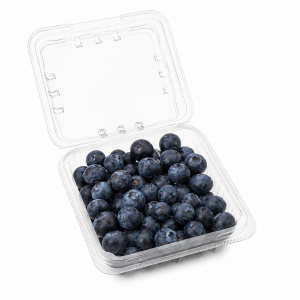
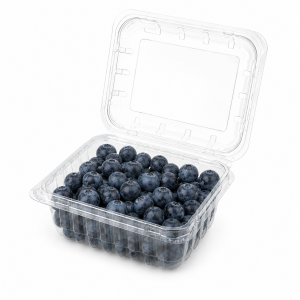
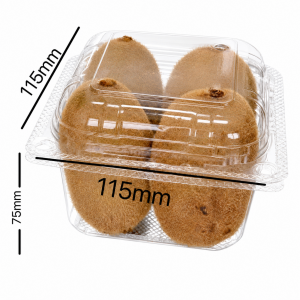
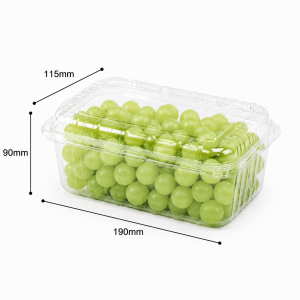
Available Packaging Specifications
Custom dimensions are available for buyers with retailer-specific tray requirements. Contact us with your target size and we will confirm feasibility and lead time.
Conclusion
Keeping blueberries fresh in biodegradable packaging isn't a single-material decision — it's a system decision. The container material, ventilation design, moisture management, and cold chain compatibility all need to work together for your specific distribution route.
For home storage, a ventilated container in the fridge gets you 7–10 days. For commercial distribution, the variables are more complex — and the cost of getting them wrong shows up as defect rates, weight loss claims, and retailer rejections, not just soft fruit.
The growers and distributors who navigate the shift to biodegradable packaging successfully aren't the ones who switch fastest. They're the ones who validate first: confirm the right material for their route, test under real cold chain conditions, and get certification documents in order before bulk production begins.
If you're evaluating a packaging switch for an upcoming season, that's exactly where we come in — not to sell you a material, but to help you validate the right one for your route.
FAQ
Both are industrial compostability standards, but they apply to different markets. EN 13432 is the relevant standard for EU retail and regulatory compliance. ASTM D6400 is the North American equivalent. AS 5810 covers Australia and New Zealand. If you're supplying multiple export markets, confirm which standard your retail buyers require — some accept either, others specify one. If your supplier holds certification for the specific container structure you're ordering, documents can typically be issued with your sample or bulk shipment.
It depends on the retailer's sustainability scoring requirements. Some retailers require a single material type per SKU with matching certification documentation. If you're mixing materials within the same distribution batch, confirm the audit requirements with your buyer before the season starts — mid-season compliance requests are significantly harder to manage.
In most cases, yes — sealing temperature parameters need to be confirmed. PLA has a different heat-seal window compared to PET, and some equipment will require recalibration. We recommend testing container-to-equipment compatibility during the sample stage, not after bulk production has begun.
Yes, for two reasons beyond actual composting. First, EN 13432 or ASTM D6400 certification satisfies an increasing number of retailer procurement scorecards regardless of local infrastructure. Second, it future-proofs your packaging against tightening regulations in key export markets. That said, if your primary goal is practical material recovery rather than compliance positioning, rPET is often the more pragmatic choice in markets where industrial composting is unavailable.
If your supplier already holds EN 13432 or ASTM D6400 certification for the specific structure you're ordering, documents can be issued with your sample or bulk shipment. If a new structure requires third-party certification, allow 4–8 weeks. Build this into your seasonal ordering timeline—certification lead times are one of the most commonly underestimated steps in a material switch.
PLA currently carries a cost premium of approximately 20–40% over standard PET at comparable specifications. This gap narrows at higher annual volumes. The more complete cost comparison should include certification documentation, retailer approval processes, and the regulatory trajectory for your target markets—particularly for EU exports where PET faces increasing compliance pressure under PPWR 2028. For many buyers, the total cost difference is smaller than the per-unit price gap suggests.
Further Reading for Blueberry Packaging Selection
Choosing the right blueberry packaging is not only about freshness control. Buyers also need to compare material performance, packaging structure, retail pack size, and cold-chain requirements before confirming a solution.
Ultimate Guide to Blueberry Packaging Materials: Biodegradable vs Plastic
PLA vs PET for Blueberry Packaging: Which Is Better?
Blueberry Packaging Size Guide: Punnets, Lids, and Clamshells
If you're still weighing options, share your distribution route with us — we'll tell you which container spec fits before you commit to anything. Samples ship in 5–7 days.
Related Products


Post time: Jun-08-2026