
“Compostable produce bags wholesale” can describe several very different products.
Supermarkets often need lightweight grocery produce bags beside loose fruit and vegetables, while farms may prefer individually separated bags for packing stations. Farms may prefer individual bags that workers can take directly from a packing table. Fruit brands, produce markets, and farm shops may need compostable handle bags that customers can carry away.
The material may be similar, but the job is not.
Before comparing prices, get clear on four points:
- Which bag format fits the daily packing routine?
- What produce will go inside, and how much will the filled bag weigh?
- Which market and compostability route does the project need?
- How will the bags be packed, replenished and reordered?
A low quote has little value when it describes a different finished bag.
Compare the Three Compostable Produce Bag Formats
YiTo Pack supplies compostable produce bags on rolls, as individually separated bags and with custom handle structures.
Use the table for a quick first choice. The final specification still needs to reflect your packing process, produce load and sales market.
|
Bag format and best use |
Main advantage |
Confirm before quotation |
Key sample focus |
| Produce bags on a roll — supermarket self-service areas and high-volume packing points | Fast access and compact storage | Bag size, thickness, roll count, core and dispenser dimensions | Dispenser compatibility and clean tear-off |
| Individually separated produce bags — farms, packhouses and manual packing stations | No roll holder required; easy to place at different workstations | Bag size, opening direction, bundle quantity and carton packing | Separation and opening speed |
| Compostable handle produce bags — farm shops, fruit brands, produce markets and retail programs | Combines produce packing, carrying convenience and brand presentation | Size, gusset, handle type, carrying load, printing and compostability route | Handle strength and carrying comfort |

The right bag format should work naturally with your packing process, produce load and retail environment—not force your operation to adapt around the packaging.
YiTo Pack helps match the bag format, material, thickness, opening style and carrying strength before sampling begins. Industrial or home-compostable options can also be reviewed according to your target market, certification route and disposal requirements.
For a complete produce packaging programme, we can coordinate custom printing, fruit labels and outer cartons together with the bags. This helps you create packaging that looks consistent, performs reliably and moves smoothly from sample approval to bulk production.
Compare Produce Bag Materials
| Material | Compostability | Transparency | Produce Protection | Cost |
|---|---|---|---|---|
| PE | Not compostable | High | Good moisture resistance | Low |
| PLA/PBAT | Industrial or home options | High | Flexible and suitable for most produce | Medium |
| Cellulose | Home and industrial options | Very high | Breathable and ideal for premium display | Higher |
| Kraft Paper | Compostable when uncoated | None | Best for dry or short-term packing | Medium |
Compostable fruit bags and vegetable bags are available in PLA/PBAT, cellulose, and kraft paper options. The right material depends on your produce, required transparency, moisture conditions, and target composting route. For custom-printed produce bags, confirm that the finished bag—including inks and seals—is covered by the relevant compostability evidence.
Give Every Supplier the Same Finished-Bag Specification
One of the biggest wholesale sourcing mistakes starts with an incomplete request.
The purchasing team sends a photo, an approximate size and an annual volume. Each supplier then fills the gaps differently.
One quotation may use a thinner structure. Another may include fewer bags per carton. Printing plates, export pallets or certification work may be missing from the lowest offer.
The product names look similar. The finished bags are not.

Start With the Produce and Normal Load
Provide the finished width and usable length. Add the gusset and handle opening where relevant.
The supplier also needs to know what will go inside and how much the filled bag normally weighs.
Leafy vegetables take up more space without adding much weight. Citrus and root crops create greater pressure around the bottom seal. Produce with long or sharp stems needs enough room to prevent direct pressure against the bag wall.
Using one oversized bag for every crop adds material and shipping volume. Going too small leads to overfilling, stretched seals and awkward handling.
When one size covers several products, compare it with the bulkiest crop and the heaviest crop.
Use Measurable Thickness
Descriptions such as "standard", “strong” and “heavy duty” mean very little in a formal quotation.
Ask for thickness in microns or mils.
Thickness still needs to be reviewed alongside seal quality, flexibility and puncture resistance. A thick bag can fail around a weak bottom seam. Some structures also become harder to open after refrigeration.
For wet or chilled produce, request a sample made to the proposed order specification. A generic stock sample may use another thickness or material structure.
YiTo Pack can review custom compostable produce bag options against the crop, filling weight and packing process.
Include the Details That Affect the Final Cost
The quotation needs to reflect the selected format.
For roll bags, confirm the roll diameter, core, winding direction, perforation, bags per roll and rolls per carton.
Individual-bag projects need the opening direction, bags per bundle, bundle arrangement and total carton quantity.
For handle bags, include the gusset, handle opening, seal structure and expected carrying weight.
Printing belongs in the same specification. Logos, certification marks and disposal instructions can affect MOQ, production time and certificate coverage.
Skip vague environmental wording. “Biodegradable,” “industrially compostable” and “home compostable” do not mean the same thing. The claim printed on the bag needs to match the evidence for the finished product.
Check the Market and Certification Route
Is it a thin roll bag offered beside loose produce? Is it a handled carrier bag? Or does it contain a fixed quantity of pre-packed fruit or vegetables? For an EU project, begin with the bag’s real use.
What PPWR Means for Produce Bag Projects
Regulation (EU) 2025/40, commonly known as the PPWR, entered into force on 11 February 2025 and generally applies from 12 August 2026. It does not create a blanket rule requiring every produce bag sold in the EU to be compostable.
PPWR defines lightweight plastic carrier bags as bags with a wall thickness below 50 microns. Very lightweight plastic carrier bags are below 15 microns. Member States must continue taking measures to reduce lightweight plastic carrier-bag consumption. Certain very lightweight bags used for hygiene or loose food may be treated differently where they help prevent food waste.
Do not accept “PPWR compliant” as a complete supplier answer.
Ask how the bag is classified in the destination market, which requirements apply to its intended use and what evidence supports the disposal message printed on the product.
From 1 January 2030, PPWR also restricts certain single-use plastic packaging for less than 1.5 kg of pre-packed, unprocessed fresh fruit and vegetables. Exemptions may apply where packaging is needed to prevent water loss, physical damage, microbiological risks or other specified problems.
A loose-produce roll bag, a compostable handle carrier bag and a pre-packed sales bag therefore need separate review based on how they are actually supplied and used.
Check the Finished Bag, Not Only the Material
A raw-material certificate does not automatically cover every bag produced from that material.
Review the certificate holder, product name, item number, thickness range and printing status. Inks, colorants and other components may affect the certification scope.
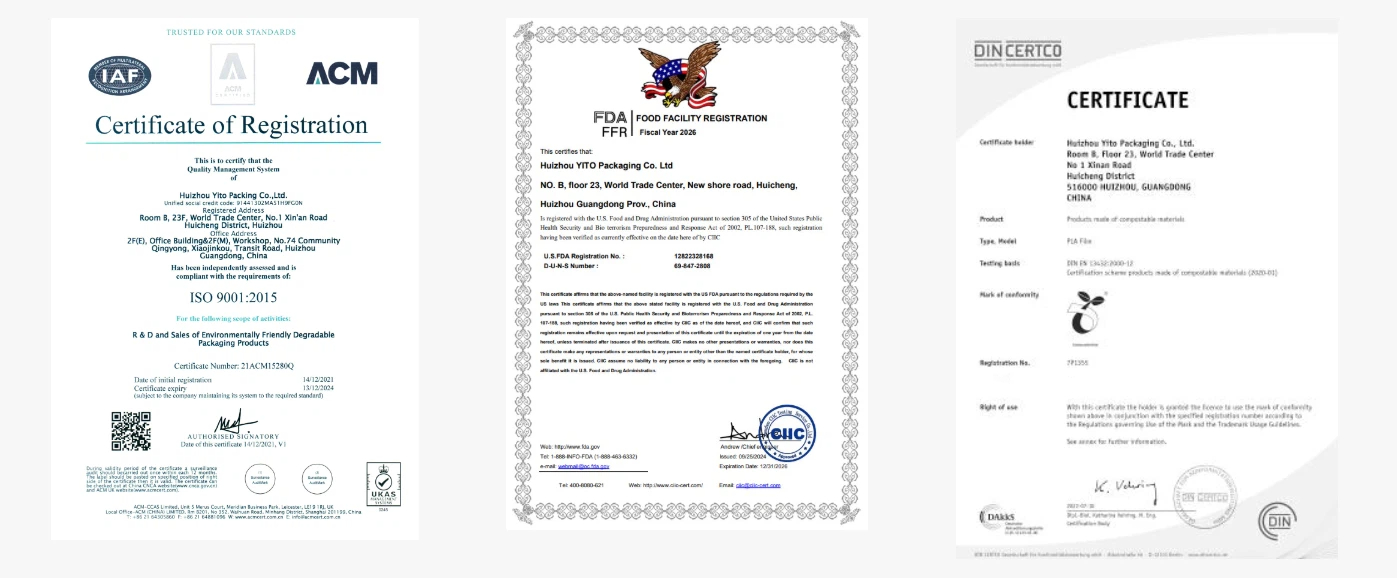
European projects commonly refer to EN 13432 and certification routes such as OK compost INDUSTRIAL or OK compost HOME. TÜV AUSTRIA presents industrial and home composting as separate certification programs, so evidence for one route does not automatically cover the other.
For North American projects, BPI uses ASTM D6400 as the base standard for commercial compostability assessment. BPI also provides a searchable directory of certified products, companies and individual items.
Our guide on how to verify a compostable produce bag explains what to review when a supplier provides a general certificate. You can also view YiTo Pack’s certification support.
Food-contact documents need a separate review. Compostability concerns the end-of-life route; it does not on its own confirm suitability for direct contact with fresh produce.
Test the Proposed Bag Before Bulk Production
Once the format and specification are clear, test the actual production sample under the conditions it will face.
Match the Test to the Format
For roll bags, install the sample on the dispenser already used in the store. Pull bags from different parts of the roll rather than checking only the first few. Look at roll movement, tear consistency and how easily customers can reach and open the next bag.
Individual bags need to be tested at the normal packing station. Ask workers to use them at their usual speed. Each bag needs to separate cleanly, open without repeated handling and remain easy to fill.
For compostable handle bags, use the actual produce and expected retail weight. Carry the filled sample for a realistic distance, then inspect the handle opening, upper area, gusset and bottom seam.
A static table-weight test often misses the stretching and small tears caused by movement.

Check the Produce After Packing
The bag may run smoothly and still be wrong for the crop.
Wet vegetables, chilled berries and fruit with sharp stems expose different weaknesses. Inspect the package immediately after filling and again after storage or transport.
For refrigerated produce, look at fogging, moisture accumulation and weight loss. A bag that traps too much moisture can hurt shelf appearance. A structure that releases too much water can reduce firmness and saleable weight.
YiTo Pack Freshness Test Data
In one YiTo Pack internal blueberry packaging test, fruit was stored at 0–4°C and 85–90% relative humidity. The program included 72 hours of transport simulation followed by seven days of retail evaluation.
The optimized packaging structure reduced the overall defect rate from 13.69% to 2.87%. Weight loss fell from 8.43% to 0.92%.
These results belong to the tested blueberry project. They are not a fixed shelf-life promise for every crop or bag.
They show why wholesale approval cannot stop at dimensions and carrying strength. Material structure, ventilation and cold-chain conditions can change the environment around the produce.
Keep the approved sample and test record as the reference for bulk and repeat production.

Compare the Whole Wholesale Offer
Once every supplier is quoting the same format and specification, compare what the offer actually includes.
Check printing plates, roll cores, bundle packing, cartons and export pallets. Confirm the total bags per carton, then place every quotation on the same Incoterm and delivery destination.
A cheaper roll may contain fewer bags. Individual bags may have poor carton efficiency. A low-cost handle bag may need a stronger structure before it can pass the agreed carrying test.
Usage costs matter too.
Poor perforation wastes bags in supermarkets. Individual bags that cling together slow packing teams. Weak handles lead to spilt produce, complaints and repacking.
Distributors face another risk: customised stock that becomes unusable after a customer changes its artwork or environmental wording.
The lowest unit price is not always the lowest project cost.
Why Choose Us
YiTo Pack does not begin every project by sending the same generic sample.
We first review the bag format, crop, filling weight, packing process and target market.
For roll bags, we look at the dispenser and complete roll structure. Individual bags are reviewed for opening direction, separation and bundle packing. Compostable handle bags are matched to the carrying load, handle design and retail presentation.
Samples normally take around seven days after the main specification is agreed. Bulk production is generally around 15–20 days after sample and artwork approval.
A common starting MOQ is 10,000 bags, although the final quantity depends on the format, dimensions, printing and certification route.
For wider produce programs, bags can also be coordinated with labels, clamshells, liners and outer cartons as part of a fresh produce packaging system.
The value is not simply buying more products from one supplier. It is finding conflicts before the packaging reaches the farm, store or distribution centre.
Conclusion
A compostable produce bag is not just a material choice — it is a decision about how the bag will actually run in your store, farm or distribution centre.
The right call depends on your dispenser, your crop, your packing team and your target market — tested under real conditions, not judged from a spec sheet alone.
That is the kind of fit YiTo Pack works to get right before bulk production begins.
FAQ
Which bag format works best for supermarkets?
Roll bags suit self-service loose-produce areas. Individual bags work well at staffed counters and manual packing stations. Compostable handle bags are more practical when customers carry the produce away in the same package.
Are YiTo Pack handle produce bags compostable?
Yes. YiTo Pack offers compostable material options for custom handle produce bags. The exact claim depends on the selected structure and certification route. Industrial and home compostability need to be confirmed separately.
Can one bag work for every crop?
Usually not. Leafy vegetables, berries, root crops and fruit with sharp stems create different load, puncture and moisture conditions. Test the most demanding crop before using one specification across a wider product range.
What is the standard MOQ?
YiTo Pack commonly starts from around 10,000 bags. Format, size, printing and certification requirements can change the final MOQ.
Related Reading
Are Produce Bags Compostable? How to Tell and What to Look For
Compostable Produce Bag Suppliers: How to Choose a Reliable One for Your Business
Top Compostable Produce Bag Suppliers Compared: Brands, Certifications, and MOQ
Request free samples to test clarity, flexibility, and sealing performance in your real packaging conditions.
Related Products


Post time: Jul-16-2026