
Replacing traditional plastic produce bags with compostable alternatives requires more than comparing material prices.
For grocery retailers, produce suppliers and distributors, the success of a packaging transition depends on whether the new bag can maintain reliable performance throughout daily operations.
PE produce bags remain widely used because they are affordable, flexible and familiar across different retail environments. Compostable produce bags can also provide reliable performance, but the final result depends on whether the film structure, thickness, sealing design and ventilation pattern match the actual application.
YiTo Pack evaluates compostable produce bag projects from a complete packaging perspective, helping customers balance sustainability objectives with cost control, product protection and supply reliability.
Key Takeaways
- · The lowest bag price does not always create the lowest packaging cost. Additional consumption, breakage and product loss can significantly affect the final result.
- · Bag strength depends on the complete structure, including film properties, seals and stress distribution, rather than thickness alone.
- · Freshness performance depends on moisture management and ventilation design that matches the produce category.
- · Compostability claims should be verified at the finished bag level, including structure, printing and final specifications.
- · Testing the bag with real produce before a full rollout helps reduce transition risks.
Evaluating Compostable Produce Bags Beyond Material Choice
A compostable produce bag can look almost identical to a conventional plastic bag.
The difference becomes clearer when the bag enters a real supply chain.
A shopper may struggle to find the opening. A store employee may use extra bags because the structure feels unreliable. A produce supplier may experience quality problems if moisture management does not match the crop.
These issues are rarely visible from material information alone.
For procurement teams, the evaluation should focus on five practical areas:
cost efficiency, durability, freshness performance, compliance requirements and supplier capability.
A successful replacement does not come from selecting an environmentally preferred material alone. It comes from ensuring that the finished package performs in the environment where it will actually be used.

Cost Comparison: Looking Beyond the Bag Price
Cost is usually the first factor considered when comparing compostable produce bags with plastic alternatives.

Compostable bags often have a higher initial unit price because of different material costs, production processes and certification requirements.
However, the purchase price does not represent the entire packaging cost.
For fresh produce businesses, the more meaningful measurement is the cost of successfully completing the intended use.
Cost Per Successful Use
A produce bag creates value when it can complete its purpose without causing additional problems.
A successful bag should allow customers to open it easily, carry the expected product weight, maintain package integrity during handling and protect the produce during the intended selling period.
A practical cost evaluation should include:
Total packaging cost = bag price + additional usage + breakage impact + handling cost + product loss
For example, a slightly higher-priced compostable bag may still provide better commercial value if it reduces unnecessary bag consumption, prevents failures during handling and maintains product quality.
On the other hand, a cheaper bag may create hidden costs if employees need to double-bag heavy products or if poor packaging performance contributes to produce waste.
YiTo Pack helps customers optimize compostable produce bag specifications based on product type, expected load, store operation and target cost, rather than focusing only on the initial quotation.
Hidden Costs During Plastic-to-Compostable Transition
A packaging transition affects more than the bag itself.
One common challenge is user behaviour.
If a bag is difficult to open or separate, shoppers may take multiple bags instead of one. Across a large retail network, small increases in consumption can become significant operating costs.
Store operations also matter.
Roll bags need to work with existing dispensers. Individual bags need to be easy to remove without excessive waste. Handle bags need to support the expected carrying weight without creating additional packaging requirements.
For produce suppliers, product protection is another important factor.
A packaging solution that reduces material cost but increases product damage may not create a better commercial outcome.
Handle Compostable Produce Bags
Handle bags provide a different carrying experience and are often considered for heavier produce.
The stress created by the load moves through the handle area, bag body and bottom seal.
For products such as potatoes, onions or apples, the finished handle structure should be tested with real produce rather than evaluated only through material data.
YiTo Pack provides custom compostable produce bags in roll, individual and handle formats, with adjustments available for dimensions, thickness, perforation and printing requirements.

Durability Evaluation: Understanding Real Bag Performance
Strength is one of the biggest concerns when replacing plastic produce bags.
However, the performance of a produce bag depends on the complete structure rather than one specification.
Film properties, seal design, dimensions and load distribution all influence whether the bag succeeds during daily use.
Throughout the supply chain, the bag needs to perform consistently — from filling and sealing during packing, to stacking pressure during transportation, and repeated handling during retail use.

Load Strength, Puncture Resistance and Seal Performance
For heavier products such as potatoes, onions and citrus, load strength becomes especially important.
The bag must support the expected weight while maintaining the integrity of the bottom seal and side structure.
Puncture resistance is equally important for products with uneven surfaces or sharp features.
For example, grape stems, vegetable edges and rough produce surfaces can create concentrated pressure points. A bag that performs well in general strength testing may still fail when pressure is applied to one small area.
Seal performance should also be evaluated carefully.
A strong film cannot compensate for a weak bottom seal or poor handle connection.
Practical testing should include the actual product weight, normal handling conditions and the expected transportation environment.
YiTo Pack supports real application testing for compostable produce bags, helping customers select suitable structures for different produce categories and load requirements.
Bag Format Matters: Roll, Individual and Handle Produce Bags
The bag format changes how the package is used and where potential problems may appear.
Roll Compostable Produce Bags
Roll bags are widely used in supermarket produce sections because they support fast self-service.
Their performance depends on more than film strength.
The bag should separate cleanly from the roll, open easily and work with existing dispensers.
Important factors include roll diameter, core size, perforation quality and winding consistency.
A suitable roll bag should reduce unnecessary customer effort while maintaining efficient store operation.
Individual Compostable Produce Bags
Individual bags are often used where quick access is needed.
Their main advantage is convenience, but dispensing performance still matters.
The bag should allow customers or employees to remove one bag easily without several bags sticking together.
Film surface characteristics, static behavior and packaging method can influence daily usability.
Freshness Performance: Matching Bag Design With Produce Requirements
Fresh produce packaging needs to balance protection and airflow.
After harvesting, fruits and vegetables continue to exchange gases and release moisture.
The bag design affects how moisture and airflow move around the product.
Insufficient ventilation may increase condensation, while excessive ventilation can accelerate moisture loss and reduce product quality.
The correct balance depends on the crop, storage period and transportation conditions.
Compostable Produce Bags for Berries, Apples, Grapes and Vegetable Applications
Different produce categories require different packaging considerations.
For compostable bags for berries, moisture control and ventilation design are especially important because berries are sensitive to condensation and quality changes during cold-chain storage.
For compostable produce bags for vegetables, factors such as product weight, surface moisture and storage duration influence the suitable structure.
For compostable produce bags for retail applications, customer experience also matters. Opening convenience, appearance and handling behaviour can affect acceptance in stores.
YiTo Pack develops crop-specific compostable produce bag solutions instead of applying one standard design across every produce category.
Why Choose YiTo Pack for Compostable Produce Bag Projects?
YiTo Pack supports supermarkets, produce suppliers, exporters and private-label brands with customised compostable produce bag solutions designed around real application requirements.
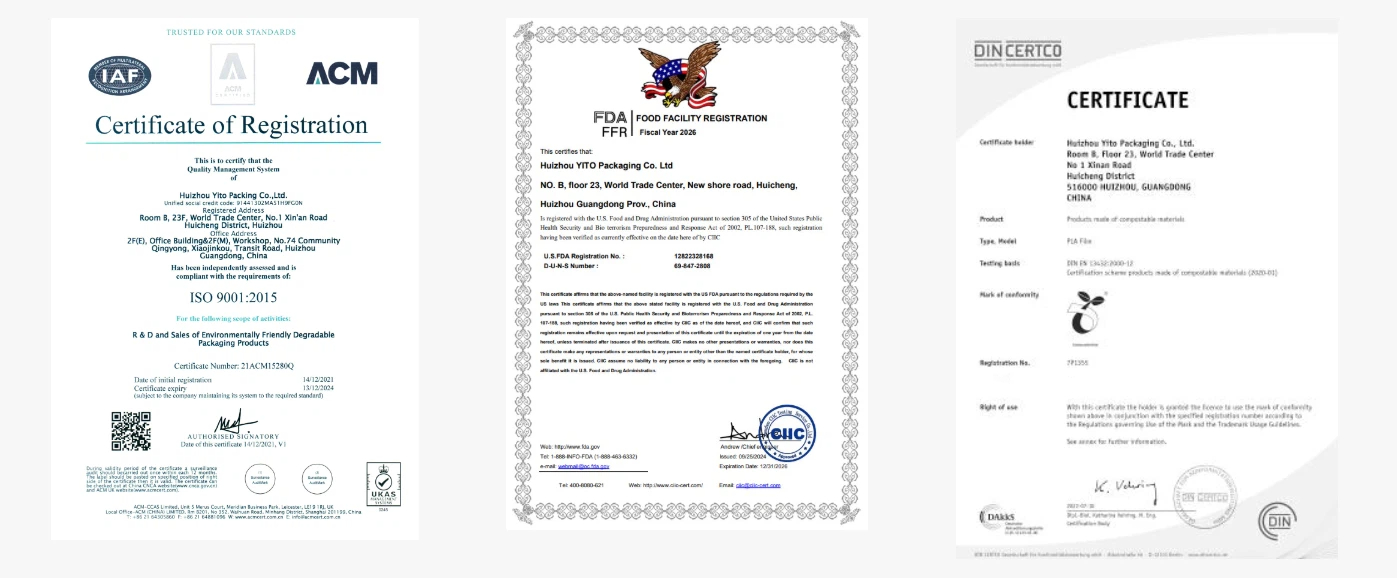
Our capabilities include EN13432 and ASTM D6400 certified compostable solutions, with PLA and cellulose-based material options for different market requirements. We provide custom sizes, printing and structure development, including roll bags, individual bags and handle bags, to match different produce categories and retail applications.
With OEM/ODM manufacturing support, YiTo Pack helps customers move from initial concept and specification review to sampling and stable production. Our team supports material selection, perforation design, documentation preparation and production coordination to reduce uncertainty during the transition from traditional plastic bags to compostable alternatives.
Standard samples can usually be prepared within around 7 days, with standard mass production completed in approximately 15–20 days after approval.
Conclusion
Choosing between compostable produce bags and plastic bags is not only a sustainability decision. For retailers, growers and produce suppliers, the final result depends on whether the packaging can deliver reliable performance in real operating conditions.
The most successful transitions usually begin with proper evaluation: understanding the produce requirements, testing the bag structure, confirming certification and selecting a supplier that can support long-term production.
YiTo Pack helps businesses move from packaging comparison to practical implementation through customized compostable produce bag solutions, application testing and production support.
FAQ
Q: Are compostable produce bags more expensive than plastic bags?
A: The initial unit price is usually higher, but the overall cost depends on bag performance, additional usage, handling efficiency and product protection.
Q: Can compostable produce bags replace PE bags?
A: They can replace PE bags in many applications, but the structure should match the produce type, handling conditions and storage requirements.
Q: Are compostable produce bags suitable for berries?
A: Yes. Compostable produce bags for berries require suitable ventilation and moisture management to support freshness.
Q: How can buyers verify compostable produce bag performance before ordering?
A: Buyers should evaluate real produce performance, including opening experience, load strength, puncture resistance, freshness impact and supplier testing support before full production.
Q: What should buyers test before switching?
A: Buyers should evaluate opening performance, strength, freshness, operational impact and supplier support before large-scale adoption.
If you're still weighing options, share your distribution route with us — we'll tell you which container spec fits before you commit to anything. Samples ship in 5–7 days.
Related Products


Post time: Jul-31-2026