
Fruit stickers seem simple, but the material behind them affects cold-chain adhesion, PLU readability, retail compliance, and end-of-life classification. Most produce labels in the market today are still made with BOPP, a plastic film widely used for high-speed labeling, curved fruit surfaces, and refrigerated handling. As sustainability requirements grow across retail and export markets, compostable fruit stickers are becoming part of real procurement discussions.
For produce buyers, the key question is not only “what are fruit stickers made of?” The more useful question is whether the full label system—substrate, adhesive, ink, coating and roll format — can work under your actual packing conditions. This guide explains how BOPP and compostable materials differ, what buyers should test before switching, and how YiTo Pack helps sourcing teams compare both options for fresh produce packaging projects.
What you’ll take away from this article:
- BOPP fruit stickers are a multi-layer system—substrate, adhesive, and print coating each affect real packing performance
- "Compostable" covers several distinct substrate types with different cold-chain and certification profiles
- Switching substrate without evaluating adhesive chemistry is the most common sourcing mistake
- Industrial compostable and home compostable certifications are not interchangeable—and retailers treat them differently
- Material selection should be confirmed against fruit type, cold-chain duration, machine format, and destination market requirements
Why Fruit Sticker Material Is Now a Procurement Variable
For many years, fruit sticker material was not treated as a major decision. Most produce operations used BOPP because the labeling machine ran well with BOPP, suppliers stocked BOPP, and retail buyers rarely asked detailed questions about label material.
That situation is changing.
Today, fruit sticker materials can affect retailer approval, export documentation, sustainability reporting, and packaging waste classification. For fruit growers, packers, and exporters, food-safe fruit stickers are no longer just a small printed sticker. It is part of the produce packaging system.
At YiTo Pack, we often see a retailer may ask whether the fruit label is plastic-based or compostable. An export buyer may request documentation for EU-bound produce packaging. A brand may want to reduce plastic components in its packaging system. An organic produce program may review every direct-contact packaging element, including PLU stickers.
These drivers are about market access, audit readiness, and procurement risk. That is why we suggest treating fruit sticker material as a project variable, not a background specification. Before choosing BOPP fruit stickers or compostable fruit stickers, you need to understand what each material system can and cannot do.

What Are PLU Fruit Stickers?
PLU fruit stickers are small produce labels used to identify fresh fruit at retail checkout and during supply chain handling. PLU stands for Price Look-Up, and the code helps supermarkets recognize the fruit type, variety, size group or growing method without relying only on visual inspection.
In supermarkets, PLU codes support faster checkout, price accuracy, inventory control, and product identification. For fruit exporters, PLU stickers also help meet buyer labeling requirements, support retail traceability and carry information such as origin, barcode, QR code, brand logo, or organic claim.
Because PLU fruit stickers are used throughout packing, transport, and retail display, the material must do more than look good. It should stay attached during cold-chain handling, keep the PLU code readable and match the buyer’s labeling system. This is why fruit sticker material, adhesive, print surface, and roll format all matter in B2B sourcing.
What BOPP Fruit Labels Are Actually Made Of
A finished BOPP fruit sticker is not only BOPP film. It usually includes four parts: substrate, adhesive, print surface, and release liner.
| Layer | Role in Fruit Labeling | What Buyers Should Check |
|---|---|---|
| BOPP substrate | Moisture resistance, flexibility, print surface | White/clear film, thickness, fruit surface fit |
| Adhesive | Sticking to waxed, curved or chilled fruit | Food-contact suitability, residue, cold-chain adhesion |
| Ink & coating | PLU, barcode, QR and brand printing | Scan readability, smudge resistance, print durability |
| Release liner | Roll feeding and automatic labeling | Core size, winding direction, and machine compatibility |
BOPP vs Compostable Fruit Sticker Materials: Quick Comparison
Fruit stickers are not made from one material only. A finished product label usually includes face material, adhesive, ink, coating, and release liner. For B2B buyers, the real question is whether the full food-safe fruit label system can match the fruit surface, cold-chain route, printing needs, and target market requirements.
| Material Type | Main Strength | Key Limitation | Best-Fit Projects |
|---|---|---|---|
| Coated paper labels | Easy to print, cost-friendly, suitable for non-transparent labels | Lower moisture resistance; coating and adhesive need verification | Standard PLU labels, brand labels, short-term retail use |
| PET clear labels | Good transparency, stable print appearance, suitable for clear labels | Plastic-based; not suitable for compostability claims | Transparent fruit labels, premium produce labels |
| BOPP labels | Moisture-resistant, flexible, good machine compatibility after surface treatment | Usually needs coating or treatment for stable printing; plastic-based | Standard film PLU labels |
| PLA-based labels | Bio-based, renewable-source material direction; compostable options available | Compostability depends on full label construction and certification scope | Sustainability-focused produce label projects |
BOPP is usually chosen for moisture resistance, flexibility, machine compatibility, and cold-chain performance when the correct surface treatment and adhesive system are used. Compostable fruit sticker materials are more suitable when buyers need plastic reduction, compostability documentation, or sustainability-focused packaging.
At YiTo Pack, we help buyers compare BOPP, paper-based, cellulose / cellophane-based, and compostable fruit stickers based on fruit type, labeling method, cold-chain route and target market requirements.
For non-transparent fruit stickers, coated paper is also a common option because it is easy to print and cost-friendly. For transparent labels, PET is often preferred, while BOPP usually requires print coating or surface treatment. Semi-transparent PE labels exist in the broader label market, but they are more commonly used for daily chemical and cosmetic packaging rather than fresh fruit PLU stickers.
For PLA and other bio-based label materials, the value is not only compostability. PLA comes from renewable biological resources instead of fossil-based petroleum sources, making it part of the future bio-based packaging direction. Buyers should still verify the finished label system, including substrate, adhesive, ink, coating, and cold-chain performance.
Custom Fruit Sticker Options YiTo Pack Can Support
YiTo Pack supports custom self-adhesive fruit labels for PLU codes, barcodes, logos, origin information, and retail branding. Available options include BOPP fruit labels, paper labels, PLA labels, cellulose / cellophane-based labels, compostable fruit stickers, removable adhesive labels, and low-halogen stickers.
Before bulk orders, we suggest testing the sticker on the actual fruit surface to confirm adhesion, scan readability, cold-chain performance, and machine compatibility.
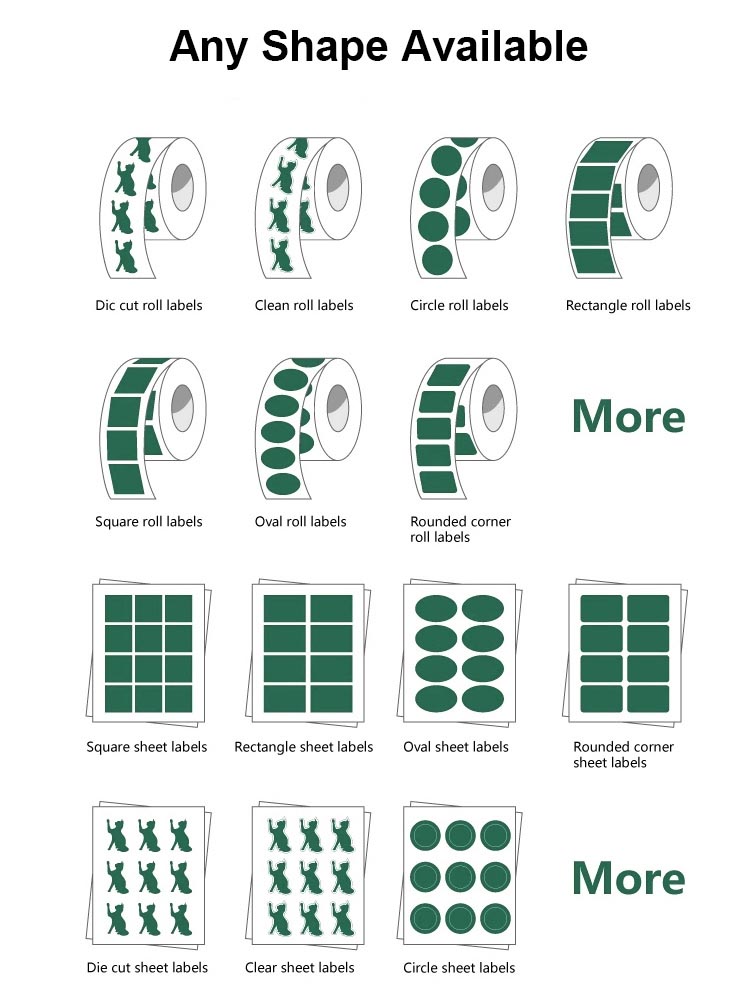
| Custom Option | YiTo Pack Can Support |
|---|---|
| Materials | BOPP, paper, PLA, cellulose / cellophane-based materials, compostable options and low-halogen materials |
| Adhesive Options | Food-contact adhesive, removable adhesive, cold-chain suitable adhesive and compostable adhesive options |
| Printing Content | Logo, PLU code, barcode, QR code, origin, variety, organic claim and custom brand information |
| Size & Shape | Round, oval, rectangle and custom die-cut fruit stickers |
| Printing Colors | Single-color, multi-color and custom brand color printing |
| Roll Format | Custom roll width, label spacing, core size and winding direction |
What “Compostable Fruit Sticker” Actually Means
A compostable fruit sticker is not one fixed material. It is a compostable label system designed to meet a compostability route under defined conditions. That system may use different substrates, adhesives, inks and coatings.
This is where many sourcing mistakes happen. A supplier may say the face material is compostable, but the adhesive or coating may not be covered by the same documentation. For B2B buyers, that difference matters.
Common compostable fruit sticker materials include PLA films, cellulose films, paper-based materials, and other compostable film options.
PLA-based labels can look and feel closer to plastic film, which makes them attractive for buyers looking for a clearer transition from BOPP. They may offer good printability and visual quality, but they usually need to be evaluated carefully for cold-chain handling and compostability scope.
Cellulose-based materials may offer a more natural or film-like alternative depending on the structure. Paper-based labels can support sustainability goals, but they may face more challenges with moisture, print durability and curved fruit surfaces if not properly coated or matched with the right adhesive.
The key point is simple: "compostable" is not one material name. You should ask what the substrate is, what adhesive is used, how the label is printed and whether the finished label construction supports the intended claim.
Why the Adhesive Changes When You Switch to Compostable Substrates
For a produce label to carry compostable certification, the entire construction—substrate, adhesive, and coatings—must meet the standard. Some conventional adhesives used for BOPP labels may not support compostable label claims. When switching to compostable substrates, buyers should confirm whether the adhesive is included in the certification scope. Replacement options include natural rubber-based adhesives, bio-acrylic formulations, and water-based certified adhesives—each with different tack profiles, cold-chain behavior, and cost implications. A supplier offering a "compostable substrate" without specifying the adhesive system is describing an incomplete construction. Ask whether the certification documentation covers the full label system, not just the face material.
Industrial Compostable vs Home Compostable
Industrial compostable and home compostable are not the same. This is one of the most common misunderstandings in compostable fruit label sourcing.
Industrial compostable materials usually require controlled composting conditions, including higher temperature, managed humidity, and controlled processing time.
Home compostable materials are expected to break down under lower-temperature, less controlled conditions, usually over a longer period.
For procurement teams, this distinction affects retailer acceptance. Others may ask for home compostable certification. Some markets or retailers may have their own preferred documentation route.
That is why you should confirm the exact requirement before selecting the substrate. Do not assume that one compostable claim works for every market.
If you are exporting fruit to different countries, we recommend checking requirements by destination market and retail channel. A biodegradable fruit label that works for one buyer’s sustainability program may not automatically satisfy another buyer’s audit.
For projects sold across multiple markets, do not assume one compostable certificate will satisfy every buyer. Some retailers may accept industrial compostability, while others may ask for home-composting compatibility or local documentation. Confirm the requirement by destination market and retail channel before finalizing the material.
For YiTo Pack fruit sticker projects, PLA-based compostable labels are usually considered for industrial composting routes, especially when buyers reference EN 13432 or similar requirements. Selected paper-based, cellulose-based, or cellophane-based label systems may be considered for industrial or home-compostable projects depending on the adhesive, ink, coating, and available certification scope. BOPP fruit stickers are suitable for standard PLU labeling, cold-chain handling, and high-volume retail use, but they should not be used for compostability claims. For any project, the final compostability route should be confirmed based on the finished label construction and the documents required by your target market or retail buyer.

Regulations Driving Compostable Produce Labels
For EU-bound produce, PPWR is also making sticky labels more visible in packaging review. Regulation (EU) 2025/40 entered into force on 11 February 2025 and will generally apply from 12 August 2026; the regulation specifically lists sticky labels attached to fruit and vegetables among packaging items that need to meet compostability requirements by 12 February 2028. For buyers, this means fruit sticker materials should be checked before the requirement becomes urgent.
Why Choose YiTo Pack
YiTo Pack helps produce buyers customize compostable fruit stickers that meet real packing, cold chain, and retail requirements. With 15+ years of packaging experience and export service to 50+ countries, we support fruit growers, packers, and exporters from material selection to sample testing and bulk production.
We can support BOPP fruit stickers, paper-based labels, PLA labels, cellulose / cellophane-based labels, and compostable sticker options. Custom options include material, adhesive, size, shape, printing content, brand colors, and roll format.
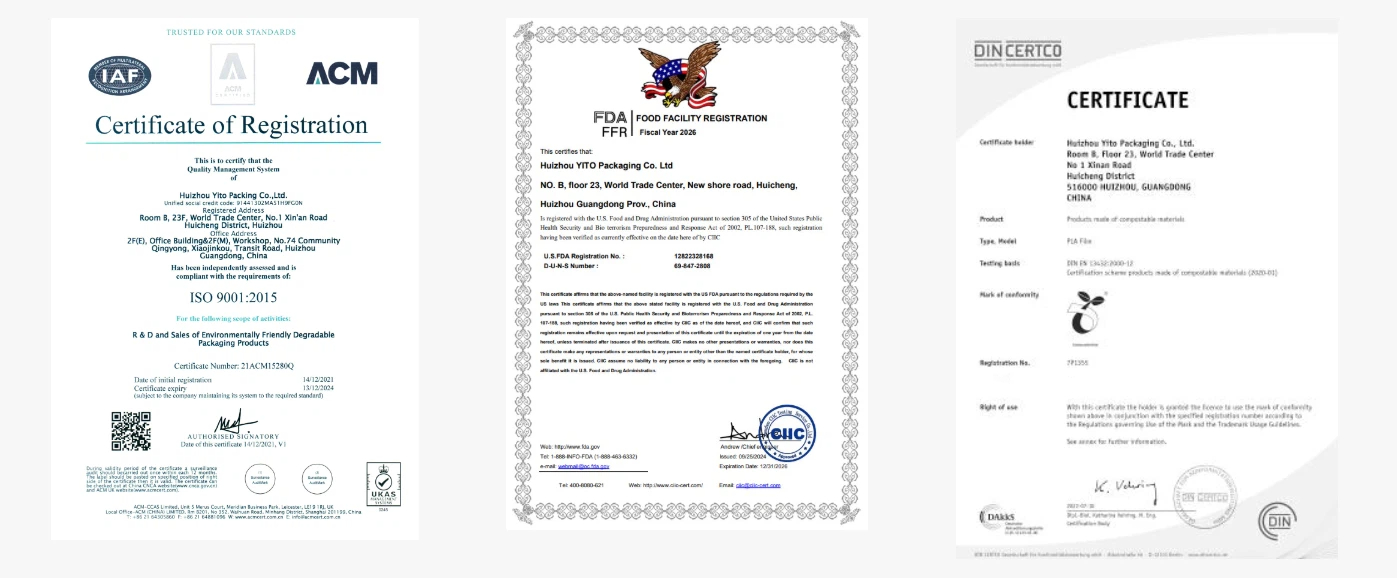
We also provide OEM and ODM customization, rapid sample development, and stable bulk order supply. For projects with compliance needs, we can support documents such as EN 13432, ASTM D6400, FDA, EU 10/2011, LFGB, and ISO 9001 where applicable.
Our goal is to help you choose a fruit sticker that is not only sustainable but also practical for cold-chain handling, PLU readability, machine application and buyer approval.
Conclusion
Eco-friendly Fruit stickers are made from more than one material. A finished label usually includes substrate, adhesive, ink, coating and release liner, and each layer affects real packing performance.
BOPP fruit stickers remain practical for many standard produce labeling projects because they offer moisture resistance, stable printing and machine compatibility. Compostable fruit stickers are more suitable when your retailer, export market or sustainability program requires plastic reduction or compostability documentation.
The best choice is not the material that sounds more advanced. It is the label system that fits your fruit surface, cold-chain route, labeling equipment, PLU readability needs and destination market requirements.
If you are not sure whether BOPP or compostable fruit stickers are better for your project, YiTo Pack can help you compare materials, test samples and prepare the right sourcing direction before bulk production.
FAQ
Q: What are fruit stickers usually made of?
A: Many conventional fruit stickers use BOPP or other plastic-based film materials, combined with pressure-sensitive adhesive, ink, coating and release liner.
Q: Is BOPP suitable for compostable fruit stickers?
A: No. BOPP is a plastic-based film and should not be used for compostability claims. It is more suitable for standard PLU labels, high-speed labeling and cold-chain produce projects.
Q: When should I choose compostable fruit stickers instead of BOPP?
A: Choose compostable fruit stickers when your buyer, export market or sustainability program requires plastic reduction, compostability documentation or compostable produce labels.
Q: What is the MOQ for custom fruit stickers?
A: For custom printed fruit stickers, the MOQ usually starts from 5,000 pieces, depending on material, size, printing colors, roll format and production requirements.
Q: Can YiTo Pack provide both BOPP and compostable fruit stickers?
A: Yes. YiTo Pack can support BOPP, paper-based, PLA-based, cellulose / cellophane-based and compostable fruit sticker options according to your fruit type, target market and labeling method.
Related compostable fruit label guides
Are Fruit Stickers Edible? What Produce Packers Need to Know
Are Fruit Stickers Compostable? How to Tell and Why It Matters
Compostable Fruit Sticker Suppliers: How to Choose the Right One
Need Food-Safe or Compostable Fruit Stickers for Your Export Project? YiTo Pack helps buyers compare food-safe fruit stickers, compostable produce labels, and PLU label options based on fruit type and target market.
Related Products


Post time: Jun-25-2026