
Choosing fresh food packaging bags is not only about finding a bag that fits your product. For food brands, farms, processors, and packaging buyers, the right bag must match product moisture, oxygen sensitivity, sealing method, storage temperature, shelf-life target, and retail presentation. At YITOPACK, we usually start from the product itself before recommending a bag structure.
Choose bags by product risk, not only by material name.
Use breathable or micro-perforated bags for selected fresh produce.
Choose high-barrier or vacuum bags for frozen food, meat, seafood, and ready meals.
Confirm zipper, valve, tear notch, window, and printing needs before quotation.
Prepare size, quantity, material, artwork, application, and shipping details for faster RFQ.
Many buyers begin by asking, “What material should I use?” But in real food packaging projects, material is only one part of the decision.
A better first question is
What does my product need during packing, storage, transport, and shelf display?
Fresh vegetables may need airflow and moisture control. Frozen seafood may need stronger sealing and barrier protection. Coffee needs aroma protection, oxygen resistance, and sometimes a degassing valve. Sauce packaging needs leak resistance and strong heat-seal integrity. Bakery, snacks, tea, and retail food products may need transparency, gloss, and food-contact safe materials.
That is why one bag type cannot fit all fresh food products.

At the same time, more food brands are looking for packaging that can reduce reliance on traditional plastic. For fresh food packaging, sustainability should not be separated from performance. A biodegradable or compostable bag still needs to seal properly, protect freshness, support clear printing, and match real storage and transport conditions.
Choose Bags by Product Risk, Not Only Material
At YITOPACK, we usually evaluate product type, moisture level, storage temperature, sealing method, shelf-life target, and sales channel before recommending a bag structure. This helps buyers avoid common risks such as product spoilage, moisture buildup, leakage, unstable sealing, poor shelf display, and repeated sample revisions.
For B2B buyers, the right fresh food packaging bag is not only a container. It is part of your product protection system.

For buyers with sustainability goals, material selection should also consider end-of-life options such as compostability, recyclability, paper-based structures, and reduced conventional plastic usage. The right choice depends on the product, shelf-life target, sealing method, and local disposal environment.
|
Bag Type |
Best For |
Key Features |
MOQ / Lead Time |
| PLA Vacuum Bag | Frozen food, meat, seafood, cheese, ready meals | Compostable, high barrier, heat sealable, transparent | 5,000 pcs / 7–14 days |
| Coffee Bag | Coffee beans, ground coffee | Aroma barrier, oxygen & moisture resistance, zipper, valve optional | 5,000 pcs / 7–14 days |
| PLA Fruit & Vegetable Bag | Fruits, vegetables, organic produce | Transparent, breathable, micro-perforation optional | 5,000 pcs / 7–14 days |
| Cellulose Bag | Bakery, snacks, tea, retail food, electronic components | Plant-based, glossy, transparent, heat sealable | 5,000 pcs / 7–14 days |
| Sauce Packaging Bag | Ketchup, mayonnaise, dressing, chili sauce | Leak-proof, anti-puncture, strong heat seal | 5,000 pcs / 7–14 days |
Sustainability Should Work with Packaging Performance
Eco-friendly food packaging should not only look sustainable. It also needs to work under real packing, storage, transport, and retail conditions.
For fresh food packaging bags, sustainability can come from different directions, such as biodegradable materials, compostable film structures, recyclable mono-material pouches, cellulose-based packaging, kraft paper structures, or reduced traditional plastic usage.
However, the best option depends on the product itself. Fresh produce may need breathable or micro-perforated packaging. Frozen food and seafood may need stronger sealing and barrier protection. Coffee may need aroma protection and a degassing valve. Sauce packaging may need leak resistance and puncture resistance.
That is why YITOPACK does not recommend material only by name. We usually consider both environmental goals and packaging performance, including sealing method, transparency, barrier needs, moisture control, printability, shelf-life target, and storage temperature.
For brands that want more sustainable packaging, the goal is not simply to replace plastic. The goal is to choose a packaging structure that can reduce environmental impact while still protecting the product properly.
Key Functional Options to Confirm
After choosing the bag type, the next step is to confirm functional options. These details can strongly affect production efficiency, storage performance, and user experience.
Micro-Perforation
Micro-perforation is mainly used for fresh fruit and vegetable bags. It helps selected produce exchange air and reduce moisture buildup. The hole size, hole quantity, and position should match the product type and storage condition.
Zipper Closure
Zipper closure is useful for products that are opened and closed repeatedly, such as coffee, snacks, dried fruits, nuts, and tea. It improves convenience and can support a stronger retail packaging experience.
Degassing Valve
A degassing valve is mainly used for roasted coffee beans. It allows gas to release from the bag while helping protect aroma and freshness. It is usually not necessary for most non-coffee food products.
Tear Notch and Transparent Window
A tear notch makes the bag easier to open. A transparent window allows customers to see the product inside. These options are useful for retail food, snacks, coffee, and specialty packaging.
Custom Printing
Custom printing helps display your logo, product information, certification marks, QR codes, and brand identity. If your project requires printed packaging, artwork should be prepared before sampling or quotation.
What to Prepare Before Requesting a Quote
To receive a faster and more accurate quotation, please prepare the following information before contacting YITOPACK:
If you only provide a product photo, the quotation may be incomplete. But if you provide size, quantity, material, application, printing, and shipping information, we can evaluate production feasibility, sample options, MOQ, and delivery time more accurately.
This is especially important for custom fresh food packaging bags, because small changes in structure, thickness, printing, or function can affect cost and production planning.

Sample, MOQ, and Lead Time
Sampling helps buyers reduce risk before bulk production.
Use stock samples when you want to check material feel, transparency, thickness, and basic sealing. Use customized samples when you need to confirm final size, printing, micro-perforation, zipper, valve, window, or product compatibility.
For selected projects, YITOPACK can support stock or customized samples within about 5–7 days. Compostable PLA Vacuum Bag sample transportation may be available within 1 week. Regular bulk production lead time is usually around 15–20 days, depending on bag type and customization requirements.
Different products also have different MOQ levels:
PLA Vacuum Bag: from 5,000 pcs.
Coffee Bag: from 5,000 pcs
PLA Fruit & Vegetable Bag: from 5,000 pcs
Cellulose Bag: from 5,000 pcs
Sauce Packaging Bag: from 5,000 pcs
If your project is still in early testing, we suggest starting with samples before confirming bulk order details.
Why Choose YITOPACK?
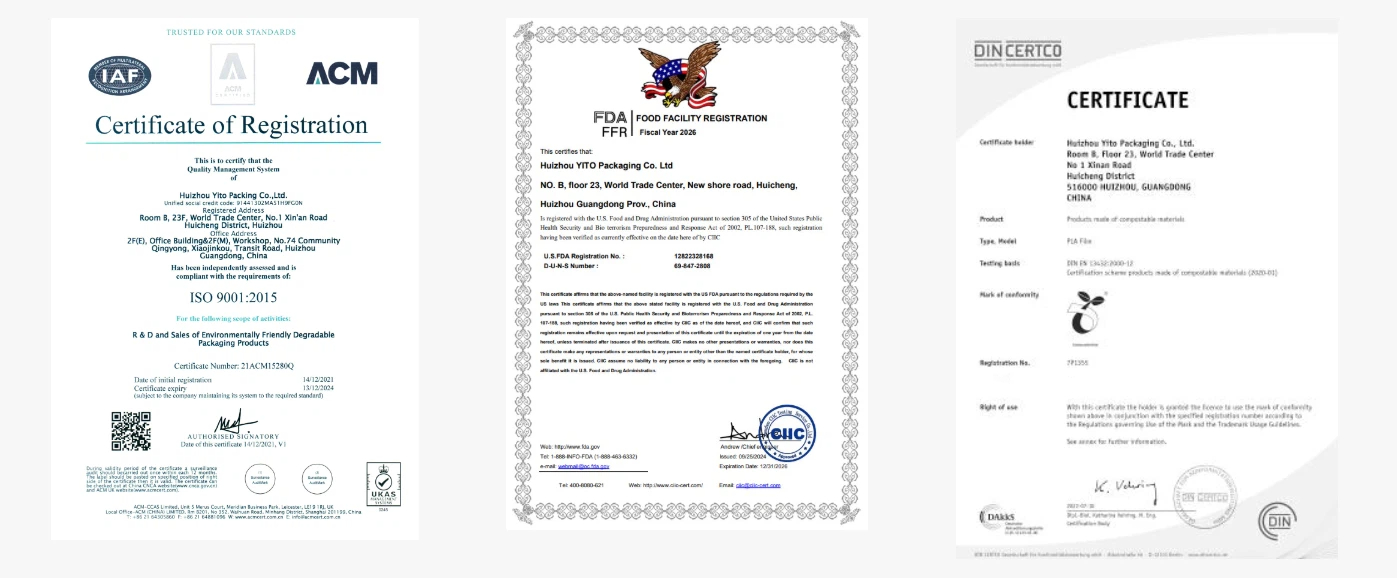
YITOPACK provides sustainable packaging solutions made with biodegradable, compostable, recyclable, and paper-based material options, helping brands reduce reliance on traditional plastic packaging while maintaining product protection, sealing performance, transparency, printability, and shelf appeal. Our packaging products can support different food-contact, environmental, and quality management requirements, with certification support such as EN 13432, FSC certification, FDA certification, and ISO 9001, depending on the material structure and application.
From PLA bags, cellulose packaging, compostable films, recyclable stand-up pouches, kraft paper packaging, labels, trays, boxes, and custom flexible packaging, YITOPACK offers one-stop packaging support for food brands, manufacturers, distributors, and procurement teams looking for eco-friendly packaging with reliable quality, flexible customization, and stable supply.
Conclusion
Choosing the right fresh food packaging bag is not only about size, material, or price. It is about matching your product risk, storage condition, sealing method, shelf-life target, retail presentation, and sustainability goals.
YITOPACK helps brands choose more sustainable packaging through biodegradable, compostable, recyclable, cellulose-based, and paper-based material options. Whether you need PLA bags, cellulose packaging, compostable films, recyclable pouches, labels, trays, or custom packaging solutions, we provide one-stop packaging support from material selection, structure recommendation, artwork communication, sampling, and testing to bulk production and stable supply.
The best eco-friendly packaging is not just environmentally responsible. It should also protect your product, support your production process, simplify procurement, and make your packaging system easier to manage.
FAQ
Q: Are YITOPACK packaging products biodegradable or compostable?
Yes. YITOPACK offers biodegradable and compostable packaging options made from materials such as PLA, cellulose film, compostable films, and paper-based structures. The final material choice depends on your product application, sealing needs, storage conditions, and target market requirements.
Q: Do your packaging materials have certificates?
Yes. YITOPACK can support different certification and compliance needs depending on the material structure and application, such as EN 13432, FDA, FSC, and ISO 9001. For specific projects, we recommend confirming the required certificate before quotation and sampling.
Q: Can sustainable packaging still provide good sealing and protection?
Yes. Eco-friendly packaging can still support heat sealing, barrier protection, transparency, printability, moisture resistance, and shelf presentation when the right material structure is selected. We usually recommend packaging based on your product type, storage condition, and shelf-life target.
Q: Can I customize the size, material, and printing?
Yes, YITOPACK supports custom sizes, thicknesses, material structures, logos, colors, printing designs, bag types, and functional options such as zippers, valves, tear notches, windows, micro-perforations, and heat-sealable structures.
Q: What information should I provide for a quotation?
To get a faster quotation, please provide the product type, packaging size, thickness, material preference, quantity, printing artwork, required functions, application, and shipping address.
Q: Can I get samples before bulk production?
Yes. We can support stock samples or customized samples depending on your project stage. Stock samples are useful for checking material feel and basic structure, while custom samples are better for confirming size, printing, and functional details.
Q: What types of packaging does YITOPACK supply?
YITOPACK supplies PLA bags, cellulose packaging, compostable films, recyclable pouches, kraft paper packaging, labels, trays, boxes, fresh food packaging bags, coffee bags, produce packaging, and other custom flexible packaging solutions.
Q: How do I know which eco-friendly material is right for my product?
The best material depends on your product's condition, moisture level, oxygen sensitivity, sealing method, storage temperature, shelf-life target, and branding needs. You can send us your product details, and YITOPACK can help recommend a suitable packaging structure.
Request free samples to test clarity, flexibility, and sealing performance in your real packaging conditions.
Related Products


Post time: May-15-2026