
Sourcing biodegradable stickers for Australia or New Zealand involves more than choosing a material described as biodegradable. B2B buyers need to match the environmental claim, certification route, adhesive and finished label construction to the market and application, especially where fresh produce labels are involved.
Key Takeaways
- · Biodegradable, commercially compostable and home compostable are different purchasing specifications.
- · AS 4736 and AS 5810 apply to different composting environments in Australia.
- · International certificates can support technical review, but do not by themselves establish conformity with Australian standards.
- · New Zealand’s current transition for plastic produce labels ends on 30 June 2028.
Note: This guide provides sourcing guidance only and does not constitute legal or regulatory advice. Importers should confirm the latest requirements with local regulators, certification bodies or qualified compliance advisers.
Start With the Claim, Not the Material
A request for “biodegradable stickers” may sound clear, but it is not precise enough for a technical quotation. The term biodegradable does not define the disposal environment or the standard against which the finished product should be assessed.
For procurement teams, the better starting point is the claim that will appear on the product or packaging. A project intended for commercial composting has a different specification from one intended for home composting. Material, adhesive and supporting documents should follow that decision.
This matters in Australia because environmental claims should be clear, accurate, evidence-based and properly qualified.
There is also a practical market issue behind that guidance. A label can have valid compostability certification and still be excluded from a particular local organics collection. Australian FOGO acceptance varies by council and processor, so buyers need to check both the product claim and the intended end-of-life route. The Australasian Bioplastics Association specifically notes that AS 4736 or AS 5810 certification does not guarantee acceptance into every organics recycling stream.

Australia: Matching the Compostability Requirement to the Project

Australian compostable packaging projects commonly refer to AS 4736 and AS 5810, but the two standards are not interchangeable.
|
Standard |
Typical Route |
Procurement Relevance |
| AS 4736 | Commercial composting | Products intended for controlled commercial composting environments |
| AS 5810 | Home composting | Products intended for home-composting conditions |
| EN 13432 | European industrial composting | Supporting evidence, not automatic conformity with AS standards |
| ASTM D6400 | North American industrial composting | Supporting evidence, not automatic conformity with AS standards |
AS 4736 is associated with commercial composting conditions. AS 5810 applies to products intended for home composting, where conditions are less controlled. A buyer should therefore specify the intended end-of-life route rather than asking only for an “Australian compostable certificate”.
International certification also needs careful interpretation. EN 13432 or ASTM D6400 documentation is not irrelevant to an Australian project. Existing international test reports can provide useful technical evidence and may help speed up Australian verification. They do not, however, grant the right to claim conformity with AS 4736 or AS 5810 on their own. The ABA makes this distinction explicitly: overseas certification can support the assessment process, but Australian conformity still requires the applicable verification route.
An overseas supplier may therefore have substantial European or North American testing while still needing further Australian verification. For AU/NZ projects, YiTo Pack reviews available overseas evidence together with the destination-market requirement rather than treating one certificate as universally interchangeable.
Buyers should also check certification scope. A certificate may apply to a raw film, an adhesive component, a defined product family or a finished label. A certified input does not automatically make every converted label construction certified.
New Zealand: Produce Labels Have Their Own Transition
New Zealand needs a separate review because plastic produce labels are specifically regulated. Under the Waste Minimisation regulations, the definition of a plastic produce label includes its adhesive, and bio-based or degradable plastics can still fall within the regulatory definition of plastic.
Since 1 July 2023, plastic produce labels sold for use on New Zealand-grown fruit and vegetables have generally been subject to a home-compostability requirement, with a transition rule for the adhesive. During this period, a label can be treated as home compostable when the whole label except the adhesive meets the requirement.
Plastic produce labels used, or intended for use, on imported fruit and vegetables are also temporarily exempt during the transition. This is not a permanent permission. Importers supplying New Zealand need to track the rule and plan specification changes before the deadline.
The key date is 30 June 2028. The 2025 amendment extended the transition to the close of that day. From 1 July 2028, the imported-produce exemption ends and the temporary treatment of the adhesive ends with it. Because the legal definition of the label includes its adhesive, the complete label construction becomes critical.
For produce exporters, the practical work should start before 2028. A change of label material or adhesive can affect performance on waxed or textured fruit, refrigeration resistance, print quality, PLU readability and automatic application. A compliant material that lifts from the fruit or causes dispensing problems is still a failed packaging solution.
YiTo Pack therefore treats New Zealand produce-label projects as both a market-requirement and application task. Existing structures can be reviewed against the target requirement, then sampled on the intended produce and packing conditions before bulk conversion.

Compostable Produce Labels for Global Fresh Food Brands
For growers, exporters, packers and fresh food brands, produce labels need to combine reliable application performance with the environmental requirements of the destination market.
YiTo Pack develops compostable fruit labels, biodegradable produce stickers and compostable PLU labels for apples, avocados, citrus and other fresh produce.
✔ Home & Commercial Compostable Options
✔ Food-Contact-Supported Materials Available
✔ Plastic-Free Paper & Cellulose Label Options
✔ Suitable for Apples, Avocados, Citrus & Other Fresh Produce
For biodegradable labels for fresh produce, adhesive performance needs to be checked against the actual fruit surface and cold-chain conditions. Waxed apple skins, textured citrus surfaces, refrigeration and condensation can all affect tack, edge lifting and dispensing performance.
For buyers sourcing compostable apple stickers in Australia, the intended composting route should also be confirmed before production. AS 4736 relates to commercial composting, while AS 5810 applies to home composting, so the selected facestock, adhesive and finished label structure should match the required claim.
YiTo Pack can also develop plastic free fruit labels using suitable paper or cellulose-based structures, together with custom printing for PLU codes, barcodes, QR codes, branding and traceability information.
For brands developing sustainable produce packaging labels, samples can be tested on the intended fruit or packaging before bulk production to review adhesion, print readability and automatic application performance.
The Finished Label Matters More Than the Material Name
Sustainable label projects often begin with a material choice such as paper, regenerated cellulose or PLA. That is useful, but it is only one layer of the specification.
Facestock affects transparency, stiffness, moisture response and dispensing. Adhesive determines whether the label stays attached and whether the finished construction remains compatible with the environmental claim. Printing and coatings may also fall within certification scope.
Adhesive selection is especially important for fresh produce. Apple skins may be waxed, citrus can be textured, and temperature and humidity change through packing, cold storage, transport and retail. A label that looks satisfactory on a room-temperature test panel may lift after refrigeration or leave residue on the product.
Certification and real-use performance should also be separated. Certification does not show whether a sticker will run smoothly through an applicator, release consistently from the liner or remain readable after a cold-chain cycle.
The approval sample should therefore represent the intended finished label, not simply an unprinted piece of certified facestock. Where the label will contact food or fresh produce, buyers should also obtain supporting information for the intended food-contact use. Food Standards Australia New Zealand requires packaging materials to be fit for their intended purpose and not likely to contaminate food, with factors such as temperature, humidity and contact conditions taken into account.
Supplier Documentation Should Match the Product Being Ordered
A useful supplier review connects the commercial quotation to the technical evidence. The objective is not to collect the largest document pack, but to confirm that the documents describe the label that will actually be produced.
| Document or Record | What the Buyer Should Confirm |
| Compostability certificate | Standard, certificate holder, number, validity and product description |
| Certification scope | Whether it covers the material, component or finished construction |
| Facestock specification | Exact substrate used for the quoted label |
| Adhesive information | Suitability for the environmental claim and application |
| Food-contact support | Relevant documentation where direct contact applies |
| Printed sample | Intended facestock, adhesive, inks and coatings |
| Roll specification | Core, winding direction, gap, orientation and liner format |
The key step is matching the paperwork to the approved sample and production specification; a certificate for a different grade or construction is not enough.
International reports can still be useful here. Rather than rejecting EN 13432 or ASTM D6400 evidence because the project is Australian, buyers can use those reports to understand what has already been tested and identify what additional local verification is required.
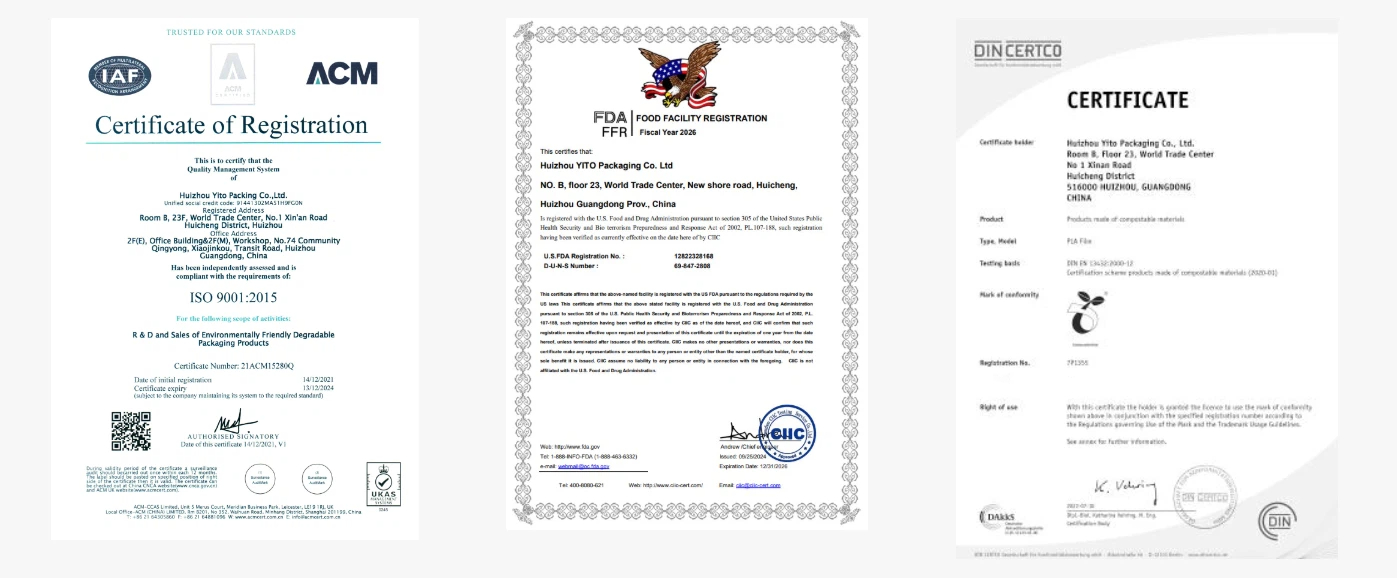
This is one reason YiTo Pack reviews the certificate scope alongside the proposed facestock, adhesive and printing structure. The purpose is not simply to confirm that a certificate exists, but to see whether the evidence actually corresponds to the label the buyer intends to order.
Import Preparation for Australia and New Zealand
For commercial shipments, importers should confirm the customs requirements for the finished label rather than relying only on the supplier’s description or a generic HS code.
In Australia, consignments valued above AUD 1,000 generally require an Import Declaration. In New Zealand, commercial imports valued at NZD 1,000 or more generally require the appropriate import declaration and importer client code.
The tariff classification can vary with the finished construction, particularly between paper labels, plastic-film labels and multi-material structures. Before shipment, buyers should provide their customs broker with the product description, material composition, country of origin, commercial value and supporting documents so that classification and clearance requirements can be confirmed.
How YiTo Pack Supports AU/NZ Label Projects
The most useful sourcing review happens before artwork approval, when changes to material, adhesive or certification route are still manageable.
For an Australian project, YiTo Pack first clarifies the intended environmental claim and disposal route. If EN 13432, ASTM D6400 or other test reports already exist, they are reviewed as technical evidence rather than presented as automatic Australian equivalence. Where AS 4736 or AS 5810 is relevant, the product structure and certification scope need to match that requirement.
For New Zealand produce labels, destination and produce origin are checked early because the current transition rules affect how the project should be planned. Attention then moves to the complete label structure, particularly the adhesive and the post-2028 requirement.
Samples should be tested on the actual surface where possible, especially for fruit, refrigerated products or automated labelling. This gives the buyer a chance to assess adhesion, print readability, liner release and packing-line behaviour before volume production.
The final production specification should stay aligned with the technical documents used during approval, reducing the risk of discovering a compliance or performance problem after import.
Conclusion
For Australia and New Zealand, sourcing biodegradable stickers requires more than checking whether the facestock is described as compostable. Buyers need to confirm that the environmental claim, certification evidence, adhesive and finished label construction match the destination market and actual application.
This is particularly important for Australian AS 4736 / AS 5810 projects and New Zealand produce labels approaching the 2028 transition. Reviewing the complete specification and testing the finished label before bulk production can help avoid certification gaps, adhesion problems and unnecessary specification changes later.
FAQ
Q: Can EN 13432 certification replace AS 4736 in Australia?
A: No. EN 13432 can provide useful supporting technical evidence, and existing testing may assist an Australian verification process, but it does not by itself establish conformity with AS 4736 or AS 5810.
Q: Are bio-based produce labels automatically exempt from New Zealand’s plastic-label rules?
A: No. New Zealand’s regulatory definition can include plastic made from bio-based sources or designed to degrade. The actual construction and intended use need to be checked against the current rule.
Q: Do New Zealand produce labels require home-compostable adhesive right now?
A: During the current transition, which ends at the close of 30 June 2028, a plastic produce label can be treated as home compostable if the label except its adhesive meets the requirement. Labels used on imported fruit and vegetables are also temporarily exempt. Buyers should plan for the post-transition requirement rather than treat these provisions as permanent.
Q: Does AS 4736 certification guarantee acceptance by a local compost facility?
A: No. Certification confirms conformity with the product standard, but acceptance into FOGO or another organics stream depends on the local council or processing facility. End-of-life acceptance should be checked separately.
Request free samples to test adhesion, print readability and dispensing performance under your actual application conditions.
Related Products


Post time: Aug-25-2026