
Cannabis packaging compliance in the U.S. is not a single standard. A pouch that clears California may not work in New York. A tube format that fits your pre-roll line may not support the CR documentation Oregon requires. For licensed brands, MSOs, and packaging buyers managing multiple SKUs or markets, these differences show up late — usually after artwork is approved or samples are already in hand.
At YiTo Pack, the first question we ask is not "What size bag do you need?" It is which state, which product, and what functions does the package need to perform before we talk about format or print? That order matters more than most buyers expect.
This guide walks through 2026 state cannabis packaging requirements from a procurement standpoint — helping you confirm structure, closure, label space, material, and documentation needs before sampling begins.
- · State cannabis packaging requirements affect structure, not only label design.
- · Child-resistant, tamper-evident, resealable, opaque, and label-space requirements are common packaging decision points.
- · California cannabis packaging requirements are especially important because they affect CR packaging, tamper evidence, resealability, opacity for edibles, and final-form package planning.
- · Flower, edibles, pre-rolls, concentrates, CBD, and hemp products should not share one generic packaging logic.
- · Sustainable materials such as cellulose film, kraft laminate, compostable film, PLA, PCR, and recyclable mono-material structures must still work with CR closure, tamper evidence, sealing, and labeling needs.
- · YiTo Pack helps B2B buyers turn state requirements into workable custom cannabis packaging specifications.
Why State Requirements Affect Packaging Structure, Not Just Labels
Many buyers assume state compliance is mainly a labeling issue. In reality, state requirements can change the actual package structure.
California’s official final-form cannabis packaging checklist includes tamper-evident packaging, child-resistant packaging, resealability for packages containing more than one serving, and opacity for edibles. California also says packaging should not imitate products typically marketed to children or people under 21.
That means compliance can affect:
|
Requirement |
Packaging Impact |
| Child-resistant | CR zipper, CR tube, CR lid, tested closure |
| Tamper-evident | Heat seal, shrink band, tear strip, tamper label |
| Resealable | Reclosable zipper, lid, box-top closure |
| Opaque | Opaque film, kraft surface, no clear window |
| Label space | Back panel, QR code zone, batch code area |
| No appeal to minors | No cartoon, candy-like, or youth-oriented design |
The risk is timing. If your team discovers a packaging issue after artwork, sampling, or printed inventory, the cost is much higher. That is why we suggest confirming packaging functions before design approval.

State-by-State Cannabis Packaging Requirements Overview
A full 50-state legal table can be too long for procurement teams to use. A practical B2B approach is to compare the packaging functions that each state may require or emphasize.
|
State / Market |
Packaging Points Buyers Should Review |
| California | Child-resistant packaging, tamper evidence, resealable packaging for multi-serving products, opaque packaging for edibles, label space, design restrictions |
| New York | Child-resistant packaging, tamper evidence, full enclosure, resealable multi-serving packaging, PCR / sustainability planning, detailed label requirements |
| Oregon | Child-resistant package certification, third-party testing documentation, package and label approval process |
| Colorado | Universal symbol, child-resistant packaging, product warnings, label clarity |
| Massachusetts | Warning statements, product identity, child-resistant packaging, readable label layout |
| Michigan | Tracking information, warning labels, secure packaging expectations |
| Illinois | Product identity, warning label space, secure package format |
| Nevada | Child-resistant packaging, product-category requirements, required label information |
Use this table as a procurement planning tool, not a legal checklist. Requirements shift by product category, license type, and regulatory update. Confirm final requirements with your compliance team before production.

Two states are worth calling out specifically. New York requires that plastic packaging contain at least 25% post-consumer recycled content, which affects material selection before you even get to closure or label planning. Oregon requires that any package submitted as child-resistant be tested and certified by a third-party testing firm, with documentation included at submission. If your supplier cannot provide that paperwork, the CR claim may not hold up in Oregon regardless of how the package performs.
California Cannabis Packaging Requirements: Key Buyer Notes
California deserves a separate section because many buyers search specifically for California cannabis packaging requirements when planning pouch, tube, jar, edible, or pre-roll packaging projects.
California’s final-form packaging guidance highlights four major packaging checks: tamper-evident, child-resistant, resealable for packages with more than one serving, and opaque for edibles.
|
California Packaging Point |
What Buyers Should Confirm |
| Child-resistant packaging | CR zipper, CR tube, CR lid, or suitable certified closure |
| Tamper-evident packaging | Heat seal, shrink band, tear strip, tamper label, or sealed opening |
| Resealable function | Reclosable packaging for multi-serving or multi-use products |
| Opaque packaging | Especially important for cannabis edibles |
| Label space | Area for warnings, THC/CBD data, batch code, QR code, and product details |
| Design control | Avoid designs that may appeal to minors |
If you want a clear window on an edible pouch, you should confirm whether opacity rules affect that design. If you want a multi-serving pouch, you should confirm whether the resealable feature also needs to remain child-resistant after opening. If you want a sustainable material, you should confirm whether that material still supports sealing, tamper evidence, and label readability.
For California-facing projects, each requirement should be translated into a clear packaging decision before sampling. Child-resistant packaging affects the opening structure first. If you are choosing a pouch, the zipper system must be reviewed; if you are choosing a tube or jar, the cap or lid mechanism becomes the key purchasing point.
Tamper evidence should also be visible and practical for your filling process. A heat-sealed pouch may work well for flexible packaging, while shrink bands or tamper labels may be more suitable for tubes, jars, or small containers.
Resealable function matters especially for packages that contain more than one serving. Buyers should not only ask whether the package can be closed again, but also whether the reclosed package still supports the required safety function.
For edibles, opacity can directly affect material and artwork decisions. If your brand wants a product window, you should confirm whether that window is suitable for the target product category before artwork approval.
Label space is another practical issue. California packaging may need room for warnings, cannabinoid information, batch or lot details, QR codes, and product identity. For this reason, we usually suggest keeping a clean back-panel compliance zone instead of using the entire surface for branding.
From a procurement perspective, California-facing packaging should not be treated as a generic pouch or container. The closure, material, label panel, window design, and sealing method should be reviewed together.


How State Rules Affect Cannabis Packaging by Product Type
|
Product Type |
State Requirement Impact |
Packaging Decision |
| Cannabis Flower | CR closure, resealability, odor control, label space | cannabis flower packaging with suitable zipper, barrier, and compliance label area |
| Cannabis Edibles | Opacity, serving information, ingredients, allergens, food-contact safety | cannabis edibles packaging with enough warning and ingredient label space |
| Pre-Rolls | CR opening, tamper evidence, tube label area | CR tube, shrink band, label wrap, or carton |
| Concentrates | Small label space, lid security, tamper evidence | Jar, cap seal, shrink band, outer box if needed |
| CBD / Hemp Products | State differences, claim control, product information | Custom pouch, box, sliding container, or storage container |

Cannabis Flower Packaging
For flower, state requirements often affect closure, resealability, odor control, and label space. A flower pouch may need a CR zipper, heat-sealable top, barrier structure, and back-panel area for warnings, batch code, QR code, and product identity. The key is to confirm the target state before locking the pouch format.

Pre-Roll Packaging
Pre-roll packaging often uses tubes, paper boxes, or pouch formats. State rules may affect whether the package needs a child-resistant opening, tamper-evident shrink band, label wrap, or carton set. The opening mechanism should be confirmed early because it affects tube style, cap design, and label layout.

Cannabis Edibles Packaging
Edible packaging usually needs more label planning than flower packaging. Buyers may need space for serving information, ingredients, allergens, warning text, net weight, QR code, and product identity. Some markets also require opaque edible packaging, so clear windows should be reviewed carefully.
Concentrate Packaging
Concentrate packaging is usually small, so label readability and first-open evidence are important. If the jar or container does not provide enough surface area, an outer box or extra label system may be needed.
CBD and Hemp Packaging
CBD and hemp packaging may vary depending on state rules, product category, and claim language. Packaging should support clear product information, compliant wording, label or QR space, and the material direction your brand wants to communicate.
Different cannabis product types face different packaging risks. This section is not a product catalog. It explains how state requirements turn into packaging decisions.
CR Packaging Certification: What Buyers Should Ask Suppliers
Child-resistant packaging is one of the most important packaging requirements in state cannabis programs. For B2B buyers, the key question is not simply:
“Is this package child-resistant?”
A better question is:
“What child-resistant structure is being used, and what documentation can support it?”
In regulated cannabis packaging, the CR function should be reviewed together with product type, package format, opening method, resealability, label space, and production process. A pouch, tube, jar, or container may use different child-resistant solutions, so buyers should confirm the exact structure before sampling or bulk production.
For B2B buyers, documentation is just as important as the structure itself. When reviewing child-resistant cannabis packaging, you should ask whether the supplier can provide CR test reports or certification support for the exact closure type, package format, size, and opening mechanism you plan to order. A general statement such as “this is child-resistant” is usually not sufficient for an internal compliance review.
At YiTo Pack, we support several CR packaging directions for cannabis projects, including squeeze-to-open CR tubes for pre-roll packaging, CR zipper pouch options for flower and edibles, dual-opening pouch structures for controlled access, and tamper-evident shrink bands for tubes, jars, and containers. For cannabis flower packaging, we usually suggest reviewing the zipper structure, resealability, barrier needs, and back-panel compliance label space together. For cannabis edibles packaging, buyers should also confirm opacity, food-contact material options, serving information space, and whether the pouch design leaves enough room for warnings, ingredients, QR codes, and batch details.
Before bulk production, we recommend confirming samples with the actual closure structure, not only with a visual mockup. This helps your team test usability, opening method, label placement, and overall packaging fit before moving into larger orders.


Sustainable Materials and State Compliance

Sustainable cannabis packaging is becoming more important, but sustainable material choice should not be separated from state compliance. A material only works if it supports the required opening structure, tamper evidence, label space, sealing performance, and production stability.
|
Material Direction |
When It May Be Considered |
What Must Still Be Checked |
| Cellulose film | Clear plant-based packaging or plastic-like appearance | Sealability, product fit, moisture sensitivity, label method |
| Kraft laminate | Edibles, CBD pouches, natural-style packaging | Inner barrier, food-contact layer, print effect, label space |
| Compostable film / PLA | Sustainability-focused packaging programs | Certification by structure, sealing, shelf-life, CR compatibility |
| Recyclable mono-material | Recycling-oriented pouch programs | Barrier level, zipper fit, printing, claim control |
| PCR material | Markets with recycled-content expectations | PCR percentage, availability, stiffness, closure compatibility |
For buyers comparing compostable cannabis packaging options, the question should not be only whether the material sounds eco-friendly. You also need to confirm whether it can support child-resistant closure, tamper evidence, sealing, label readability, and shelf-life needs.
New York’s guidance is a useful reminder: sustainability planning can interact with CR packaging availability, and suppliers may need to help brands work through child-resistant certification when sustainable options are limited.
At YiTo Pack, we usually evaluate sustainable material options from two sides: regulatory fit and production performance. Both matter for B2B packaging projects.
Multi-State Packaging Planning for MSOs and Brands
For MSOs and multi-state brands, the goal is not always to create a completely different package for every state. A smarter approach is to build a packaging system with two layers:
|
Layer |
What It Means |
| Base compliance layer | Shared pouch format, closure type, material direction, tamper-evident method |
| State-specific layer | Label content, QR code, warning text, opacity decision, regulatory sticker area |
Some packaging elements may be easier to standardize across states, such as pouch size, zipper type, tube diameter, carton format, and base material. Other elements may need state-by-state adjustment, especially warnings, cannabinoid information, QR codes, batch data, and edible-related opacity decisions.
If your team is planning multiple markets, we suggest preparing a simple matrix before RFQ:
|
Information |
Example |
| Target states | California, New York, Oregon |
| Product categories | Flower, edibles, pre-rolls |
| Required functions | CR, tamper-evident, resealable, opaque |
| Label strategy | Printed label, sticker, QR code, variable batch area |
| Material direction | Kraft, cellulose, compostable, PCR, mono-material |
| Documentation needs | CR report, sample record, material data |
This makes supplier communication much easier and reduces the risk of rebuilding the package after sampling.
For buyers who need documentation support — whether for state submission, internal compliance review, or retail program requirements — here is what we can provide across applicable packaging structures.
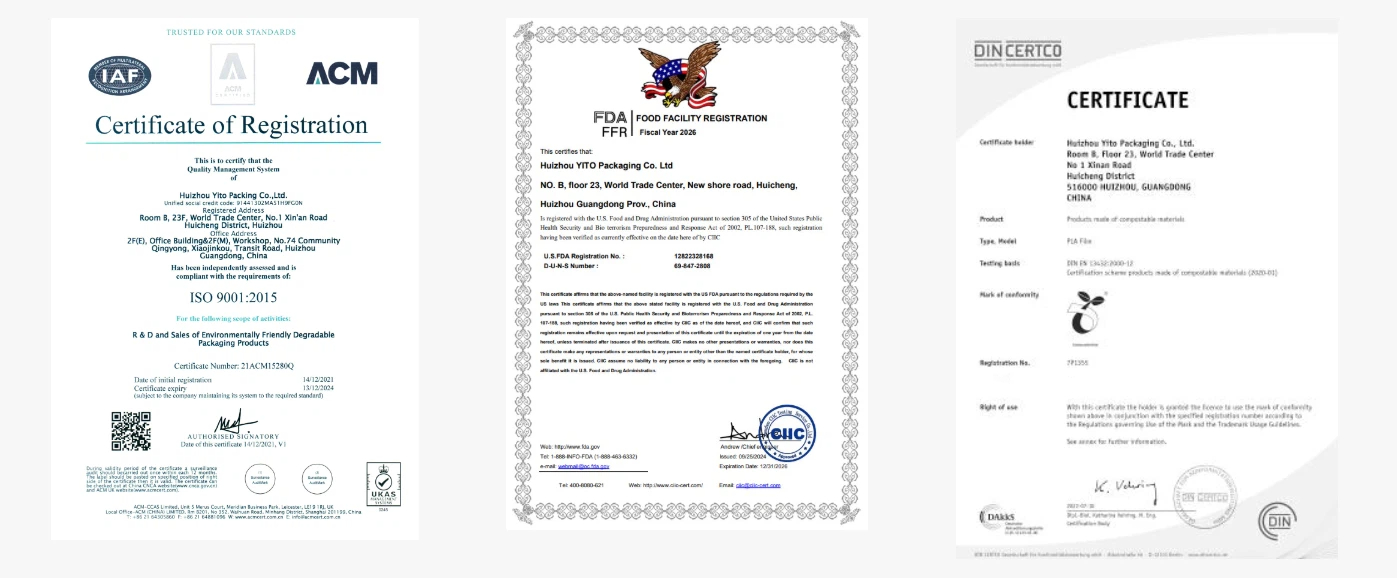
YiTo Pack holds ISO 9001 certification for quality management. Food-contact packaging structures carry FDA and LFGB compliance documentation where applicable. For compostable material projects, we can support EN 13432, ASTM D6400, OK COMPOST, and BPI ASTM D6400 certification depending on the selected material structure and project requirements.
Why Choose YiTo Pack for State-Compliant Cannabis Packaging?
State cannabis packaging requirements can affect closure structure, tamper evidence, label space, opacity, material selection, and production planning. For B2B buyers, the goal is not just to buy packaging, but to choose a structure that can support compliance review, sampling, filling, labeling, and repeat orders.
At YiTo Pack, we help buyers turn state-level packaging requirements into practical custom cannabis packaging solutions. Our support can include child-resistant structure options, tamper-evident sealing, opaque or window-free pouch design, back-panel label space planning, sustainable material recommendations, sample confirmation, and bulk production support.
For cannabis flower packaging, we can help review CR zipper options, resealable pouch structures, odor-control needs, and compliance label areas.
For cannabis edibles packaging, we usually focus on opacity, food-contact material options, serving information space, ingredient label space, and warning layout.
YiTo Pack also supports sustainable material directions such as compostable cannabis packaging, cellulose film, kraft laminate, PLA-based structures, PCR materials, and recyclable mono-material options. We help buyers compare these options based on product fit, sealing performance, label readability, and state packaging expectations.
For multi-state cannabis brands, we can help plan packaging systems that keep the main structure consistent while allowing state-specific label or information adjustments.
Conclusion
State cannabis packaging requirements affect more than label design. For you, they translate into structural decisions that need to be confirmed before sampling begins—not after artwork is finalized or inventory is already printed.
The most common packaging problems we see are not caused by wrong intentions. They happen because structural questions were left too late. Confirming your target state, product category, child-resistant requirement, tamper-evident method, and label space needs early in the project gives your team a much cleaner path from specification to production.
If you are planning a 2026 cannabis packaging project, share your target state, product type, and packaging format with our team at YiTo Pack. We can help review structure, material direction, label space, sample options, and documentation support before production begins.
FAQ
No. Cannabis packaging requirements vary by state, product category, license type, and sales channel. Buyers should confirm the target market before finalizing packaging structure, material, artwork, and label layout.
California’s final-form packaging guidance includes tamper-evident packaging, child-resistant packaging, resealable packaging for packages with more than one serving, and opaque packaging for edibles. Buyers should also review label space and design restrictions before sampling.
Possibly, but it depends on the selected structure, closure system, certification support, and product format. Compostable material alone does not automatically make packaging compliant.
Ask for the CR structure description, third-party test report if available, certification support, sample records, and confirmation that the structure matches your product format and target market.
Edibles usually need more attention to serving information, ingredient labels, allergen information, food-contact material, and opacity. Flower packaging often focuses more on resealability, odor control, barrier performance, and compliance label space.
Feel free to contact us for samples or custom packaging solutions.
Related Products


Post time: May-28-2026