
A fruit sticker looks small, but it can create real problems in an EU export program. A label may lift after cold storage, fail to run smoothly on an automatic applicator, lose barcode readability during handling, or get rejected during buyer document review because the compostability claim is not supported by the full label system.
For EU-bound fresh produce, buyers are no longer asking only whether a fruit sticker is biodegradable. They need to know whether the sticker can meet PPWR-related expectations, stay attached through cold-chain handling, remain readable at retail checkout, and come with the right documents before bulk orders.
At YiTo Pack, we treat fruit stickers as a sourcing decision, not just a printed label. Before recommending biodegradable fruit stickers, compostable fruit stickers or conventional fruit labels, we review the fruit surface, adhesive, ink, roll format, labeling method and document requirements together.
This guide is written for EU fruit exporters, produce packers and packaging buyers who want to reduce approval risk, avoid packing-line problems and choose a safer label specification for real export programs.
Key points for buyers:
- A biodegradable claim alone does not prove the label is suitable for EU export.
- Adhesive failure, barcode issues and roll-format mismatch can delay packing.
- Industrial compostable and home compostable labels need separate review.
- PPWR makes fruit stickers part of packaging compliance planning.
- Testing samples before bulk orders is cheaper than fixing problems after packing starts.
Is Your Fruit Sticker Claim Enough for EU Buyers?
If you are buying biodegradable fruit stickers for EU-bound produce, the word “biodegradable” is only the beginning. Your buyer may care less about the green wording and more about the proof behind it.
Can the label support compostability evidence?
Will it stay attached after refrigeration?
Does the certificate cover the final sticker, or only the material film?
Will the PLU code still scan after transport?
Those are the questions that matter in B2B produce packaging.

Biodegradable, Industrial Compostable and Home Compostable: What Buyers Need to Compare
Many sourcing problems start when buyers treat biodegradable and compostable as the same thing. They are related, but they are not the same in procurement or documentation.
Before comparing suppliers, use the terms more carefully.
|
Term |
What It Usually Means |
Buyer Risk |
What to Check |
| Biodegradable | Broad material breakdown claim | Test conditions may be unclear | Material type, test report, claim scope |
| Industrial compostable | Designed for controlled composting conditions | Certificate may not cover the full sticker | EN 13432 / OK Compost Industrial scope |
| Home compostable | Designed for lower-temperature composting conditions | Harder to achieve and market-dependent | OK Compost Home or buyer-required proof |
| Certified compostable label system | Complete label construction reviewed together | Cost and lead time may be higher | Face material, adhesive, ink and coating coverage |

For EU projects, industrial compostability is usually the first baseline to review. Home compostability becomes relevant when the buyer, retailer or national market asks for stricter proof.
For biodegradable fruit stickers, the key issue is whether the claim has real test support. For compostable fruit stickers, the key issue is scope: does the certificate cover the finished label system, or only one layer?
Why PPWR Makes Fruit Stickers a 2028 Procurement Issue
For years, eco-friendly fruit stickers were treated as a small detail in produce packing. PPWR changes that mindset.
Sticky labels attached to fruit and vegetables are included in the EU packaging discussion. From 12 February 2028, these labels need to meet compostability requirements under industrially controlled conditions, and Member States can introduce home-composting requirements where applicable.
For exporters, the deadline is not the only issue. A new label specification takes time. Sample testing, buyer approval, document review and machine trials do not happen overnight. If your packing program already has fixed label applicators or strict retail artwork rules, switching materials can take longer than expected.
Why France Deserves Extra Attention
France is a useful market to watch. A USDA report on French circular economy legislation noted that France targeted non-home-compostable stickers on fruit and vegetables, and it also pointed out adhesive performance as a technical challenge for home-compostable produce stickers.
That is why one “EU label” specification may not fit every customer. Before confirming a bulk order, ask your buyer one direct question: do you need industrial compostability only, or do you also need home-compostable proof?
That answer can change the material, adhesive, certificate and cost structure of the project.
Why Small Fruit Stickers Became a Composting Concern
Why would a tiny fruit sticker appear in a packaging regulation at all?
Because it often follows the fruit peel into the organic waste stream. Consumers may remove cartons and bags, but fruit stickers are easy to miss. They stay on apple peels, citrus rinds, banana skins or avocado skins and enter composting systems together with organic waste.
Non-compostable produce stickers can remain as visible residue and contribute to compost contamination. Recent food-industry reporting has also noted that small produce stickers are difficult to filter out once mixed into industrial composting streams.
For buyers, this explains the policy pressure. Eco Fruit labels are no longer discussed only as PLU tools. They are now part of the conversation around packaging waste, compost quality and retailer responsibility.
A Fruit Sticker Is a System, Not Just a Material
A common mistake is judging a fruit sticker only by what you can see. Buyers may ask whether the sticker is PLA, paper or cellulose, but the face material is only one layer.
At YiTo Pack, we look at the full construction. A sticker can use a sustainable-looking material and still fail if the adhesive lifts, the ink is outside the document scope, or the roll does not release cleanly on the applicator.
The table below gives a quick comparison of common material directions for biodegradable fruit stickers, compostable fruit stickers and conventional fruit labels.
|
Material Option |
Main Advantage |
Main Risk |
Better For |
| PLA film | Clear appearance, compostable positioning | Adhesive and ink need to be checked together | EU sustainability projects |
| Cellulose film | Plastic-reduction positioning, natural-source story | Cost and supply stability can vary | Premium produce / eco programs |
| Paper label | Easy printing, cost-friendly | Moisture and edge lifting risk | Short-chain or dry-surface fruit |
| BOPP label | Strong durability, good print clarity | Usually not compostable | Standard non-EU retail programs |
| Compostable label system | Better for PPWR-sensitive projects | Certificate scope must be reviewed | EU fresh produce exports |
This table is a starting point, not the final answer. In real fruit packing, adhesive performance often decides whether a biodegradable or compostable fruit sticker is usable.
Adhesive Is Where Many Projects Get Stuck
Different fruit surfaces need different adhesives. A waxed apple and a rough citrus peel do not behave the same way in cold storage.
A sticker has to stay attached during packing, refrigeration, transport and retail display. At the same time, the adhesive has to fit the compliance story behind the label. If the face material is compostable but the adhesive is not included in the review, the claim becomes weaker.
For fruit stickers, adhesive is rarely a small technical detail. It is often the difference between a smooth project and a rejected sample.
Ink and Coating Are Not Just Decoration
Printing is not only about logo appearance. PLU codes, barcodes, QR codes, origin text and brand information need to stay readable after handling.
Ink and coating also matter during food-contact or compostability review. If the printing layer sits outside the certificate scope, the final sticker may not match what the buyer expects.
This is one reason we prefer to review artwork and material together before sampling.
Roll Format Can Stop a Packing Line
For automatic labeling, the roll format matters more than many buyers expect.
Core size, winding direction and label gap can all affect machine performance. A roll that looks fine in the carton can still cause poor release, missed application or machine stoppage on the line.
If you already use a Sinclair-style applicator or another automatic labeling system, share the machine requirement before sampling. It saves time.
Compliance Is Not Enough: Test the Sticker on Real Fruit
A compostable fruit sticker can have a strong sustainability claim and still fail in real use. This is especially common when buyers switch from conventional labels to biodegradable fruit stickers or compostable fruit stickers without testing the packing conditions.
Test Adhesion on the Actual Fruit
Flat samples are useful, but they do not tell the full story.
Waxed fruit, curved peel, rough skin and moisture all change adhesion. A sticker that looks perfect on a sample card may lift on refrigerated citrus or wrinkle on a small apple.
Real fruit testing is not optional for export programs. It is where the hidden problems show up.
Cold-Chain Handling Changes the Result
Fresh produce often moves through low temperature, high humidity, condensation, and transport vibration. Adhesive problems often appear after the label has already passed the first visual check.
A good fruit sticker stays attached and readable after cold-chain handling. For long-distance export, a short refrigerated test before bulk production can prevent a much more expensive problem later.
PLU and Barcode Readability Still Come First
A compostable label that cannot scan at retail is still a failed label.
PLU codes, barcodes and QR codes support checkout, traceability and inventory control. When switching materials, printing clarity needs to be checked again because ink behavior can change from one face stock to another.
Automatic Labeling Needs a Real Machine Check
If the eco sticker runs on automatic equipment, the roll sample needs a machine trial. Material stiffness, liner release and winding direction can all change the result.
This matters most when replacing BOPP labels with paper, PLA or compostable alternatives. The new material may look right, but the machine may not like it.
Sample Test Example: Why Adhesive Testing Matters Before Bulk Orders
In a citrus labeling sample test, the buyer first focused on the compostable face material. The artwork looked fine, and the flat-sheet sample looked acceptable. The problem appeared only when the label was tested on real citrus peel after refrigeration.
The first adhesive option started lifting at the edge after cold storage, especially on fruit with light surface oil. The buyer also wanted to keep using an existing automatic fruit labeling line, but the first roll sample did not release as smoothly as expected. It was not a complete failure, but it was not stable enough for bulk packing either.
YiTo Pack suggested testing a second adhesive option on the actual citrus surface under refrigerated conditions. After 72 hours of cold-chain simulation, the selected adhesive reduced visible edge-lifting by around 20–35% compared with the initial sample. The PLU code stayed readable, and the roll release became more stable during machine testing.

What Actually Needs to Be Customized?
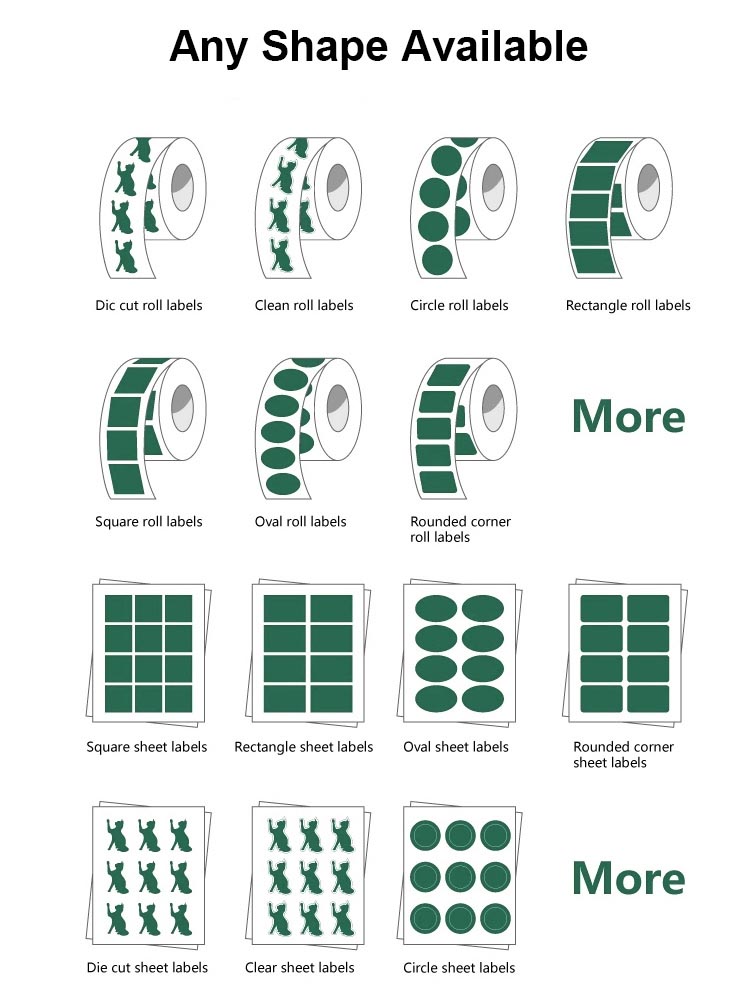
In fruit label projects, “custom” is not only about putting your logo on the sticker. Most problems come from smaller details: the label is slightly too large for the fruit curve, the roll direction does not match the applicator, or the adhesive works on one fruit but not another.
|
Customization Area |
Key Options |
Info Needed Before Order |
| Size & Shape | Round / Oval / Square / Custom shape | Fruit type, fruit diameter, applicator model |
| Print Content | PLU code, barcode, QR code, logo, country of origin, organic mark | Content list and layout priority |
| Adhesive | Custom formula based on fruit skin type | Cold storage/high humidity exposure, clean-removal requirement |
| Roll Format | Core size, winding direction, label gap | Labeling method and machine requirements |
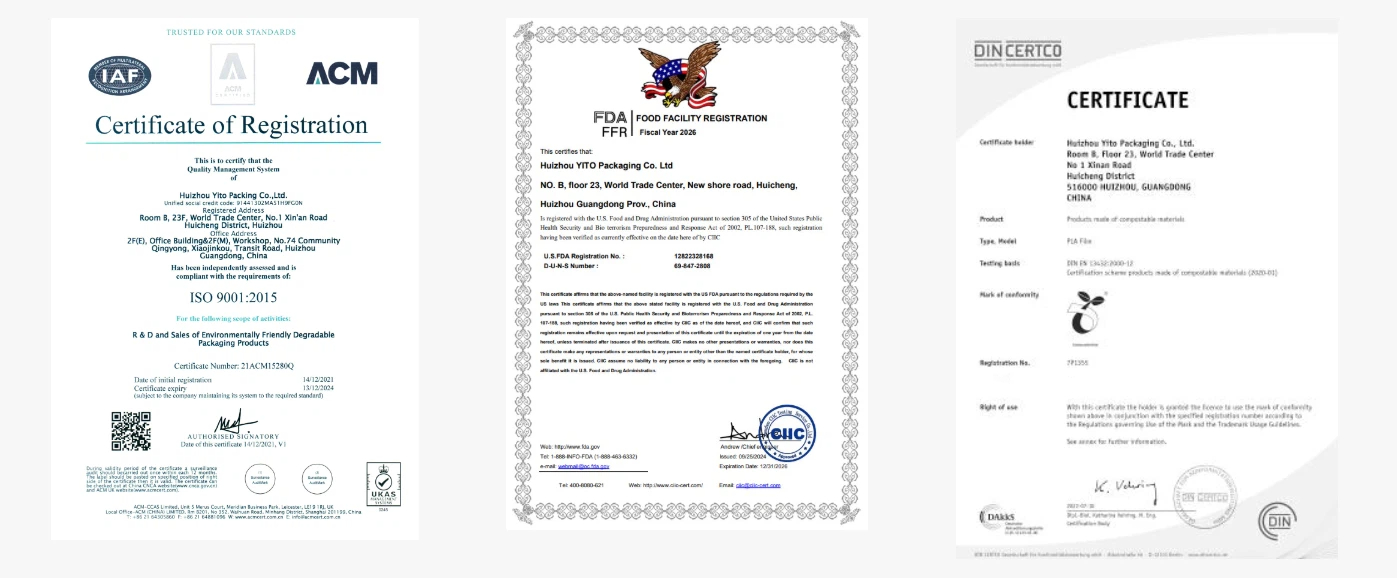
| Certifications | EN 13432, ASTM D6400, FDA, EU 10/2011, LFGB, ISO 9001 | Target market, sales channel |
YiTo Pack Fruit Sticker Solutions
YiTo Pack provides custom fruit sticker solutions for fresh produce packing, retail labelling and export programmes. We support biodegradable fruit stickers, compostable fruit stickers, paper labels, BOPP labels, PLA labels and cellulose-based options by project.
Our customisation can include PLU codes, barcodes, QR codes, logos, country-of-origin text, organic marks, adhesive selection, roll direction, label gap and applicator-compatible roll format. For EU-bound produce, we can also help review compostability documents, food-contact requirements and sample testing before bulk orders.
YiTo Pack also supports related produce packaging such as clamshells, punnets, tray liners, freshness films, fruit tubes and cartons, helping buyers build a more complete fruit-packaging solution.

When Should You Choose Compostable Fruit Stickers?
You do not need the same fruit sticker for every market. A standard non-EU retail program, an organic supermarket project and an EU PPWR-sensitive export program can lead to different label choices.
|
Project Situation |
Better Choice |
Why |
| EU fresh produce program | Certified compostable fruit stickers | Better fit for PPWR-sensitive projects |
| Organic supermarket supply | Compostable label + food-contact documents | Supports stricter buyer review |
| Standard non-EU retail | Based on buyer requirement | Cost and durability may matter more |
| Automatic labeling line | Tested roll format + adhesive | Reduces machine stoppage risk |
| Composting claim project | Certified compostable label system | Helps avoid unsupported green claims |
For EU retail, organic produce and sustainability-focused programs, compostable fruit stickers are usually the safer direction. For other markets, paper, BOPP, PLA, cellulose or biodegradable film labels may still fit, depending on the buyer’s requirement and budget.
Conclusion: Building a Sustainable Seedling Retail System
If you only need a general sustainability message, biodegradable fruit stickers may sound attractive. But if your fruit is entering EU retail or PPWR-sensitive programs, the safer route is a complete label system.
A better fruit sticker decision combines compostability evidence, real-fruit testing, machine compatibility, custom specification and supplier documentation.
At YiTo Pack, we usually recommend confirming samples and documents before bulk orders. That way, you choose compostable fruit stickers, biodegradable fruit stickers or conventional fruit labels based on real export and retail use, not only material wording.
FAQ
Q: Are biodegradable fruit stickers the same as compostable fruit stickers?
A: No. Biodegradable fruit stickers usually refer to materials that can break down under certain conditions, but this does not always prove compostability. Compostable fruit stickers need clearer testing and documentation, especially for EU-bound produce projects.
Q: Do EU fruit exporters need compostable fruit stickers under PPWR?
A: For EU-bound fresh produce, sticky labels attached to fruit and vegetables are becoming part of PPWR-related packaging compliance. Buyers need to check whether industrial compostability is enough, or whether the target market also requires home-compostable proof.
Q: Is the face material enough to prove a fruit sticker is compostable?
A: No. The full label system needs to be reviewed, including face material, adhesive, ink, coating and printing structure. A compostable face material alone does not always mean the final printed sticker can support a compostable claim.
Q: Why is adhesive testing important for fruit stickers?
A: Adhesives affect whether the sticker can stay attached during packing, cold storage, transport and retail display. Waxed fruit, citrus peel, avocado skin and rough surfaces can all behave differently, so testing on the actual fruit is important before bulk orders.
Q: What information should buyers provide before ordering custom fruit stickers?
A: Buyers should provide fruit type, label size, artwork content, PLU or barcode needs, target market, labeling method, applicator model, cold-chain conditions and document requirements. This helps confirm material, adhesive, roll format and certification scope before sampling.
Not sure whether your current biodegradable fruit stickers are suitable for EU export or PPWR compliance?
Related Products


Post time: Jul-04-2026