
If you are evaluating PLA clamshell packaging for fruits and vegetables, the decision is no longer just about material preference—it is increasingly driven by market pressure and supply chain realities.
In many projects we’ve worked on, buyers don’t start with “Should we use PLA?”
They start with problems like the following:
– Retailers requiring more sustainable packaging options
– Export markets (EU / US) tightening regulations on plastic use
– Increasing pressure to reduce plastic footprint without affecting product performance
– Rising costs caused by repacking, product damage, or inconsistent packaging formats
At the same time, switching materials is not risk-free.
Many suppliers focus on sustainability messaging, but in real operations, packaging failures happen in very practical ways:
– Condensation builds up due to poor ventilation design
– Clamshells deform under stacking pressure
– Temperature fluctuations affect material stability
– A mismatch between packaging stages increases operational complexity
So the real question is not simply:
“Is PLA better than PET?”
It is, "Will this packaging actually work in your supply chain?"
A PLA (polylactic acid) clamshell for fruit and vegetables works best in cold chain, fast-moving fresh produce supply chains. It is not suitable for heavy products, high-temperature environments, or long-term storage.
Because in fresh produce logistics, packaging doesn’t fail in theory—it fails in real conditions.
Does Your Packaging Fit Your Supply Chain?
A lot of buyers start with material comparison: PLA vs PET.
But when issues happen, they rarely come from the material alone.
More often, problems look like this:
Products fog up after packing because the airflow wasn’t designed properly.
Boxes collapse slightly during pallet stacking because the structure isn’t strong enough.
Different packaging formats across stages create unnecessary sourcing complexity.
So instead of asking, “Is PLA better?" we usually suggest reframing the question:
Does this packaging match how your products actually move?
At YITO PACK, this shift alone already helps many clients avoid the wrong decision early.

Compostable PLA clamshell is not a universal solution, but in the right scenarios, it performs very well.
We’ve seen it work particularly well with high-moisture fresh produce like berries, grapes, and cherry tomatoes. These products benefit from controlled ventilation and retail-ready presentation, and PLA structures can support both when properly designed.
It also makes sense in operations where products move directly from packing to the shelf. In these cases, reducing repacking not only lowers labor costs but also reduces handling damage — something many exporters underestimate.
A PLA clamshell for fruit and vegetables works best in cold chain, fast-moving fresh produce supply chains where ventilation, retail display, and sustainability requirements matter. It is not suitable for heavy products, high-temperature environments, or long-term storage. Cold chain environments are another natural fit. As long as temperature and humidity are managed within expected ranges, PLA clamshells can maintain stable performance while aligning with sustainability requirements in the EU and US markets.
Where Biodegradable PLA Clamshell Actually Works — And Why

Standard Size We Have
125×110×40 mm | 196×116×60 mm
115×115×75 mm | 190×115×90 mm
Typical Use Cases for PLA Clamshell in Fresh Produce
In practice, the PLA clamshell for fruit and vegetables is not used the same way across all products. Its performance depends heavily on the type of produce, handling conditions, and supply chain structure.
We usually see it applied in three main scenarios:
1. Soft, high-moisture fruits (best fit)
Products like strawberries, blueberries, grapes, and cherry tomatoes benefit the most. These items require ventilation, protection from pressure, and strong retail presentation. PLA clamshell structures, when properly designed, can support all three.
2. Retail-ready packaging (direct-to-shelf operations)
In operations where packaging moves directly from packing lines to retail shelves, the PLA clamshell helps reduce repacking, minimize handling damage, and improve presentation consistency.
3. Short-cycle cold chain distribution
A PLA clamshell performs well when products move quickly through controlled cold chain systems. Fast turnover reduces exposure to temperature variation and helps maintain structural stability.
This is why the PLA clamshell for fruit and vegetables works best in controlled, fast-moving supply chains—not in long storage or unpredictable logistics environments.
Where Compostable Clamshell Packaging Starts to Become Risky
This is the part that often gets skipped—but it’s where real decisions are made.
Eco-friendly PLA clamshells are not ideal for heavier products. Once the weight increases, stacking pressure becomes a real issue, especially during long-distance transport. This is where structural limitations can show up.
Temperature is another critical factor. If your logistics include exposure to higher ambient temperatures — for example, non-refrigerated trucking or hot climate storage — PLA may soften slightly, which can affect shape stability.
It’s also not designed for slow-moving inventory. If your products sit in storage for extended periods, the advantages of PLA become less relevant compared to its limitations.
So in practice, PLA (polylactic acid) works best in fast-moving, controlled fresh supply chains—not in every scenario.
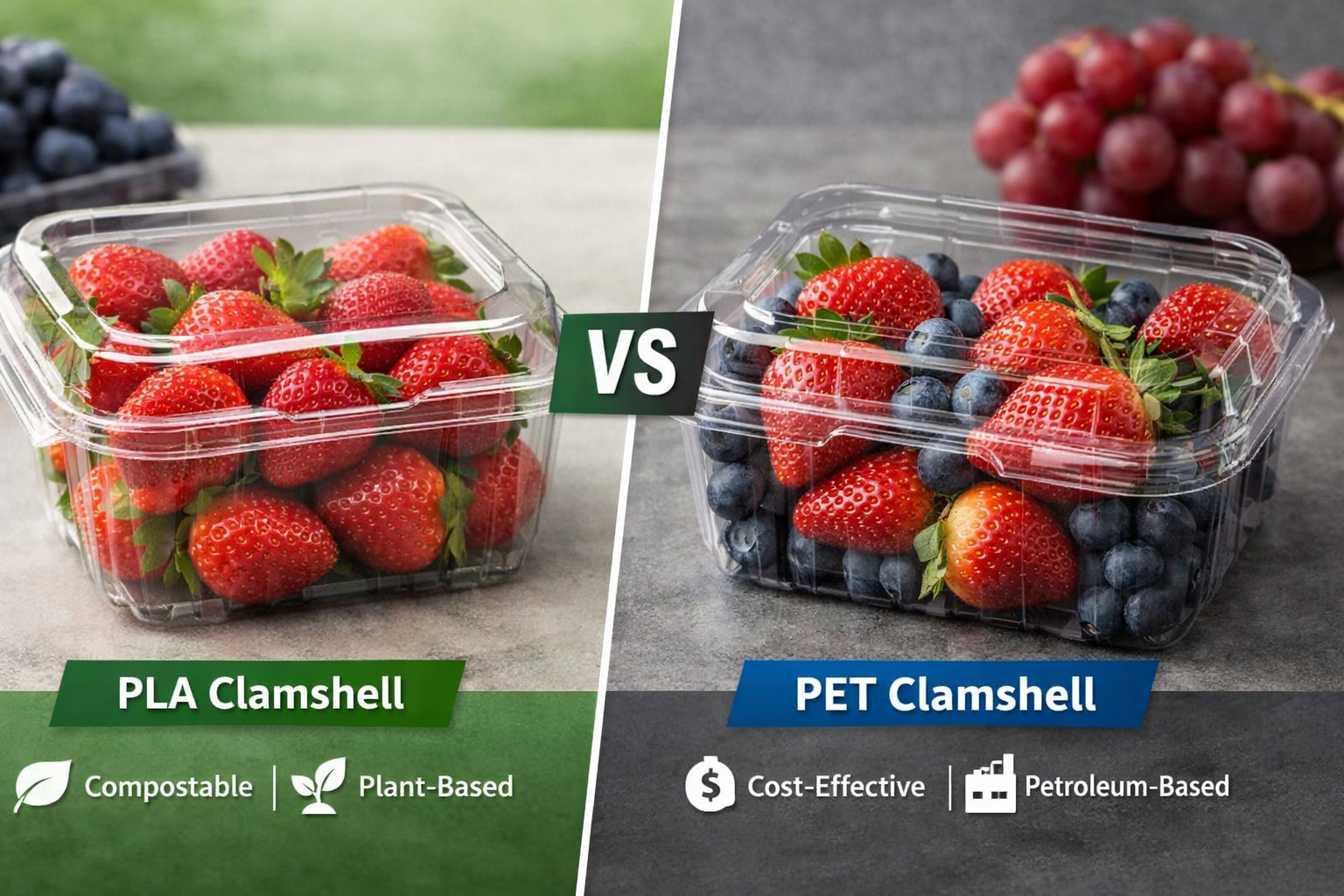
PLA vs PET: The Difference That Actually Matters
A lot of comparisons online focus on sustainability messaging. But for B2B buyers, that’s rarely enough.
In real operations, the differences show up in how packaging behaves under pressure.
PET is more forgiving. It performs consistently across a wider range of conditions, which is why it has been the default for so long.
PLA, on the other hand, works best when conditions are predictable. Within a controlled cold chain, it performs well — but outside of that, its margin for error is smaller.
Cost also needs to be looked at differently. PET may appear cheaper per unit, but PLA can reduce long-term risk in markets where sustainability requirements are becoming stricter.
So the comparison is not just about material. It’s about how much uncertainty your packaging needs to handle.
Why Structure Design Often Matters More Than Material
One thing we’ve learned across multiple projects is this:
The same PLA material can perform very differently depending on the structure design.
Ventilation is a good example. Too little airflow, and condensation builds up. Too much, and moisture loss becomes an issue. The balance directly affects shelf life.
Lid strength is another overlooked detail. A weak hinge might not fail immediately, but under stacking pressure during transport, small weaknesses become big problems.
Even size plays a role. Poorly optimized dimensions reduce pallet efficiency, increasing logistics costs without being obvious upfront.
So when evaluating the PLA clamshell container for fruit and vegetables, it’s worth paying as much attention to structure as to material.
How to Decide If Fresh Produce Clamshell Packaging Fit Your Product
Instead of trying to find a “best option,” it’s more useful to walk through a few practical questions.
Start with your product. Soft fruits behave very differently from bakery items, and both require different structural considerations.
Then look at moisture conditions. High humidity environments need airflow design, while drier products may not.
Transport conditions come next. If your supply chain is fully cold chain controlled, PLA becomes a stronger candidate. If not, you need to evaluate the risk more carefully.
Finally, consider how your product is presented at retail. If packaging goes directly onto shelves, a PLA clamshell offers both visibility and branding advantages.
These are the factors that usually determine success or failure — not the material label alone.
What to Expect When Sourcing Compostable PLA Clamshell
Once you decide that the PLA clamshell for fruit and vegetables fits your operation, the next step is understanding supply conditions.
In our B2B projects, we’ve had that:
Standard PLA clamshell sizes typically start from 3,000–5,000 pcs MOQ
Custom designs (size, ventilation, logo) may require higher volumes
Sample lead time is usually 3–10 days, while mass production takes around 2-4 weeks, depending on order size
At YITO PACK, our PLA clamshell for fruit and vegetables is produced under a certified quality system and complies with key international standards. Our packaging meets FDA and LFGB food contact requirements, and our PLA materials are certified under EN13432 and ASTM D6400 for industrial compostability. With ISO 9001-certified production management, we ensure stable quality and consistency for bulk B2B supply, especially for export-oriented fresh produce and bakery packaging projects.
Conclusion
PLA clamshell for fruit and vegetables is not the right choice for every operation, but it works well when your supply chain is built around cold chain distribution, fast turnover, and retail-ready packaging.
Compared with traditional options, the custom clamshell packaging performs best in controlled conditions, especially for fresh produce like berries and ready-to-display products.
The key is simple: choose a PLA clamshell based on real use conditions, not just material preference.
At YITO PACK, we recommend testing structure and fit before scaling—because the right packaging is the one that performs consistently in your supply chain.
FAQ
Q1: What is a PLA clamshell for fruit and vegetables?
A PLA clamshell is a plant-based, compostable packaging solution used for fresh produce such as berries, grapes, and vegetables, designed for retail display and cold chain distribution.
Q2: Is the PLA clamshell better than the PET clamshell?
A PLA clamshell is better for sustainability and compliance in EU and US markets, while a PET clamshell offers wider performance tolerance; the right choice depends on your supply chain conditions.
Q3: When should I use a PLA clamshell for fruit and vegetables?
PLA clamshells work best in cold chain logistics, fast-moving fresh produce, and retail-ready packaging where visibility and ventilation are important.
Q4: When is a PLA clamshell NOT suitable?
A PLA clamshell is not ideal for heavy products, high-temperature environments, or long-term storage where structural stability may be affected.
Q5: Does a PLA clamshell affect the shelf life of fresh produce?
A PLA clamshell can support shelf life when designed with proper ventilation, but an incorrect airflow design may cause condensation or moisture loss.
Q6: Is PLA clamshell packaging compostable?
Yes, PLA clamshell is industrially compostable under standards like EN13432 and ASTM D6400, but it requires proper composting conditions.
Q7: Can the PLA clamshell replace plastic packaging completely?
A PLA clamshell can replace plastic in specific applications, especially fresh produce packaging, but it is not suitable for all logistics scenarios.
Q8: How do I choose the right PLA clamshell supplier?
Choose a supplier that can optimize structure, ventilation, and size based on your product, transport conditions, and packaging system requirements.
Q9: What products are best suited for PLA clamshell packaging?
PLA clamshell is commonly used for berries, cherry tomatoes, grapes, leafy greens, and some bakery products that require visibility and protection.
Q10: Does a PLA clamshell work for bakery packaging?
Yes, a PLA clamshell can be used for bakery products where presentation matters, but structure and moisture conditions need to be carefully evaluated.
Looking for a reliable supplier of clear clamshell packaging?
Explore our custom PLA clamshell packaging to check available sizes, MOQ options, and customization details
Related Products


Post time: Apr-27-2026