
What Are Mycelium Building Materials?
Mycelium building materials are bio-based composites formed from fungal mycelium and agricultural by-products such as sawdust or straw.
During production:
Mushroom mycelium packaging acts as a natural binder
Growth cycle: 5–7 days
Thermal drying: 24-hour stabilization
The result is a lightweight, rigid structure suitable for insulation boards, acoustic panels, molded components, and protective construction packaging.
Unlike petroleum-based EPS (expanded polystyrene), mycelium materials are:
Bio-based
Compostable (for packaging applications)
Free from synthetic resins
Low-carbon production

Who Is This Solution Designed For?
Our mycelium building materials are ideal for:
Green building developers
Sustainable architecture firms
Contractors seeking EPS alternatives
Interior designers focused on low-VOC materials
Brands requiring compostable construction packaging
Mycelium Building Materials vs EPS: Technical Comparison
Mycelium building materials and EPS differ significantly in carbon footprint, fire performance, and end-of-life behavior. The table below summarizes the key technical differences.
|
Property |
Mycelium Material |
EPS (Expanded Polystyrene) |
| Carbon Footprint | Low-carbon production Carbon stored in biomass during growth (carbon stored in biomass) |
High energy consumption |
| Thermal Conductivity | 0.035–0.045 W/m·K | 0.030–0.038 W/m ·K |
| Fire Performance | Exhibits inherent flame-retardant characteristics, with no toxic smoke | Highly flammable, requires chemical retardants |
| Density | 40–160 kg/m³ | 15–30 kg/m³ |
| End-of-Life | Industrial composting conditions: 30–90 days (for packaging formats) | 300–500 years of degradation |
| VOC Emission | Low-VOC emission under indoor conditions | May release styrene compounds |
In terms of compressive strength, mycelium building composites typically range between 0.2–0.6 MPa, depending on density and substrate formulation. They are suitable for non-load-bearing applications.
While EPS may have slightly lower density, mycelium building materials provide superior environmental performance and improved fire behavior without chemical additives.
Advantages and Limitations of Mycelium Packaging
Advantages:
-
100% bio-based and compostable, reduces long-term waste.
-
Low-carbon production process compared to EPS.
-
Naturally flame-resistant, it chars instead of melting.
-
Provides cushioning for fragile items.
-
Can be molded into custom shapes.
Limitations:
-
Sensitive to moisture, not ideal for wet conditions.
-
Limited compressive strength (0.2–0.6 MPa).
-
Production requires 5–7 days of growth.
-
Best degraded in industrial composting, not landfills.
Five Commercial Applications of Mycelium Building Materials
1. Prefabricated Insulation Systems
Traditional insulation manufacturing generates significant pollution. Mycelium boards offer:
Low-energy production
Compostable end-of-life
Molded custom shapes
At building decommissioning, panels can be crushed and returned to soil.
2. Non-Load Bearing Bio Bricks
Mycelium blocks are suitable for:
Temporary structures
Exhibition halls
Interior partition walls
They are not currently recommended for structural load-bearing applications but provide architectural design flexibility through mold-based growth fabrication.


3. Acoustic Wall Panels
The organic texture provides both:
Functional sound absorption
Biophilic aesthetic value
Suitable for sustainable commercial interiors.
4. Healthy Interior Decoration
Because the material is 100% bio-based:
No formaldehyde
No benzene
Low-VOC emission under indoor test conditions
It supports indoor air quality requirements in green buildings.
5. Biodegradable Packaging
One of the fastest-growing Mycelium packing uses is protective packaging for:
Bathroom ceramics
Stone components
Smart home devices
various protective packing
Mycelium compostable packaging can be composted after use, eliminating disposal costs and reducing “white pollution.”
YITO Custom Mycelium Packaging
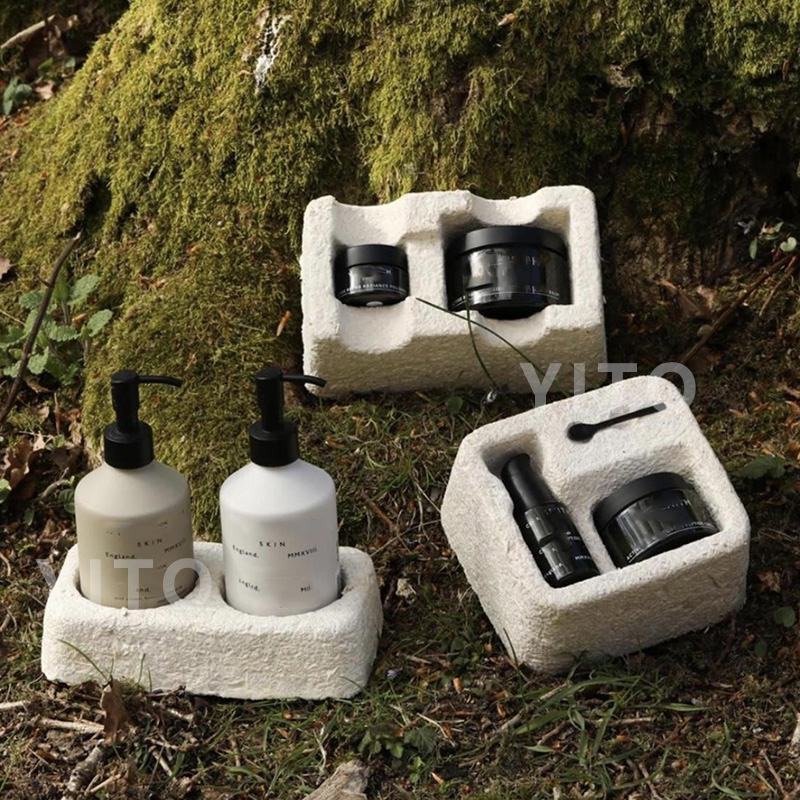
For protective packaging, explore our custom bio-based mushroom mycelium packaging options:
Compostable Small Square Mycelium Packaging Box

Why Choose YITO as Your Mycelium Material Supplier?
In-house mold development capability
Stable density control across batches
engineering customization
Rapid sample response cycle
Custom MOQ available upon project discussion
We support sustainable mushroom mycelium packaging boxes projects across international markets.
Authoritative Certification
YITO's production process of mushroom mycelium packaging has passed multiple international authoritative certifications to ensure safety and compliance from the construction site to delivery:
100% Biodegradable (EN 13432/OK Composite):
Ultimate safety (FDA certified):
Quality controlled (ISO 9001)
Reliable traceability (FSC certification)


Conclusion
Mycelium building materials represent a shift toward regenerative construction. Architecture should not be a burden on the earth but part of the ecological cycle. The transition of mycelium from packaging to building materials is not only a technological breakthrough but also a leap from "manufacturing" to "growth" in architectural thinking.
F&Q
A: Mycelium composites exhibit natural flame resistance due to their chitin-based cell structure. Fire classification depends on density and formulation.
A: In dry indoor environments, mycelium materials can remain stable for Long-term durability under controlled dry indoor conditions
Accelerated aging tests indicate stability. Biodegradation occurs only under active composting conditions with moisture and microbial exposure.
A: Currently, mycelium composites are recommended for non-load-bearing applications. Mycelium materials are not intended to replace reinforced concrete in structural systems but may reduce concrete dependency in non-structural insulation and partition applications
Related Products

Post time: Mar-04-2026