
When you start looking for compostable film options, the first instinct is usually to compare materials: PLA, PBAT, and cellulose.
But from what we’ve seen in real projects at YITOPACK, that’s rarely where the problem begins.
In real production environments, problems usually appear later — during heat sealing, under humid storage conditions, or on automated production lines where films begin to wrinkle, shrink unevenly, or reduce packaging efficiency. That’s why this guide is not just about “what films exist.”
It’s about answering a more practical question: Will this film actually work in your packaging system—under real conditions?
Choosing a compostable film for molded fiber trays is not just about the material.
In many real projects, failure doesn’t come from selecting the “wrong” material—it comes from choosing a film that doesn’t match the production process.
If your packaging involves sealing, grease resistance, or moisture protection, your film choice becomes a system-level decision, not just a material comparison. This is also how we approach every project at YITOPACK—starting from the system, not the material.
Choosing a compostable film for molded fiber trays is not about material alone.
The real question is: Will the film run stably on your production line under real conditions (heat, humidity, sealing, and transport)?
Key factors include:
- Sealing temperature compatibility
- Shrink behavior during lamination
- Moisture and grease resistance
- Production line stability
Why Molded Fiber Trays Often Need Lamination
In real packaging systems, laminated molded fiber trays are widely used in takeaway meals, ready-to-eat food packaging, bakery applications, frozen food containers, and fresh-cut produce packaging.
The reason is simple: these applications require more than sustainability alone. The packaging also needs to resist grease, moisture, condensation, and transportation stress while maintaining stable sealing performance and product appearance.
Without lamination, molded fiber trays often begin to show limitations during real distribution. We’ve seen trays absorb oil over time, soften in humid environments, or lose visual consistency after transport and refrigerated storage.
This is why compostable laminated structures are becoming increasingly common in food-service packaging systems — especially for brands trying to balance sustainability, functionality, and production efficiency at the same time.

Coating vs Lamination: Which Problem Are You Solving?

We’ve seen cases where coating performs well in initial lab tests but begins to degrade after just a few days in real distribution environments.
Lamination, on the other hand, provides the following:
More stable moisture and grease resistance
The ability to support heat sealing
Better surface consistency for branding and presentation
Of course, this comes with trade-offs—higher cost and stricter process control.
So the real question is not "Which is better?" but "What problem are you actually trying to solve?"
In laminated tray systems, peel strength becomes especially important when the package requires reliable sealing during transportation and refrigerated storage. Reference lamination structures may show peel strength values around 0.128 N/mm under controlled testing conditions.
However, real-world sealing performance can still vary significantly depending on:
tray geometry
coating parameters
machine temperature stability
lamination direction
product weight and moisture exposure
This is why sealing validation under actual production conditions is critical before scaling up.
What Compostable Films Are Actually Used in Fiber Tray Lamination?
Once lamination is required, the next step is material selection. But instead of comparing materials in isolation, it’s more useful to understand where each option actually works.
PLA / PBAT-Based Compostable Film (Mainstream Solution)
PLA / PBAT-based compostable films are the most widely used solution for molded fiber tray lamination in scalable packaging systems.
They offer a practical balance between performance, cost, and process compatibility.
From real production data, these films typically show:
Shrink temperature: 100–140°C
Tensile strength: 20–40 MPa
Light transmittance: above 60%
This allows the films to work within common sealing conditions while still maintaining sufficient handling strength and acceptable product visibility for retail applications.
However, there is an important constraint. If your production line has unstable temperature control, the shrink behavior of the film can become inconsistent, which may affect sealing quality and appearance.
This is one of the most common reasons why a “technically correct” material fails in practice.
Cellulose Film (Premium Option)
Cellulose films are often used as a premium biodegradable film for fiber packaging, especially when sustainability positioning is critical.
They offer:
Strong eco-friendly perception
High visual clarity
Breathability in certain applications
At the same time, they require more precise control:
Higher cost
Narrower sealing window
Greater sensitivity during processing
For this reason, they are typically better suited for premium or brand-driven applications, rather than cost-sensitive projects.

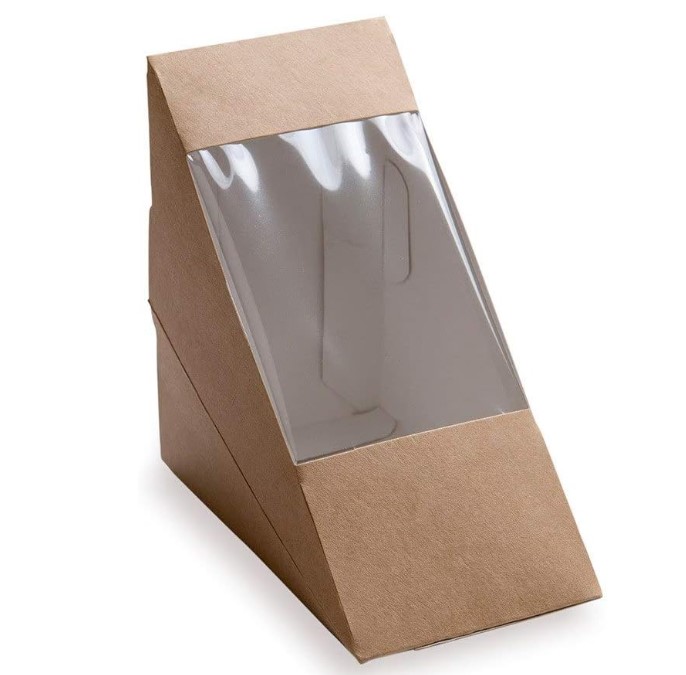
Compostable Window Film
Beyond full-surface lamination, another growing trend in molded fiber packaging is the use of compostable window films.
This is a category that is often overlooked but is becoming more relevant in real packaging scenarios. In retail environments, product visibility plays a major role in purchasing decisions. Traditional plastic windows provide clarity but are increasingly restricted due to sustainability concerns. As a result, more brands are moving toward compostable window films, which can be used for:
Tray windows
Product display areas
Visual branding enhancement
At YITOPACK, we see a clear shift toward visible, compostable packaging designs, especially in fresh produce and bakery applications.
Rather than treating window film as a standalone component, we integrate it as part of a complete packaging system design.
Will the Film Actually Run on Your Production Line?
This is often one of the most underestimated factors in compostable packaging projects. A film may look technically suitable on paper but still create problems during real production.
From what we’ve seen on actual packaging lines, failures usually happen when sealing stability, shrink behavior, and material strength are not properly matched with the production process.
If sealing temperatures fall outside the film’s workable range—typically around 100–140°C for many PLA/PBAT structures—sealing quality can quickly become inconsistent, and in some cases the film may even deform during lamination.
Shrink behavior is another common issue. In certain structures, shrinkage in one direction can exceed 50%, which may affect tray shape, surface appearance, and sealing consistency, especially on high-speed production lines.
Mechanical strength also plays a major role. If the material structure is too weak, problems such as edge cracking, tearing, or handling damage may begin to appear during automated packaging and transportation.
So the real question is not simply whether a film is compostable. The real question is whether it can run consistently on your production line without creating additional operational problems.
Example of Why Technical Data Matters in Real Production
In real lamination projects, packaging performance is rarely determined by compostability claims alone.
What often matters more is whether the film can maintain stable mechanical behavior during sealing, transport, and handling.
For example, in one common PE lamination film structure used for molded fiber trays, tensile strength can reach around 252–255 kgf/cm², while elongation at break may exceed 500–800%, depending on machine direction and testing conditions.
This directly affects:
sealing consistency
resistance to tearing during transport
tray deformation during lamination
handling performance on automated production lines
We’ve seen cases where films with insufficient tensile stability began wrinkling or distorting under continuous heat and tension—even though the material itself was technically “compostable.”
That’s why packaging engineers increasingly evaluate films not just by sustainability labels but also by whether the structure can remain stable under real production conditions.
How to Choose a Compostable Film Based on Your System
A pattern we often observe is that buyers start by comparing cost—and only later encounter performance issues.
Typical problems include the following:
trays softening in humid environments
oil penetration affecting product appearance
inconsistent sealing during production
These issues usually trace back to one root cause: decisions made based on material labels or unit price, instead of system performance in real conditions.
What we usually recommend is simple: A lower-cost solution that fails during distribution will always result in a higher total cost.
How to Build a Stable Compostable Packaging System
At YITOPACK, we position ourselves as a one-stop packaging solution provider. We integrate molded fiber trays, compostable films, and sealing processes into one system—ensuring compatibility from production to distribution.
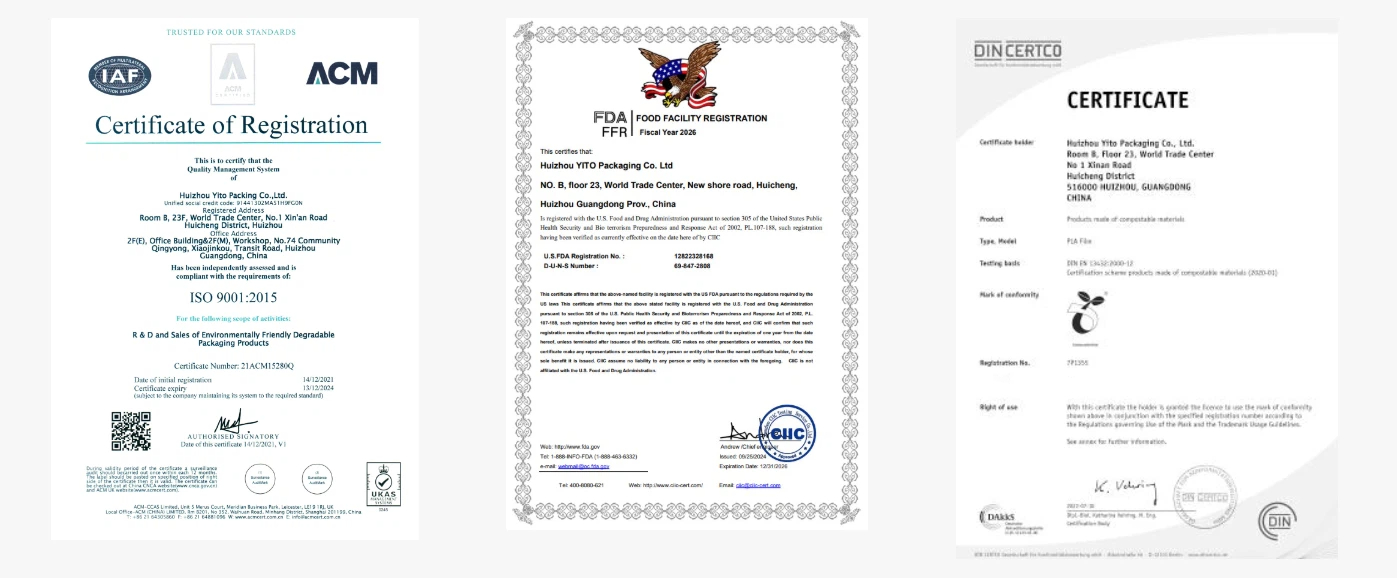
Our capabilities are backed by internationally recognized certifications—including ISO 9001, BPI, OK compost INDUSTRIAL, FDA food contact compliance, and EU 10/2011—ensuring that every material we recommend meets strict standards for compostability, safety, and industrial applicability.
That means we don’t start by recommending a specific film.
We start by understanding your full packaging scenario:
What product are you packing?
Do you require sealing?
What does your production line look like?
From there, we move step by step:
Sample selection
Lamination and sealing testing
Production simulation
Optimization before scaling
Because in real projects, even when a material looks correct on paper, it can still fail in actual production.
Conclusion
So here’s the bottom line:
Choosing a compostable film for molded fiber trays is not about specifications alone.
It’s about whether the film can run consistently in your packaging system—under real conditions.
Choose it by how it performs on your line, with your trays, under your real conditions.
Because packaging performance, production stability, and long-term cost—those are not material questions.
They are system questions.
And that’s exactly what YITOPACK helps you solve. We make sure your packaging system works—under real conditions.
FAQ
Q1: Does my product need lamination, or is coating enough?
A: It depends on your product's real-world exposure conditions. If your product is dry, has a short shelf life, requires no sealing, and has low oil/moisture exposure → water-based coating is usually sufficient and more cost-effective. If you need heat sealing (lid film / top sealing), contact with oil or sauce, moisture resistance, or better visual presentation → coating often fails under the combination of oil, heat, and time. In that case, compostable lamination is the safer system-level choice. Our advice: Ask yourself, “Does my packaging need to resist oil, moisture, or sealing in real use?” If yes to any, lamination is the more reliable path.
Q2: Why does the film work in lab tests but fail on my production line?
A: Because lab conditions are not production conditions. The three most common reasons are the following: (1) Sealing temperature mismatch – your line’s actual temperature may fall outside the film’s 100–140°C window, leading to poor seals or film damage. (2) Shrink behavior impact—e.g., MD shrinks 50–54%, TD shrinks 23–31%. If feed direction is wrong, tray shape and appearance are affected. (3) Insufficient mechanical strength – high-speed lines or sharp tray edges can tear low-strength films. That’s why we always run lamination + sealing tests and production simulation on your equipment before scaling. We make sure the film works in real conditions—not just in specifications.
Q3: How do I balance cost and performance without risking project failure?
A: Failed projects rarely start from a total cost-of-risk analysis—they start from unit-price comparison. A lower-cost film might save 10–20% on material, but if it causes oil leakage, tray softening, or line stoppages, the actual loss is far higher than the savings. The right approach: Treat your packaging as a system (tray + lamination film + sealing process + end-use environment). Run small-scale validation under real conditions—high humidity, high oil, cold chain, or hot filling—before calculating total cost. At YITOPACK, we don’t start with a price quote. We start with testing, simulation, and optimization. Once the solution is stable, we provide a cost recommendation that includes performance risk. That’s what we call true reliability.
Request free samples to test clarity, flexibility, and sealing performance in your real packaging conditions.
Related Products


Post time: May-06-2026